
Chapter 1: When Does ERISA Apply?
A threshold condition for an investment or an account to be subject to ERISA is whether a “Benefit Plan Investor,” as defined in ERISA, is involved. Benefit Plan Investors include:
-
Employee benefit plans subject to ERISA (and related trusts), such as U.S. corporate pension plans, 401(k) plans and union-sponsored Taft Hartley multiemployer plans, but not:
- governmental plans and public retirement systems,
- non U.S. plans and pension systems, or
- plans maintained by a church or church-affiliated organization, unless a special election has been made to be subject to ERISA.
- Individual retirement accounts (“IRAs”) and other plans that may not be subject to ERISA itself but are subject to many similar rules under the Internal Revenue Code of 1986, as amended (the “Code”).
- Pooled entities such as collective funds, group trusts, limited partnerships or insurance company general or separate accounts that are deemed to hold plan assets by reason of investments in the entity by one or more of the Benefit Plan Investors listed above.
Thus, a client account and its fiduciary managers will be subject to ERISA if the client is a Benefit Plan Investor, with the limited exception that certain IRAs and IRA-only funds may be subject to a similar subset of rules. ERISA counsel should be consulted in this rather limited circumstance.
As noted above, pooled entities in which one or more Benefit Plan Investors invest alongside can themselves be subject to ERISA as determined under the so-called “Plan Asset Rules”, which are a combination of ERISA statutory provisions and regulatory guidelines promulgated by the U.S. Department of Labor (“DOL” or the “Department”).
Under the Plan Asset Rules, if a Benefit Plan Investor invests in any pooled investment vehicle, then, unless one or more of the exceptions described below apply, the fund’s assets are deemed to be “plan assets” for purposes of ERISA, causing the fund itself to be a Benefit Plan Investor subject to ERISA, and the fund’s manager (or, as applicable, its general partner (“GP”), managing member, trustee, adviser or similar entity) becomes an ERISA fiduciary with respect to the assets attributable to those investors that are subject to ERISA.
Exceptions to Plan Asset Status
A Benefit Plan Investor’s investment in an entity will cause the assets of that entity to be treated as plan assets unless one or more of the following exceptions apply:
-
Registered investment companies: The entity is an investment company registered under the Investment Company Act of 1940, as amended (the “1940 Act”) (e.g., a mutual fund, but not a business development company)
- Note: Funds subjects to other laws similar to the 1940 Act do not qualify for this exemption.
-
Publicly offered securities: Interests in the entity that constitute a “publicly offered security”—generally, a freely transferable security that is part of a class of securities that is widely held and registered under Sections 12(b) or (g) of the Securities Exchange Act of 1934, as amended (the “Exchange Act”). This exception effectively requires a U.S. listing, so publicly listed companies outside of the United States cannot rely on this exception.
- Note: This can make it challenging for ERISA plans and IRAs to invest in non U.S. exchange traded funds and Undertakings for Collective Investment in Transferable Securities (“UCITS”).
“Freely transferable” – Whether a security is “freely transferable” is a factual question per the Plan Asset Rules “to be determined on the basis of all relevant facts and circumstances” and no one factor will generally be dispositive on its own. The regulations note that where the minimum investment amount in connection with an offering is $10,000 or less, the following factors ordinarily will not, alone or in combination, affect a finding that such securities are freely transferable:
- A requirement that a minimum amount of shares or units be transferred or assigned by an investors, provided that such requirement does not prevent the transfer of all the remaining shares or units held by the investor;
- A prohibition on the transfer or assignment to an ineligible or unsuitable investor;
- A restriction or prohibition on a transfer that would result in a termination or reclassification of the issuer for federal or state tax purposes or that would violate any state or federal statute, regulation, court order, judicial decree or rule of law;
- Any requirement that reasonable transfer or administrative fees be paid in connection with a transfer or assignment;
- Any requirement that advance notice of a transfer or assignment be given to the entity and any requirement regarding execution of documentation evidencing such transfer or assignment;
- Any restriction on substitution of an assignee as a limited partner of a partnership, including a general partner consent requirement, provided that the economic benefits of ownership of the assignor may be transferred without regard to such restriction or consent (other than other permitted restrictions above);
- Any administrative procedure which establishes an effective date, or an event, such as the completion of the offering, prior to which a transfer or assignment will not be effective; and
- Any limitation or restriction of transfer or assignment which is not created or imposed by the issuer or any person acting for or on behalf of such issuer.
“Widely Held” – A class of securities is “widely held” only if it is a class of securities that is owned by at least 100 investors who are independent of the issuer and of one another. A class of securities will not fail to be widely held solely because subsequent to the initial offering the number of independent investors falls below 100 as a result of events beyond the control of the issuer.
While the publicly offered security exception is generally intended to shield the assets of exchange-traded companies and funds from being treated as plan assets subject to ERISA (and the directors and officers of these entities from being deemed to be ERISA fiduciaries by virtue of their oversight of such assets), the registration requirements of Section 12(b) or 12(g) of the Exchange Act can sweep in additional entities not traded on established exchanges. For example, so long as the “freely transferable” requirements are met, a fund otherwise considered to be a private offering with over $10 million in assets and securities held of record by at least 2,000 individual shareholders or 500 nonaccredited investors, such as certain closed end funds and large real estate funds, may need to register under Section 12(g) and therefore be eligible for this exception in the Plan Asset Rules.
- Note: Funds subjects to other laws similar to the 1940 Act do not qualify for this exception.
- Operating companies: The entity is an “operating company” because it is primarily engaged, either directly or through a majority owned subsidiary, in the production or sale of a product or service other than the investment of its capital (e.g., the entity’s primary business is conducted through a majority owned manufacturing company). Note, the term “operating company” includes an entity that is either a “venture capital operating company” or a “real estate operating company”, each a creature of the DOL regulations under the Plan Asset Rules.
- VCOC or REOC: The entity qualifies as either a “venture capital operating company” (“VCOC”) or a “real estate operating company” (“REOC”). As further described below, in order to qualify as a VCOC or REOC, the entity would need to invest primarily in operating companies (in the case of a VCOC) or managed real estate (in the case of a REOC), and it would need to obtain and exercise management rights with respect to those investments.
- Significant participation test (also known as the “25% test”): If, immediately after the most recent acquisition of any equity interest in the entity, less than 25% of the total value of each class of equity interests in the entity is held by Benefit Plan Investors then participation by Benefit Plan Investors will be treated as not “significant” and will be disregarded for purposes of determining whether the entity holds plan assets. This test and its many definitions and special rules is discussed further below after the VCOCs and REOCs section. Requiring a determination “immediately after the most recent acquisition of an equity interest” is interpreted by the DOL as requiring a test both upon the entry of any investor into the fund as well as upon a redemption or withdrawal of an investor from the fund.
Considerations for VCOC or REOC Eligibility
The VCOC and REOC exceptions are designed to allow certain specific types of pooled funds to be structured, operated and managed outside the constraints and obligations of ERISA. For example, the VCOC exception is widely used by leveraged buyout funds and in recent years, the many private credit funds have started operating in reliance on the VCOC exception as well.
The decision by a Benefit Plan Investor or its fiduciary to invest in a VCOC or REOC would be an ERISA-governed decision for that investor or fiduciary to make, but the manager of the VCOC of REOC would not itself become an ERISA fiduciary by virtue of managing the fund.
The determination of whether an entity qualifies as a VCOC or REOC is made periodically with reference to annual “valuation periods.” These valuation periods are pre-established by the fund and may last up to 90 days. The first valuation period must begin no later than the anniversary of the first long-term investment. A fund will qualify as a VCOC or REOC from the date of its first long-term investment through the end of the first annual valuation period if both tests described in the table below are satisfied.
| VCOC Status | REOC Status | |
|---|---|---|
| 50% Investments Test | As of the date the fund makes its first long-term investment, at least 50% of its assets (other than short-term investments pending long-term commitment or distribution), valued at cost, are invested in operating companies with respect to which the fund has obtained management rights. | As of the date the fund makes its first long-term investment, at least 50% of its assets (other than short-term investments pending long-term commitment or distribution), valued at cost, are invested in real estate that is actively managed or developed, and in which the fund has the right to participate substantially and directly in management or development activities. |
| Management Rights Test | The fund actually exercises management rights with respect to one or more of its portfolio companies during the applicable measurement period. | The entity, in the ordinary course of its business, is engaged directly in management or development activities with respect to its real estate investments during the period beginning on its initial valuation date and ending on the last day of its annual valuation period. |
Since the DOL has indicated that VCOC or REOC status only begins prospectively on the date of the first long-term investment, many funds do not make their first capital call (at least from Benefit Plan Investors) until the first investment is ready to close, thereby avoiding ERISA fiduciary status with respect to fund assets prior to that closing. Furthermore, because portfolio investment closing dates can be fluid, many funds that intend to rely on either VCOC or REOC status establish a specific type of escrow account to hold the initial capital call on behalf of Benefit Plan Investors until the closing date. The escrow account itself would be subject to ERISA for its short duration; many banks that serve private equity clients have products designed to serve this purpose.
VCOC or REOC qualification for succeeding 12-month periods is determined with reference to the annual valuation periods. Under the Plan Asset Rules, the annual valuation period should be “pre-established,” which is not defined in the DOL’s regulations. A best practice is to have the fund’s GP or managing member adopt a resolution, no later than the closing date of the first investment, establishing the annual valuation period. Once established, a fund’s annual valuation period may be changed only for an undefined “good cause” unrelated to VCOC or REOC qualification. A VCOC or REOC will continue to qualify as such for the 12-month periods following the end of the first and subsequent annual valuation periods if:
- on at least one day during the annual valuation period, the entity meets the 50% investment test described above (which may also include “derivative investments” as defined below), and
- during the 12-month period, it exercises management rights with respect to one or more of the portfolio operating companies (in the case of VCOCs); or engages directly in the management or development of its real estate investments in the ordinary course of its business (in the case of REOCs).
In the VCOC context, management rights are direct contractual rights between a fund and an operating company to substantially participate in, or substantially influence the conduct of, the management of the operating company. The existence of sufficient management rights depends upon the facts and circumstances of each case. The contractual right to appoint one or more directors is an example set forth in the preamble to the Plan Asset Rules, and as a result, it is considered to be a safe harbor typically sought by an entity looking to qualify as a VCOC. However, substantial participation or influence may also be achieved by a combination of other contractual rights depending upon the circumstances, such as:
- a veto power of certain corporate actions;
- a right to regularly consult with and advise management on significant corporate issues;
- a right to receive materials sent to the board of directors or have observers attend meetings of the board of directors; or
- a right to inspect company properties or books and records.
According to the DOL, these rights should be above and beyond those normally obtained by institutional investors in established credit-worthy companies; in practice, the demonstration of this criteria is not always practicable and the Plan Asset Rules themselves do not require such a comparative standard.
In the REOC context, a fund or entity seeking to qualify must, in the ordinary course of its business, be engaged directly in real estate management or development activities. There is little specific guidance on what types of activities will qualify as direct real estate management or development activities, and whether an entity meets this requirement depends upon the facts and circumstances of each case. Generally, an entity leasing property subject to long-term leases where the lessee performs substantially all of the management functions would not qualify as a REOC. That said, an entity need not actually participate in day-to-day management activities with respect to its qualifying investments in order to be a REOC. Instead, it may hire independent contractors to carry out such activities, provided, the REOC maintains supervisory control and the authority to terminate the arrangement(s) with the contractors. Furthermore, examples in the Plan Asset Rules imply that the REOC may be an indirect parent of the entity holding the real property and still be considered to be “invested in” real estate that is managed or developed.
Management rights matters are typically addressed in the shareholders agreement or less frequently in the purchase and sale agreement. Alternatively, it is common for funds to use a separate agreement known as a “management rights letter” for this purpose. Regardless, the key issue is that the fund and the operating company itself must each be a party to the agreement. Moreover, management rights must be specific to the VCOC or REOC, and they cannot be shared with other entities (i.e., if the fund has the right to appoint a board member at the portfolio company, it must not share this right with other co-investors; rather the entities jointly holding the management rights must delegate them to the VCOC or REOC).
Finally, in certain situations, there may be a desire to put in place a structure that “stacks” VCOCs and REOCs. Note, a fund cannot qualify as a VCOC by investing in another VCOC and counting it as an “operating company”; however, it may qualify as a VCOC by investing in a REOC and treating the REOC as an operating company. Moreover, a VCOC must invest directly into the operating company, or a holding company that owns a “majority” of the operating company. While majority ownership is not defined, practitioners generally prefer a majority of both vote and value. For this purpose, wholly-owned subsidiaries in a chain of entities may be disregarded.
Considerations for the Significant Participation Test
The DOL has not issued guidance on what constitutes a separate “class” of equity interests for purposes of the significant participation test. Some factors that are often considered include, but are not limited to:
- differences in economics (e.g., distribution waterfalls);
- differences in redemption and/or liquidation rights;
- terminology (e.g., denoting different “classes” of issued interests); and
- the existence of any side letter agreements.
As a matter of market practice, funds and their counsel generally do not regard differences in fees alone as constituting a separate class. Regardless, ERISA counsel should be consulted in any doubtful cases.
Various technical rules apply in determining whether Benefit Plan Investor participation in a fund is significant. Notably, for purposes of applying the test, any equity interests held by a person who has discretionary authority or control with respect to the assets of the entity, or who provides investment advice for a fee with respect to the entity, plus that person’s affiliates, must be excluded from the test’s denominator, unless the manager or affiliate is itself a Benefit Plan Investor (this is sometimes referred to as the “Disregard Rule”). “Affiliates” include any person directly or indirectly controlling, controlled by or under common control with the person. “Control” means the power to exercise a controlling influence over the management or policies of the entity. The determination of who an affiliate is can be highly fact dependent, so care should be given when applying this aspect of the significant participation test.
The requirement to exclude capital of or under the control of the manager and its affiliates for purposes of the significant participation test can create difficulty when a fund is structured as a master-feeder fund where multiple feeder vehicles all invest into the master fund and each vehicle is controlled by an affiliate of the manager. This type of structure is common if tax exempt or non U.S. investors and taxable U.S. investors are all permitted to invest in a strategy. If the manager has discretion to choose how the feeder vehicles are invested, then there is an argument that the feeder funds should be treated as being under the control of the master fund manager or its affiliate, which would require the master fund to run the significant participation test based on the direct investments in the master fund, and the Benefit Plan Investor money invested in the feeder funds. In practice, this would cause many funds to be treated as being subject to ERISA despite those funds having sufficient third party non ERISA capital to pass the test on an aggregated look-through basis.
To address this concern, many funds are structured as “hardwired” master feeder funds where each feeder fund is required to invest only in the master fund. By hardwiring a feeder fund and removing all discretion from the manager or GP, practitioners take the position that the GP or manager of the feeder fund is not an ERISA fiduciary; however, the feeder fund may need to be treated as subject to ERISA for purposes of more technical requirements such as bonding and indicia of ownership – both discussed separately in this Handbook.
Typically, if a feeder fund does not hold plan assets and it is not hardwired, its assets are not counted when running the significant participation test at the master fund because of the Disregard Rule mentioned above. However, if a feeder fund is hardwired, practitioners generally advise counting all of its assets when running the test at the master fund level regardless of whether the feeder is a plan asset fund or not.
There is some disagreement about how counting works for the 25% test when a non-hardwired feeder holds plan assets. A common view in the market is that all of the feeder fund’s assets should be counted at the master fund level. However, some practitioners take the position that only Benefit Plan Investor money is counted at the master fund level. The following chart summarizes these different views:
| Type of Feeder | Plan Asset Status | Counting at Master Fund Level |
|---|---|---|
| Hardwired |
Plan Assets | Count all assets of feeder fund |
| Not Plan Assets | Count all assets of feeder fund | |
| Non-hardwired | Plan Assets | Count all assets or just plan assets of feeder fund |
| Not Plan Assets | Don’t count any assets of feeder fund |
Please note, hardwiring is a market‑based practice and there is no statutory or DOL guidance on this topic, so funds normally try to adhere to market standards when structuring a hardwired fund. These market standards are constantly evolving based on commercial trends and developments under other laws, so ERISA counsel should be consulted before launching a new hardwired structure based on previous documents.
Sponsors of private equity and real estate funds with several accounts and funds under management may often create a so-called “aggregator” vehicle on a deal-by-deal basis. Typically, these entities are formed largely for the convenience of the investors in a transaction as the single holder of the target investment or its direct or indirect parent—there are no management fees or GP carry/promote fees, and the entity may also be disregarded for tax purposes. As a business matter, these “aggregators” are thought of as merely conduits for investment; however, they must be analyzed under the Plan Asset Rules if any investor in the aggregator is subject to ERISA or otherwise a Benefit Plan Investor. To avoid triggering Plan Asset status for the aggregator, it must either demonstrate that Benefit Plan Investor participation is not significant, or, depending upon the structure, qualify as a VCOC or REOC (which may be challenging given the need for management rights and the possibility that other co-investor VCOCs or REOCs may be investing below the aggregator level).
A client cannot elect in its investment management agreement (“IMA”) or subscription documents to be subject to ERISA, although governmental pension plans and certain other investors that are not Benefit Plan Investors frequently ask to be treated, for various purposes, as if they were subject to ERISA. A pooled fund, likewise, cannot elect to be subject to ERISA—it either is or is not, as a matter of law. It is not uncommon, however, for a manager to decide to operate a fund as though it were subject to ERISA in order to ensure compliance in case the fund becomes subject to ERISA and to avoid the need for continuous testing to see if participation of Benefit Plan Investors at any given time is significant. It is also common for union‑sponsored Taft‑Hartley multiemployer plans to request that a manager act as an ERISA fiduciary when the plan invests in a fund that is not subject to ERISA.
Care should be given in negotiating the language for any such acknowledgement, since a contractual agreement can bind a manager to an ERISA‑like standard of care but cannot actually cause a manager to be subject to ERISA as a matter of substantive law. In all cases where a manager elects by contract to take on ERISA‑type fiduciary responsibilities with respect to a fund that is not expected to actually be subject to ERISA, the parties should consider whether to limit these contractual undertakings to the standard of care, and not agree to comply with ERISA’s prohibited transaction rules or other requirements. In particular, it would be difficult for a manager to comply with a contractual version of the ERISA prohibited transaction rules (discussed at Prohibited Transactions) when a fund is not subject to ERISA, because the prohibited transaction exemptions that apply under ERISA would not be available as a technical matter.
Chapter 2: Fiduciary Duties
Notwithstanding the exceptions in the Plan Asset Rules discussed above, this Handbook is intended as a guide for managers of assets that are, in fact, subject to ERISA. Accordingly, the topics that follow are presented in the context of complying with ERISA as a fiduciary of such assets.
- Note: Just because one or more of the manager/fund sponsor’s funds is a plan asset vehicle that is subject to ERISA, that does not mean the manager/fund sponsor is now an ERISA fiduciary with respect to all of its funds. Only those accounts and funds that are actually subject to ERISA bring with them the statutory and regulatory duties and obligations discussed in this Handbook.
Core Fiduciary Duties
A manager of ERISA plan assets—i.e., a person who either has discretionary authority over the investment of ERISA plan assets or is a nondiscretionary paid adviser—is a “fiduciary” with respect to those assets and must satisfy the fiduciary standards found at ERISA Section 404, which are generally regarded as the highest fiduciary standards under U.S. law. This means that:
- Exclusive interest / benefit of the ERISA plan participants: The manager must act solely in the interest and for the exclusive benefit of the ERISA investor’s participants and beneficiaries. For example, the manager cannot, acting in its fiduciary capacity, use plan assets to benefit itself or its other clients, and cannot benefit itself or its other clients at the expense of an ERISA investor or a fund holding plan assets.
- Prudence Standard: The manager must act prudently with respect to decisions affecting the plan—that is, with the care, skill, prudence and diligence under the circumstances then prevailing that a prudent person acting in a like capacity and familiar with such matters would use. This is often referred to as a “prudent expert” standard.
- Diversification: The manager must diversify the plan assets under its management so as to minimize the risk of large losses, unless under the circumstances, it is clearly prudent not to do so. Where a manager is investing only a portion of a Benefit Plan Investor’s assets (i.e., the usual scenario), it is typical for the parties to agree that the manager will be responsible for diversification as it relates to the allocated funds, but not for the overall diversification or asset allocation of the plan.
-
Act in accordance with plan documents: The manager must act in accordance with the documents and instruments governing the plan insofar as those documents are consistent with ERISA. As a practical matter, many managers do not ask for or receive the entirety of an ERISA plan document, trust agreement or similar governing documents nor do they determine whether such documents are consistent with ERISA. More typically, a manager will receive and review the relevant investment policy statement or other guidelines generated by the plan’s named fiduciary and seek a representation from the Benefit Plan Investor that the intended asset class and investment strategy to be employed by the manager is consistent with the investor’s governing documentation.
- Note: Unlike other statutes that may govern investment manager conduct (such as the Investment Advisers Act of 1940, as amended (the “Advisers Act”)), ERISA’s duties and restrictions normally may not be waived or mitigated through client disclosure. For example, a conflict of interest on the part of an ERISA fiduciary may not be addressed simply by disclosing such conflict in a manner required by the Advisers Act.
An ERISA client will typically make a formal appointment of the manager and require that the manager acknowledge in writing that it is a fiduciary, so that the plan’s fiduciary will have properly delegated its fiduciary authority to an “investment manager” as defined in ERISA Section 3(38) and so that the manager will be able to use the QPAM Exemption (as discussed in QPAM Exemption). Each ERISA plan must identify at least one “named fiduciary” such as a trustee or investment committee with oversight of overall investment responsibility and the authority to appoint and allocate among asset managers. Unless the named fiduciary at the plan level has properly delegated investment authority to the investment manager and continues to ensure that the delegation is appropriate, the named fiduciary will remain liable as a “co fiduciary” for losses caused by the manager’s breach of its fiduciary duties. Proper delegation means that the appointing fiduciary will generally remain liable for prudent selection and oversight of the manager, but not for losses caused by the breach of the appointed investment manager.
ERISA imposes a few other technical requirements on fiduciaries managing plan assets:
-
Bonding: The manager must be bonded against theft or fraud under a so-called “fidelity bond” in an amount determined according to the value of the assets of each plan with assets under management (and whether the plan holds employer securities). A manager should confirm that any fidelity bond obtained clearly covers third party ERISA plans for which the manager is responsible (certain bonds only apply to the purchaser’s own plans). See Fidelity Bonds for further details.
- Note: This is a statutory requirement separate and distinct from any liability insurance obtained to protect against losses caused by a fiduciary breach. ERISA does not itself require that such insurance be in place, and allows plans to pay for the premiums subject to certain conditions. As a matter of market practice, managers will often purchase their own liability insurance at levels at least sufficient to satisfy client expectations; care should be taken that any such coverage or riders to existing coverage specifically apply to breaches under ERISA.
- Indicia of ownership: The manager must maintain the “indicia of ownership” of the assets being managed within the jurisdiction of the U.S. district courts, with certain exceptions. This means that if the fund intends to invest internationally, certain structural considerations may need to be taken into account. See Indicia of Ownership for further details.
- No indemnification of the manager against losses: Under ERISA, fiduciaries are personally liable for losses suffered by a plan as a result of a breach of ERISA’s fiduciary standards and restrictions. An account or fund that holds plan assets may not indemnify the manager for any losses caused by a breach of the manager’s fiduciary duties. As referenced above, a fiduciary may be indemnified or insured outside the plan, however, including by the plan sponsor if agreed to by the sponsor.
ERISA provides robust enforcement opportunities to plan participants, co-fiduciaries, and the DOL. “Prudence is process” is an old adage among ERISA practitioners. This means that the best way to demonstrate that a manager has acted in accordance with ERISA’s fiduciary standards is to establish compliance policies and procedures and to maintain detailed documentation of how those policies and procedures were followed. Any policies or procedures should be reviewed on a periodic basis to ensure that they remain appropriate in light of changing market practices and conditions. Care should also be given to written communications regarding ERISA accounts, including emails.
Chapter 3: Prohibited Transactions
In addition to the affirmative duties assigned to ERISA fiduciaries discussed above, a series of so-called “prohibited transaction” rules are set forth in Sections 406, 407 and 408 of ERISA and Section 4975 of the Code. The regulatory scheme surrounding prohibited transactions is based on broad prohibitions coupled with conditional exemptions. Accordingly, many apparent ordinary course arrangements are swept up in the prohibited transaction definitions, but are still permitted under applicable exemptions that require satisfaction of a variety of conditions.
Most prohibited transactions are subject to penalty taxes—initially, 15% of the amount involved for each year that the transaction continues. This tax is imposed on the person dealing with the plan, which may be the manager or a third party on the other end of a trade. If the tax is imposed on another person, the ERISA fiduciary causing the transaction might nevertheless be subject to liability by reason of indemnification or other contractual obligations. This tax regime requires self‑reporting and payment. Failure to pay the required taxes and correct the prohibited transaction can result in an additional tax of 100% of the amount involved. Additionally, a fiduciary that is involved in a prohibited transaction is required under ERISA to take action to correct that prohibited transaction, which may involve disgorging fees or otherwise making payments to the plan to make it whole. Plans involved in nonexempt prohibited transactions are required to publicly disclose them on their annual reports (Form 5500).
Party in Interest Transactions
A fiduciary that manages ERISA assets may not—unless an exemption applies—use those assets to engage in a sale or exchange, leasing of property, loan or extension of credit, or furnishing of goods, services or facilities with any “party in interest” to an ERISA plan with an interest in those assets. A party in interest with respect to an ERISA plan includes any fiduciary of the plan, any person providing services to the plan, any employer whose employees are covered by the plan and any of certain affiliates. A chart showing the complete array of potential parties in interest is shown below.
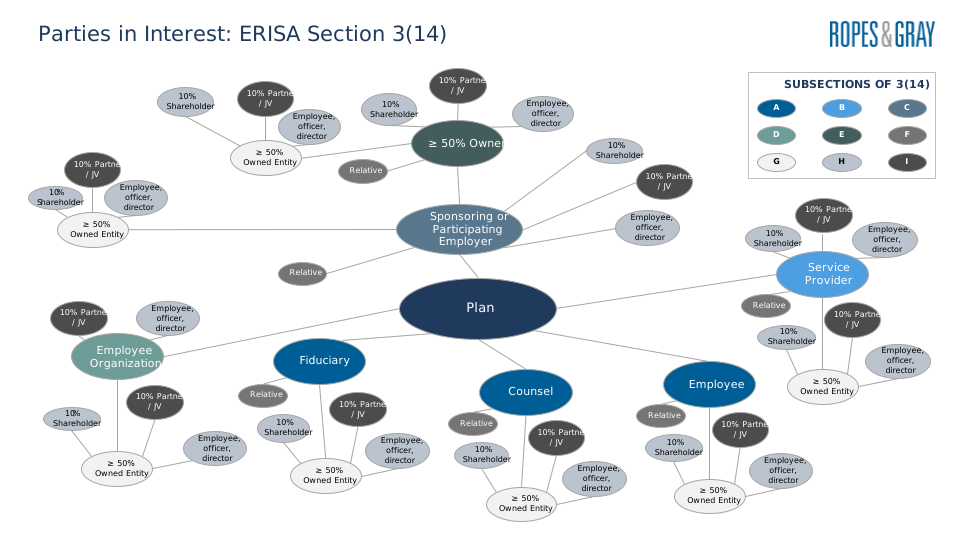
Party in interest transactions—absent an exemption—are prohibited regardless of whether they are beneficial or harmful to a plan, and regardless of the fiduciary’s motivation. Large plans especially have numerous parties in interest and their lists are not static. It is generally impracticable for a larger plan to constantly update a list of parties in interest for an appointed asset manager’s use; which highlights the utility (and necessity) of the exemptive relief discussed below and a manager’s need to satisfy any conditions required of it under those exemptions.
Self‑Dealing Transactions
A fiduciary may not—unless an exemption applies—allow plan assets to be transferred to or used by or for the benefit of itself or any person (such as an affiliate) in which the fiduciary has an interest that could affect the exercise of its best judgment as a fiduciary. Moreover, a fiduciary may not, absent an exemption, stand on both sides of a transaction involving plan assets, whether acting for itself or for client accounts. This generally prohibits cross‑trades, including most rebalancing and warehousing transactions as well as transactions with affiliates of the manager. A fiduciary also may not receive payments from third parties in connection with a transaction involving plan assets, again, unless an applicable exemption is available. The determination of whether a transaction is a self‑dealing prohibited transaction (other than a cross‑trade) must be made based on the prevailing facts and circumstances.
Framework for Exemptive Relief
There are three tiers of exemptive relief that may be available for any one or more prohibited transactions. All contain conditions of applicability.
1. Statutory Exemptions – As of the time of this publication, there are 20 exemptions contained in ERISA Section 408(b). Examples include: the ability to compensate service providers to a plan, allowance of certain cross-trades and the ability to trade with certain parties in interest. Those we believe most relevant to the typical asset management relationship are discussed in this Handbook.
2. Class Exemptions – The DOL has authority to grant exemptive relief on a “class” basis, meaning it is available to any person who meets the applicable definitions and conditions of the particular exemptions. Several of these are discussed in this Handbook, the most notable in this context being the “QPAM” Exemption.
3. Individual Exemptions – The DOL also has authority to grant exemptive relief to specific parties upon application and demonstration to the Department’s satisfaction that the proposed transaction is in the interest of the plan and its participants and other criteria. Upon issuance only the named parties may rely on an individual exemption.
Manager Compensation
Under ERISA Section 408(c)(2), a fiduciary will not be treated as having breached these prohibitions on self‑dealing if it receives “reasonable” compensation for services rendered.
Manager compensation is obviously an important aspect of any arrangement with a client. As a general matter, the extent to which a compensation arrangement is reasonable is dependent on the facts and circumstances. That said, the compensation must be for services that are necessary or helpful to the plan in pursuit of its mission, and the investment of its assets would be expected to satisfy that standard. Furthermore, arrangements must be terminable by the plan on “reasonably short notice under the circumstances.” There are also disclosure requirements discussed in Reporting and Disclosure.
Substantively, it is typically incumbent on the plan’s appointing named fiduciary to ensure that the compensation arrangement is consistent with market practice and is in the best interests of the plan, although the manager remains at risk for disgorging excess compensation because the manager is the party in interest with respect to the plan in the context of a compensatory transaction.
Some common issues arising in the establishment of a compensation arrangement that need to be considered in the context of ERISA’s prohibited transaction rules include:
- the extent to which a manager is able to determine the value of a security when the fee is based on assets under management or similar proxy for portfolio value;
- the extent to which a manager’s discretionary investment decisions can affect the timing of fee payment;
- “lock-ups,” fee tails and other restrictions on a plan’s ability to terminate the arrangement; and
- incentive arrangements, which must be structured to avoid conflicts on interest or improper use of manager discretion to generate a fee.
- Over the years, the DOL has issued a series of advisory opinions approving particular incentive fee structures for managing plan assets in the hedge fund context (for example, see DOL Advisory Opinion No. 86-20A (BDN Advisers, Inc.), DOL Advisory Opinion No. 86-21A (Batterymarch Financial Management) and DOL Advisory Opinion No. 89-31A (Alliance Capital Management L.P.). The Department has not explicitly approved performance-based fee arrangements for other types of asset classes, and the level of comfort a manager has in relying on the DOL’s guidance may depend on (i) whether the structure is commercially standard and (ii) the extent of the manager’s ability to exert control of the timing and amount of the fees.
Employer Securities
It is prohibited for an ERISA plan to acquire “employer securities” or “employer real property” except in accordance with ERISA Section 407(a). Employer securities are securities issued by an employer of employees covered by a plan or by an affiliate of the employer, and employer real property is real property (and related personal property) leased to such an employer or affiliate. ERISA section 407(a) prohibits a plan from acquiring employer securities that are not “qualifying employer securities,” defined to include stock and certain marketable obligations. Moreover, generally, even qualifying employer securities may not be acquired if, immediately after the acquisition, the aggregate fair market value of the employer securities held by the plan exceeds 10% of the fair market value of the plan’s assets. An exception to the 10% rule applies in the context of 401(k) and other defined contribution plans. These prohibitions can be particularly challenging for union‑sponsored Taft‑Hartley multiemployer plans. Where a plan sponsor is part of an index to be tracked or an important element of a desired sector, the employer securities rule needs to be discussed with clients in that context. ERISA clients may request assistance from managers in abiding by these restrictions, and managers may require clients to provide lists of restricted securities to assist with this compliance.