
In This Edition
- SEC Guidance on Government Shutdown: Impact on Filers & IPO Companies
- SEC Staff Clears the Way for Standing Proxies under Retail Shareholder Voting Program
- Acceleration of Registration Statement Effectiveness: Proper Disclosure, Not Existence, of Mandatory Arbitration Provisions Is What Matters, Says SEC
- SEC Issues Spring 2025 Regulatory Flexibility Agenda
- SEC Staff Guidance Clarifies Timing Interplay Between SRC-Revenue Test Status and Accelerated/Large Accelerated Filer Status
- SEC Intensifies Focus on Cross-Border Fraud with New Enforcement Task Force
- SEC Approves Texas Stock Exchange
- Nasdaq Proposes Higher Float Thresholds for New Listings and Immediate Delisting for Low Market Cap. Issuers
- Nasdaq Proposes Alignment of de‑SPAC Listings Involving OTC‑Trading SPACs with IPO Treatment
- Nasdaq Proposes to Enable Trading of Tokenized Securities on Its Exchange
- Nasdaq Proposes Accelerated Delisting and Trading Suspension for Persistently Low-Priced Securities
SEC Developments
SEC Guidance on Government Shutdown: Impact on Filers & IPO Companies
On September 30, 2025, the Division of Corporation Finance (the “Division”) of the U.S. Securities and Exchange Commission (the “SEC”) issued guidance regarding its operations during a government shutdown and updated the guidance on October 9, 2025. We summarize the key points from the updated guidance as it relates to filers and IPO companies below.
EDGAR REMAINS OPERATIONAL
- EDGAR, the SEC’s electronic filing system, will remain fully operational during a shutdown and companies and other filers will be able to electronically submit all their filings under the Securities Act of 1933 (the “Securities Act”) or the Securities Exchange Act of 1934 (the “Exchange Act”).
- Filing deadlines under the federal securities laws continue to apply; the days during a shutdown will still count as “business days” for purposes of rules involving day counting.
REGISTRATION STATEMENTS AND OFFERINGS
- The Division staff will not declare registration statements or post-effective amendments effective.
- Well-known seasoned issuers (“WKSIs”) can continue offering activity since their Form S-3/F-3 registration statements are automatically effective upon filing.
- Non-WKSIs with already-effective shelf registration statements may proceed with offerings through prospectus supplements.
- While the Division staff will not issue comment letters or respond to responses to their comments during this period, companies may submit responses via EDGAR.
- The Division staff will suspend review of all IPO registration statements, including confidentially submitted draft registration statements.
- If an offering (under an effective registration statement) relying on Securities Act Rule 430A (“Rule 430A”) will not price within 15 business days of effectiveness as required by Rule 430A, the issuer may restart the 15-business-day clock by filing a Securities Act Rule 462(c) post-effective amendment (i.e., a post-effective amendment that does not include substantive changes to the effective prospectus) as such a post-effective amendment is effective upon filing.
- 20-day automatic effectiveness path: while historically not a path that companies have used, the Division notes that a company may amend a pending registration statement to remove a delaying amendment (the statement included in registration statements that delays effectiveness until the registration statement is declared effective by the SEC) or file a new registration statement without a delaying amendment, so that, in each case, the registration statement becomes effective after 20 days by operation of Section 8(a) of the Securities Act.
- IPO companies and other companies relying on Rule 430A (which permits pricing and price-dependent information to be omitted from a registration statement and is ordinarily only available for registration statements that are declared effective by the SEC) may have their registration statements go effective automatically under Section 8(a) of the Securities Act.
- In its updated guidance, the Division staff, taking into account their unavailability to review or accelerate the effectiveness of registration statements during the shutdown, advised that they will not recommend enforcement action if a company omits Rule 430A information from its registration statement that is filed during the shutdown without a delaying amendment and goes effective automatically, during or after the shutdown, by operation of Section 8(a) of the Securities Act.
- If the SEC reopens during the 20‑day period, the Division staff may ask the company to re‑insert a delaying amendment.
- Post‑effectiveness, the SEC may review and could request amendments or, in emergencies, issue a stop order under Section 8(d) of the Securities Act suspending the effectiveness of the registration statement.
- IPO companies and other companies relying on Rule 430A (which permits pricing and price-dependent information to be omitted from a registration statement and is ordinarily only available for registration statements that are declared effective by the SEC) may have their registration statements go effective automatically under Section 8(a) of the Securities Act.
PROXY STATEMENTS
- The Division staff will not respond to no-action requests seeking exclusion of shareholder proposals from proxy statements.
ACTION STEPS
- Continue timely Exchange Act filings via EDGAR.
- Companies with effective shelf registration statements may proceed with offerings via prospectus supplements (and, for WKSIs, via post-effective amendments, if needed).
- Non-WKSIs that must update an effective registration statement should consider whether they can proceed without a post-effective amendment that will need to be declared effective.
- For offerings relying on Rule 430A that missed the 15-business-day pricing window, consider Rule 462(c) post-effective amendments to restart the 15-business-day period.
- IPO companies and Non-WKSIs considering using the 20-day automatic effectiveness path must weigh several factors, including whether Division staff review of their registration statement was substantially complete and, if not, how to address any unresolved SEC comments, as well as the antifraud provisions of the federal securities laws, which apply regardless of the manner in which the registration statement becomes effective.
SEC Staff Clears the Way for Standing Proxies under Retail Shareholder Voting Program
THE BOTTOM LINE
- The SEC staff will not object to a retail shareholder voting program that allows retail shareholders to provide their company with a standing proxy to vote their shares at every shareholder meeting in line with the recommendations of the company’s board if the program is voluntary, available to all retail shareholders at no cost, allows participants to opt out and to override votes cast by the board for them, provides shareholders with annual reminders of their enrollment status and their opt-out and override rights, and is consistent with other features of the program proposed by Exxon Mobil Corporation (“Exxon”).
- Since the granting of the no-action relief:
- Two shareholder advocacy organizations have formally asked the SEC staff to reconsider and rescind the no-action relief, arguing that the program conflicts with SEC rules, including the plain language of Exchange Act Rules 14a 4(d)(2) and 14a-4(d)(3), undermines the policy goals of the proxy rules, and sets a harmful precedent for retail shareholder voting rights; and
- An Exxon shareholder has filed a class-action suit against Exxon and its directors seeking an injunction enjoining the continued operation of the program and alleging breaches of the directors’ fiduciary duties, claiming that the program is an unlawful solicitation in violation of SEC rules that unlawfully impairs the voting rights of shareholders and seeks to entrench Exxon’s board and suppress shareholder dissent.
- While the program provides a blueprint for public companies that have large retail bases and are incorporated in states permitting standing proxies to consider, those companies should consider waiting for the resolution of the shareholder litigation before acting.
THE DETAILS
On September 15, 2025, the SEC staff granted no-action relief with respect to the compliance of Exxon’s proposed retail shareholder voting program (the “program”) with Exchange Act Rules 14a-4(d)(2) and 14a-4(d)(3).
The program, which is voluntary and at no cost to retail shareholders, would allow participants to provide Exxon with a standing voting instruction to vote their shares at each shareholder meeting in line with the voting recommendations of its board, thereby promoting voting by Exxon’s retail shareholders at shareholder meetings. According to Exxon’s letter requesting the relief, in addition to providing participants with the option to opt out from the program at any time, participants would also be able to override their standing voting instruction for a particular meeting by directly casting their votes using the proxy materials they receive, and Exxon would provide participants annual reminders of their enrollment status and these opt-out and override rights.
Given the on-going nature of the voting instruction, Exxon sought confirmation from the SEC staff that they would not recommend any SEC enforcement action on the basis that the program violates Exchange Act Rules 14a-4(d)(2) and 14a-4(d)(3), which generally prohibit a proxy conferring authority to vote at more than one meeting. While noting that a standing instruction is permitted under New Jersey law, the state corporate law applicable to Exxon, and under Delaware law, Exxon argued that “the choice made (in response to the annual reminder or the proxy materials) is . . . a reaffirmation or renewal of the standing voting instruction, which enables compliance with Rules 14a-4(d)(2) and 14a-4(d)(3).” Exxon also clarified that it was not seeking no-action relief regarding whether the program involves a “solicitation” of proxies, as defined under the SEC rules.
We discuss below the key features of the program and key developments since the granting of the no-action relief.
Key Features of the Program
- Who can participate: All retail shareholders (both registered owners and beneficial owners) are eligible to participate, at no cost; each retail shareholder will be offered the same opportunity to enroll in the program. Investment advisers registered under the Investment Advisers Act of 1940 exercising voting authority for clients are, however, excluded.
- Opt in via standing voting instruction: Participation is voluntary. Retail shareholders must affirmatively opt in to the program. To opt in, retail shareholders must provide the company with either an unqualified or a limited standing instruction to vote their shares, on an ongoing basis, in accordance with the voting recommendations of the company’s board. While an unqualified standing instruction would apply to all matters coming to a vote, a limited standing instruction would apply to all matters except contested director elections or mergers, acquisitions, or divestitures requiring shareholder approval under applicable state law or stock exchange rules (“shareholder approval transactions”).
- Ability to opt out: Participants may opt out of the program at any time at no cost. A participant’s cancellation of its standing voting instruction will, however, only apply to meetings for which the company has not yet filed a definitive proxy statement (i.e., future meetings). This is because votes covered by a standing voting instruction will be cast by the company on the date it files a definitive proxy statement for an upcoming meeting.
- Ability to override vote: Even though participants may only opt out of the program in relation to future meetings, they may at any time (and at no cost) override their standing instruction for a particular meeting by casting their vote on any proposal using the proxy materials.
- Continuous receipt of proxy materials: Even after opting in to the program, participants will continue to receive all the company’s proxy materials for each meeting and their ability to vote directly will not be limited or restricted.
- Annual reminders:
- Participants will receive annual reminders of their enrollment status, their ability to opt out of the program with respect to future meetings, and their ability to override their standing instruction by casting their vote on any proposal using the proxy materials.
- Ahead of meetings involving contested director elections or shareholder approval transactions, the company will provide additional reminders to participants that provided unqualified standing instructions.
- Disclosure:
- The company will fully disclose the program on its website and in its proxy statement.
Key Developments Since the No-Action Relief
Exxon Files Copies of Communications and Website Pages for the Program
On September 17, 2025, Exxon filed with the SEC copies of the email invitation to shareholders to enroll in the program, as well as copies of printed versions of the invitation and the website instruction, confirmation, and service description pages. The copies were filed as soliciting material under Exchange Act Rule 14a-12 under the cover of Form DEFA 14A.
SEC Staff Is Asked to Reconsider and Rescind the No-Action Relief
On September 30, 2025, two shareholder advocacy organizations, As You Sow and the Interfaith Center on Corporate Responsibility, submitted a letter to the SEC staff requesting the staff to reconsider and rescind the no‑action relief, arguing that the program’s standing proxy violates both the plain language of Rules 14a‑4(d)(2) and (d)(3) and the proxy form requirements for a meeting‑specific, dated proxy that clearly identifies each matter and provides voting choice by boxes, while the solicitation of the standing proxy contravenes Rule 14a‑4(f), which prohibits solicitation of a proxy unless the security holder concurrently receives, or has previously received, the related filed definitive proxy statement. They further contend in the letter that “opt‑out” or override features do not cure ongoing violations, and that the standing proxy would reduce informed voting and investor engagement, contrary to the policy goals underlying the proxy rules.
Shareholder Suit Is Filed against Exxon and Its Directors
On October 14, 2025, the City of Hollywood Police Officers’ Retirement System, an Exxon shareholder, filed a class-action suit in the federal district court in New Jersey against Exxon and its directors alleging breaches of the directors’ fiduciary duty of loyalty in connection with their adoption of the program and seeking injunctive relief enjoining the continued operation of the program. In the suit, the plaintiffs claim that Exxon’s invitation to retail shareholders to enroll in the program is an unlawful solicitation in violation of the disclosure and filing requirements of Exchange Act Rules 14a-3 through 14a-6, and 14a-9 through 14a-12. Their case is that, by adopting the program in violation of federal law, the directors breached their fiduciary duty because the program unlawfully impairs the shareholder franchise by providing shareholders who participate in the program with inadequate disclosure and by diluting the voting power of properly voted shares of other shareholders (including institutional shareholders) with votes based on illegally solicited proxies. The plaintiffs further claim that the directors breached their fiduciary duty because they adopted and maintain the program to entrench themselves, suppress shareholder dissent, and separate shareholders from informed, contemporaneous voting.
On the claim that the program violates the Exchange Act rules, the plaintiffs contend that:
- Rule 14a-3 (information to be furnished): Exxon solicited proxies without furnishing a preliminary/definitive proxy statement or the required annual financial report and cannot furnish those materials for unspecified future meetings.
- Rule 14a-4 (form, scope, and duration of proxy): The program materials do not clearly state the solicitation is on behalf of the board, do not identify each matter to be acted upon, do not provide for the option to vote/withhold/abstain on each item, and seek authority to vote at more than one meeting and beyond the next meeting, contrary to Rule 14a‑4(d)’s limits requiring contemporaneous, informed consent
- Rule 14a-5 (presentation and required dates): The materials omit required disclosures about the subjects to be voted, the substance of any proposals, and the key deadline dates (e.g., shareholder proposal and nomination deadlines).
- Rule 14a-6 (filing requirements): Exxon purported to solicit proxy authority without filing and furnishing the required preliminary/definitive proxy statements.
- Rule 14a-9 (anti‑fraud): By omitting material facts—most notably any specifics about the matters for which authority is sought—the solicitation is materially misleading.
- Rule 14a-10 (prohibition of certain solicitations): The program effectively seeks proxies dated for or operative on unspecified future dates and meetings beyond the date of signing.
- Rule 14a-12 (pre‑proxy solicitations): Even if treated as a pre-proxy statement solicitation under Rule 14a‑12, the materials fail to include required legends and participant identity/interest disclosures and improperly request consent/authorization before furnishing a compliant proxy statement, which cannot be done for indefinite future meetings.
Acceleration of Registration Statement Effectiveness: Proper Disclosure, Not Existence, of Mandatory Arbitration Provisions Is What Matters, Says SEC
THE BOTTOM LINE
- The SEC will no longer deny requests for the acceleration of a registration statement solely on the basis that a registrant’s corporate charter or bylaws or other governing document includes a provision requiring arbitration of investor claims arising under the federal securities laws (a “mandatory arbitration provision”). The SEC staff will instead focus on the adequacy of the registration statement’s disclosures, including disclosure regarding any mandatory arbitration provision. Public companies (and companies planning to go public) should weigh the benefits and risks of including such provisions in their governing documents going forward.
THE DETAILS
In a reversal of its staff’s longstanding practice, dating back to 1990, on September 17, 2025, the SEC issued a policy statement declaring that the presence of a mandatory arbitration provision will not impact decisions whether to accelerate the effectiveness of a registration statement. In essence, the SEC will not deny requests for the acceleration of a registration statement solely on the basis that a registrant has a mandatory arbitration provision in its corporate charter or bylaws or other governing documents. Instead, in considering acceleration requests, the SEC staff will focus on the adequacy of the registration statement’s disclosures, including disclosure regarding any mandatory arbitration provision, consistent with its mandate of ensuring investors have complete and adequate disclosure to make informed investment decisions.
The SEC’s power to accelerate the effectiveness of a registration statement stems from Section 8(a) of the Securities Act, which requires the SEC to consider the adequacy of the information about the issuer and the securities to be offered, as well as “the public interest and the protection of investors,” in exercising that power. In addressing the public interest consideration, the SEC noted that governing case law instructs that, in considering the public interest and the protection of investors, only matters over which the SEC has authority under federal securities laws may be considered. Taking this into account, the SEC, relying on Supreme Court jurisprudence interpreting and applying the Federal Arbitration Act of 1925 (the “FAA”), concluded that (i) in the context of mandatory arbitration provisions, “the Federal securities statutes do not override the [FAA’s] policy favoring the enforcement of arbitration agreements” and (ii) because they do not override the FAA in that context, the existence of a mandatory arbitration provision is not an appropriate consideration under Section 8(a)’s public interest and investor protection standard.
Notably, based on Supreme Court jurisprudence, the SEC, in reaching that conclusion, expressed the view that:
- “the inability to proceed in a judicial forum as a result of [a mandatory arbitration provision] would not violate the anti-waiver provisions of the Federal securities statutes”—referring to Section 14 of the Securities Act and Section 29(a) of the Exchange Act, which void any requirement that a person “waive compliance with any provision” of those statutes or rules or regulations made under them;
- “nothing in the Federal securities statutes demonstrates a clear and manifest congressional intention to displace the FAA in the context of [mandatory arbitration agreements]”; and
- the Securities Act and the Exchange Act, both of which were enacted before class-action proceedings were permitted, “do not expressly include a right to proceed through class actions or collective actions” and “do not guarantee an affordable procedural path to the vindication of every claim.”
PRACTICAL CONSIDERATIONS
Public companies (and companies planning to go public) considering including a mandatory arbitration provision in their governing documents must consider several factors, including:
- Whether such provisions are enforceable under applicable state corporate law – For example, the SEC noted in its policy statement that new Section 115(c) of the Delaware General Corporation Law, which became effective on August 1, 2025, may prohibit Delaware corporations from including a mandatory arbitration provision in their charters or bylaws. New Section 115(c) permits the charter or bylaws to prescribe a forum or venue for certain claims that are not internal corporate claims but only if a stockholder may bring such claims in at least one Delaware court with jurisdiction.
- Litigation risk. Given that the Supreme Court, as well as many, if not all, state courts have not ruled on the enforceability of arbitration provisions in the context of a corporation’s governing documents, mandatory arbitration provisions may be subject to litigation, including on their enforceability under the FAA (which expressly covers written provisions in “contract[s] evidencing transaction[s] involving commerce”) or applicable state corporate law.
- Investor perception. Public companies must consider that investors may have different views on such provisions, which might impact demand for their stock and views on their governance practices.
SEC Issues Spring 2025 Regulatory Flexibility Agenda
THE BOTTOM LINE
- In the near term, SEC rulemaking relevant to public and private companies is expected to focus on enhancing accommodations for emerging growth companies, simplifying filer status, rationalizing and scaling disclosure requirements, modernizing the shareholder proposal and shelf registration regimes, expanding pathways for private placements, clarifying the regulatory framework for crypto assets, and modernizing the crypto market structure.
- For capital formation and disclosure and filing requirements, changes may include changes to the “emerging growth company” and “accreditor investor” definitions, further scaled disclosure for emerging growth companies, higher financial thresholds for SEC filer categories, entirely new filer categories or simplified accelerated-filer definitions, and scaled executive compensation disclosure.
- For shareholder proposals, the SEC may propose raising ownership thresholds for proposal submissions, tightening resubmission rules, clarifying exclusion grounds or repealing Exchange Act Rule 14a-8, its shareholder proposal rule.
- For crypto assets, proposed rules would address issuance, custody, and trading of crypto assets and would likely include exemptions or safe harbors for token offerings.
THE DETAILS
On September 4, 2025, the SEC published the SEC Chair’s agenda of rulemaking actions (the “Spring 2025 agenda” or the “agenda”). The Spring 2025 agenda, the first under Chair Paul Atkins, reflects the SEC Chair’s rulemaking priorities as of June 27, 2025.
The agenda, which excludes the human capital management disclosure and corporate board diversity proposals contemplated by the Gensler-led SEC, underscores a decisive shift in tone and direction: an emphasis on capital formation, regulatory simplification, and clearer frameworks for digital assets. In his statement on the agenda, Atkins declared that the “agenda reflects that it is a new day at the [SEC],” noting further that it represents the “[SEC]’s renewed focus on supporting innovation, capital formation, market efficiency, and investor protection.”Since taking office in April 2025, Chair Atkins and several SEC Commissioners have articulated themes that now appear embedded in the rulemaking docket—ranging from scaled disclosure, emerging growth company (EGC) accommodations, expanded pathways for capital raising, and shareholder-proposal reform to crypto-asset regulation and market-structure modernization.
We highlight below the agenda items most relevant to SEC-reporting companies and private issuers. According to the Spring 2025 agenda, proposed rules on these agenda items are expected by April 2026.
Enhancing EGC Accommodations and Simplifying Filer Status
Agenda item: Proposed rule amendments to expand accommodations for emerging growth companies (generally new issuers with total annual gross revenues of less than $1.235 billion) and to rationalize filer statuses to simplify the categorization of registrants and reduce their compliance burdens.
In a keynote address at the Florida Bar’s securities conference in February 2025, which we discuss here, Commissioner Mark Uyeda, then Acting SEC Chair, had provided some insights on possible changes. Possible changes may include changes to the EGC definition, including as to qualification (e.g., higher EGC revenue thresholds) and duration of the status, further scaled-down disclosure requirements for EGCs, higher financial thresholds for SEC filer categories, entirely new filer categories or simplified accelerated-filer definitions, and a spectrum of disclosure requirements, with less disclosure requirements for smaller companies.
Rationalization of Disclosure Practices
Agenda item: Proposed rule amendments to rationalize disclosure practices to facilitate material disclosure by companies and shareholders’ access to that information.
This proposal would likely focus on streamlining disclosure requirements, including by eliminating certain requirements and reducing duplication while enhancing clarity. Executive compensation disclosure may be one of the targeted areas given the SEC roundtable on executive compensation disclosure requirements held in June this year.
Shelf Registration Modernization
Agenda item: Proposed rule amendments to modernize the shelf registration process to reduce compliance burdens and further facilitate capital formation.
Shareholder Proposal Modernization
Agenda item: Proposed rule amendments to modernize the SEC’s shareholder proposal rule (Exchange Act Rule 14a-8) to reduce registrants’ compliance burdens and reflect legal developments.
Chair Atkins recently commented on the shareholder proposal regime and this rulemaking priority in his keynote address at the Weinberg Center for Corporate Governance’s 25th anniversary gala on October 9, 2025. In his remarks, he stated that shareholder meetings must be de-politicized, with their focus returned to voting on director elections and significant corporate matters, emphasizing that “nothing has epitomized the politicization of shareholder meetings more than shareholder proposals focused on environmental and social issues.” Noting that such proposals are generally precatory (i.e., they call for actions that are not binding on the company), he questioned whether such proposals are permissible under state corporate law and by extension whether they are required to be included in a company’s proxy statement under Exchange Act Rule 14a-8, which disqualifies proposals that cannot be properly brought under state corporate law. While pointing out that “at least one Delaware practitioner has recently concluded that precatory proposals are not a “proper subject” for shareholder vote, Atkins went on to suggest that the SEC may certify precatory proposal questions to the Delaware courts for expeditious resolution. Continuing further on the interplay of Rule 14a-8 and state law, Atkins opined that proposals subject to higher submission thresholds under state law or a company’s governance documents should be excludable under Rule 14a-8, rejecting preemption of such higher thresholds by Rule 14a-8.
In concluding his remarks, he stated that he had directed the SEC staff to evaluate whether the original rationale for adopting Rule 14a-8 still applies today, and expressed the view that the SEC should re-evaluate the rule’s fundamental premise that shareholders should be able to force companies to solicit for their proposals.
Chair Atkins’ remarks suggest that the SEC may end up proposing a repeal of Rule 14a-8. Absent a repeal proposal, the SEC may propose raising ownership thresholds for proposal submissions, tightening resubmission rules, and clarifying exclusion grounds.
Updating the Exempt Offering Pathways
Agenda item: Proposed rule amendments to facilitate capital formation and simplify the pathways for raising capital for, and investor access to, private businesses.
Atkins and Commissioners have repeatedly noted the importance of private markets in driving U.S. growth. This proposal will likely revisit investor qualifications (likely changes to the “accredited investor” definition) and offering limits and may implement the recommendations of the SEC’s Office of the Advocate for Small Business Capital Formation for “targeted regulatory changes” to the SEC’s regulatory regime for exempt offerings. In February 2025, Commissioner Uyeda (then Acting SEC Chair) stated that the SEC staff had been directed to explore changes to the accredited investor definition and ways to implement those recommendations.
Crypto Regulation and Market Structure Modernization
Agenda item: Proposed rules relating to the offer and sale of crypto assets to help clarify the regulatory framework for crypto assets and provide greater certainty to the market.
In his statement on the agenda, Atkins noted that “clear rules of the road for the issuance, custody, and trading of crypto assets” is a key priority of his Chairmanship. The agenda specifically provides that the proposed rules could potentially include certain exemptions and safe harbors. We expect that these would likely include exemptions or safe harbors for token offerings.
Relatedly, per the agenda, the SEC is also expected to propose rule amendments to account for the trading of crypto assets on alternative trading systems (ATSs) and national securities exchanges.
SEC Staff Guidance Clarifies Timing Interplay Between SRC-Revenue Test Status and Accelerated/Large Accelerated Filer Status
In August 2025, the SEC staff issued guidance clarifying that an issuer that ceases to qualify as a smaller reporting company (SRC) under the SRC revenue test, as of its mid-fiscal year annual test date, will not qualify as an accelerated or large accelerated filer as of the end of the same fiscal year (i.e., as of that fiscal year’s accelerated or large accelerated filer status test date). This means that such an issuer would be a non-accelerated filer for filings due in the next fiscal year. For example, a calendar year issuer that fails to qualify as an SRC as of June 30, 2025, would be a non-accelerated filer for all its 2026 filings.
According to the guidance, this is because such an SRC would continue to be eligible to use the SRC revenue requirements under paragraph (2) or (3)(iii)(B) of the SRC definition in Exchange Act Rule 12b-2 until its Form 10-Q for the first fiscal quarter of its next fiscal year and would, therefore, not satisfy the “accelerated filer” and “large accelerated filer” condition that the issuer must not be eligible to use those requirements as of the end-of-fiscal-year test date. In this regard, the SEC staff referred to paragraph (3)(i)(C) of the SRC definition, which provides that such an SRC must reflect the result of its annual SRC status test in its Form 10-Q for the first quarter of the next fiscal year and in subsequent filings for that fiscal year. The guidance also means that such an SRC will remain eligible to use SRC scaled disclosure requirements through the end of the fiscal year in which it failed the SRC test and in its Form 10-K (for the current fiscal year) filed in the next fiscal year.
SEC Intensifies Focus on Cross-Border Fraud with New Enforcement Task Force
On September 5, 2025, the SEC announced the formation of a Cross-Border Task Force aimed at identifying and combating cross-border fraud that threatens U.S. investors. In particular, the task force will investigate securities law violations involving foreign issuers and market gatekeepers—auditors and underwriters—who facilitate foreign companies’ access to U.S. capital markets. The SEC’s announcement focuses particularly on China, noting the degree of government control among market actors and other factors. The task force appears to represent a continuation of the administration’s America First Investment Policy by targeting foreign actors, muddling Chinese access to U.S. capital markets, and prioritizing enforcement against cross-border fraud. We discuss this development in detail here.
Stock Exchange Developments
SEC Approves Texas Stock Exchange
On September 30, 2025, the SEC granted the application of Texas Stock Exchange LLC (TXSE) to be registered as a national securities exchange. According to the SEC order granting the application, the TXSE will operate a fully automated electronic trading system and will not maintain or operate a physical trading floor. In granting the order, the SEC noted that the TXSE’s proposed initial and continuing listing standards are substantially similar to those of the Nasdaq Global Select Market and the New York Stock Exchange (NYSE), while its proposed corporate governance standards are substantially similar to those of Nasdaq and the NYSE. The TXSE is expected to launch listings and trading in 2026.
Nasdaq Proposes Higher Float Thresholds for New Listings and Immediate Delisting for Low Market Cap. Issuers
Nasdaq has proposed two notable adjustments to its listing framework aimed at promoting liquidity. First, for companies seeking to list based on net income, the minimum market value of unrestricted publicly held shares would increase to $15 million across both the Nasdaq Global and Nasdaq Capital Markets. This change would align the float requirement for the net income pathway with the thresholds already applicable to other initial listing standards, addressing Nasdaq’s observation that lower public floats have contributed to thin trading and impaired price discovery.
Second, Nasdaq would adopt an accelerated delisting mechanism for issuers exhibiting severe and sustained deterioration. If a company falls out of compliance with one or more quantitative listing criteria and its market value of listed securities remains below $5 million for 10 consecutive business days, its securities would be suspended from Nasdaq trading and immediately slated for delisting without the opportunity for a compliance plan or cure period. Although the opportunity for a hearing would remain available, a hearing request would not stay the trading suspension; securities would trade over the counter during the appeal. A hearings panel could, however, reinstate trading if the company demonstrates full compliance or, in appropriate cases, grant a limited exception period while trading remains off-exchange.
If approved by the SEC, the heightened float requirement would become operative 30 days after approval, and the immediate suspension and delisting regime would apply to new deficiency notifications beginning 60 days after approval. Together, the proposals are designed to ensure that newly listed companies present a sufficiently robust public float to support efficient trading and that issuers with persistently low market values do not remain on-exchange during periods of acute distress. The SEC is expected to act on the proposed rule by December 18, 2025.
Nasdaq Proposes Alignment of de‑SPAC Listings Involving OTC‑Trading SPACs with IPO Treatment
In August 2025, Nasdaq proposed amendments to its initial listing standards for special purpose acquisition companies (SPACs) completing business combinations ("de‑SPAC transactions") to harmonize the treatment of SPACs that trade over‑the‑counter with those already listed on a national exchange. Under the proposal, a company listing in connection with a de‑SPAC transaction upon effectiveness of a Securities Act registration statement would be evaluated as the functional equivalent of an IPO. In doing so, Nasdaq would exclude such listings from legacy “reverse merger” seasoning concepts that were designed to address back‑door registrations, recognizing that de‑SPACs with an effective registration statement entail Securities Act disclosure, SEC staff review, and underwriter involvement and diligence akin to a traditional IPO. Current Nasdaq rules exclude de-SPACs by listed SPACs from those "reverse merger" seasoning concepts.
The proposal would also remove the applicability of pre‑listing average daily trading volume thresholds that otherwise apply to issuers uplisting from the OTC market, when the listing occurs in connection with a de‑SPAC transaction and upon effectiveness of a Securities Act registration statement. According to Nasdaq, that liquidity requirement is poor proxy in this context since pre‑combination trading in a SPAC is generally linked to the SPAC's trust value and redemption features and therefore is not indicative of post‑combination trading dynamics in the operating company.
Importantly, the post‑combination company would still be required to satisfy all other initial listing standards, including quantitative criteria related to public float, investor distribution, and price. If approved by the SEC, the changes would create a more predictable path to exchange listing at the time of a de‑SPAC for OTC‑trading SPACs, aligning market practice with the SEC’s view of de‑SPACs as IPO‑equivalents from an investor‑protection and disclosure standpoint. The SEC is expected to act on the proposal by December 8, 2025.
Nasdaq Proposes to Enable Trading of Tokenized Securities on Its Exchange
On September 8, 2025, Nasdaq filed a proposal with the SEC to allow trading of tokenized versions of existing equities and exchange-traded products on its exchange. The proposal would allow tokenized instruments to trade--in the same order book and according to the same execution priority rules--alongside traditional shares fungible with them and having the same CUSIP and core shareholder rights. Tokenized securities will not be treated as equivalent to their traditional counterparts if they do not have the same CUSIP or share the same core shareholder rights. According to Nasdaq, the proposal would keep trading in tokenized securities, which are increasingly in demand, squarely inside the regulated U.S. equity market.
Operationally, the proposal relies on post-trade processing through The Depository Trust Company to effect clearing and settlement of transactions designated for tokenized settlement. Members of the exchange could specify tokenized settlement on an order-by-order basis, and, upon execution, that instruction would be communicated for post-trade processing. Notably, tokenized transactions would continue to settle on a T+1 basis, and fee schedules, order types, routing strategies, and risk controls would remain unchanged.
The SEC is expected to act on the proposal by November 6, 2025
Nasdaq Proposes Accelerated Delisting and Trading Suspension for Persistently Low-Priced Securities
Nasdaq has proposed amendments that would significantly tighten the application of its minimum bid price framework for severely distressed securities. Under the proposal, if a listed security closes at $0.10 or less for ten consecutive trading days, Nasdaq will promptly issue a staff delisting determination without affording the compliance periods otherwise available for bid-price deficiencies. Unlike under the current rules, this would apply even if the company has not had a closing bid price below $1.00 for 30 consecutive days. The change is intended to address rapid price deterioration that Nasdaq views as indicative of substantial financial or operational distress and to move more quickly to remove such securities from the exchange in the interest of investor protection and market integrity.
The proposal would also alter the procedural posture during appeals. A company that receives a delisting determination for falling below the $0.10 threshold would see its securities suspended from trading on Nasdaq during the pendency of any appeal to a hearings panel, rather than benefitting from an automatic stay; during suspension, the securities would trade in the over-the-counter market. A hearings panel would retain discretion to grant a limited exception period and could reinstate trading if it determines that the issuer meets applicable standards, which may be demonstrated by sustaining the requisite bid price for at least ten consecutive business days, subject to staff’s discretion to extend that period.
If approved, the rule change would become operative 45 days after Commission approval. The new framework would apply prospectively to companies that have not already received a delisting determination for a bid-price deficiency and have appeared before a hearings panel by the operative date, preserving the status quo for those already within the panel’s jurisdiction. The SEC is expected to act on the proposal by December 7, 2025.
U.S. Equity & Debt Markets Activity – Q3 2025
(data sourced from Dealogic)
Traditional IPOs
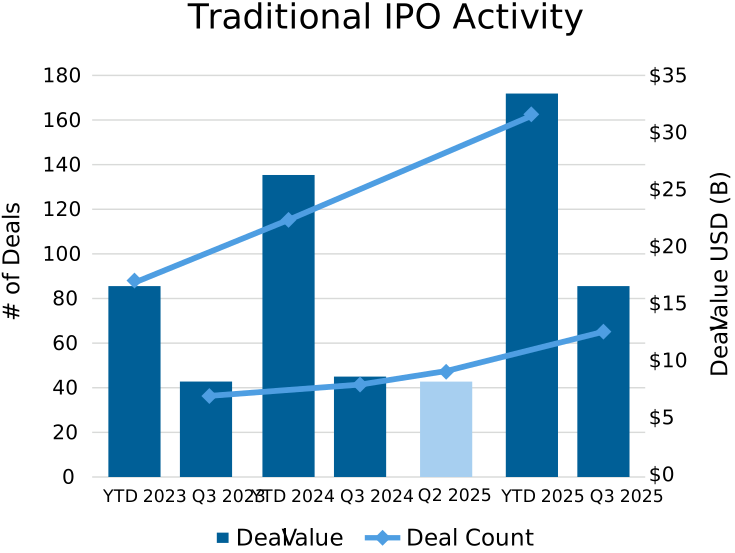
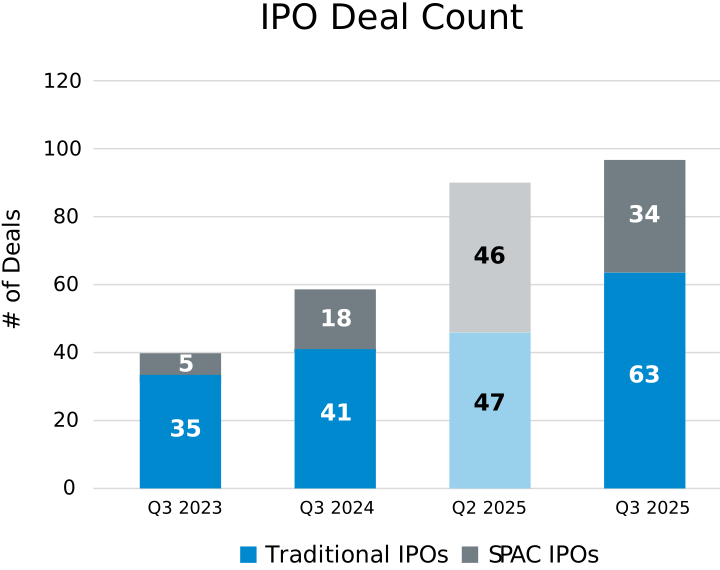
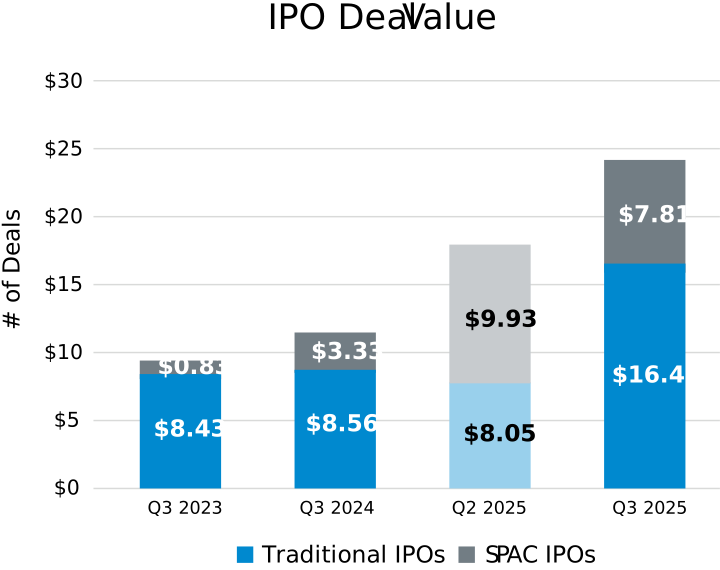
Traditional IPO activity accelerated in Q3 2025, reaching the highest level since 2021 with 63 IPOs raising nearly $16.5 billion. As compared to Q3 2024, activity was up significantly, increasing 93% by deal value and 54% by deal volume. YTD1 2025 activity was up 29% by value and 44% by volume compared with the same period last year—with 166 IPOs and $34 billion so far, the first three quarters in 2025 alone surpass all of 2024 (164 IPOs and $31 billion), confirming 2025 to be the strongest year since 2021’s records.
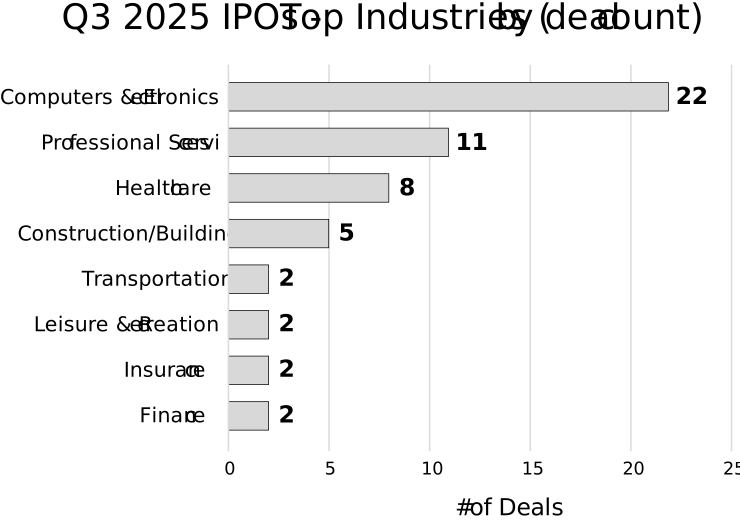
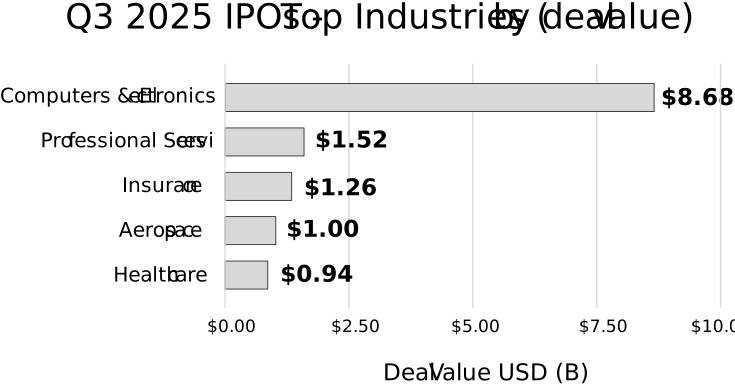
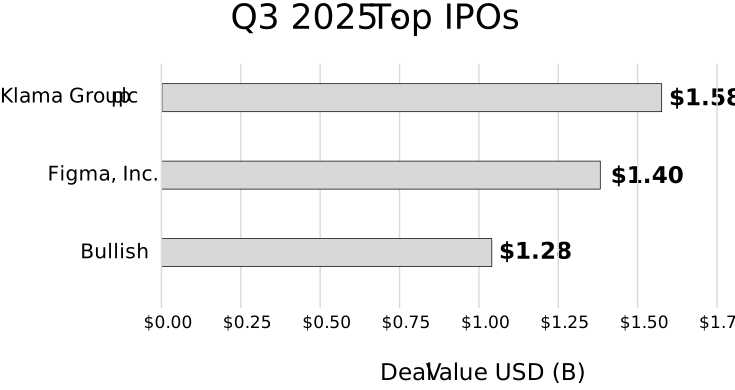
In Q3 2025, the computer and electronics industry continued to top the charts with a record 22 IPOs raising $8.68 billion, nearly six times the value and twice the volume of the professional services industry (with 11 IPOs raising $1.52 billion), which ranked second—a level of industry activity not seen since 2021. While the three largest IPOs of the quarter (Klarna, Figma and Bullish) bolstered results, their combined $4.26 billion proceeds accounted for less than half the sector’s value, with sheer volume driving the remainder.
SPAC IPOs
SPAC IPOs made a good showing in Q3 2025, with nearly $8 billion in deal value across 34 IPOs. Although not as outstanding as Q2 2025’s three-year record, the continued strength in SPAC IPOs signals renewed investor interest and momentum after several quieter years. Compared to last quarter’s boom, deal value was down 21% and volume down 26%. Compared to Q3 2024, however, deal value and volume were up 134% and 89%, respectively. Deal value and volume in YTD 2025 were also up 261% and 194%, respectively, versus YTD 2024.
Follow-Ons
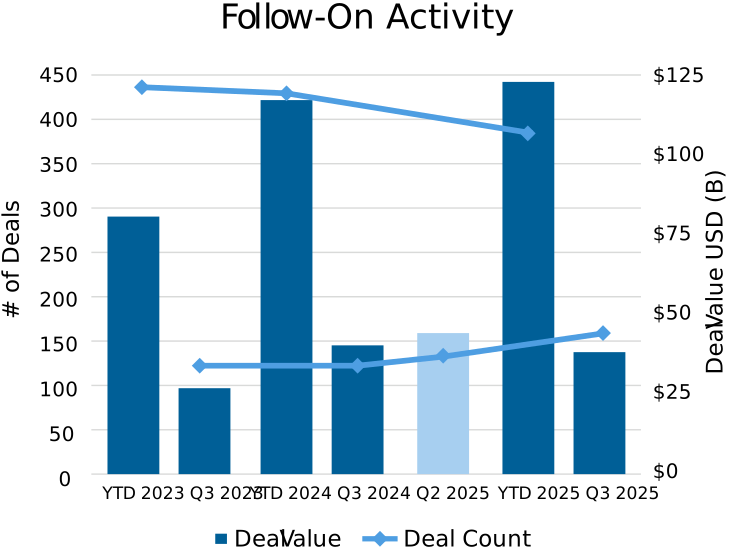
The number of follow-on offerings held strong in Q3 2025, increasing 25% from Q3 2024 and 17% from the prior quarter. Deal value, on the other hand, decreased modestly: 8% from Q3 2024 and 16% from the prior quarter. YTD 2025 saw flipped results—deal value increased 7% from YTD 2024, while deal volume declined 10%. The first three quarters in 2025 have recorded the strongest deal value in the period since 2021, totaling nearly $125 billion.
Convertible Bonds
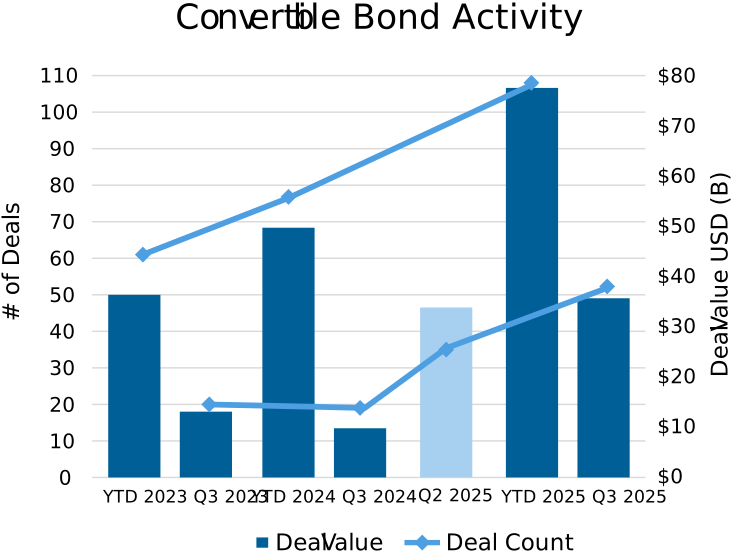
Q3 2025 marked another record quarter for the convertible bonds market, climbing another 16 transactions (44%) and $1 billion (3%) from Q2 2025’s four-year high. Issuances of convertible bonds were up 174% from Q3 2024, and 3.5 times by deal value; YTD 2025 activity also jumped from the same period last year (55% by value and 41% by volume), suggesting issuers are increasingly turning to this financing option.
Investment-Grade Debt
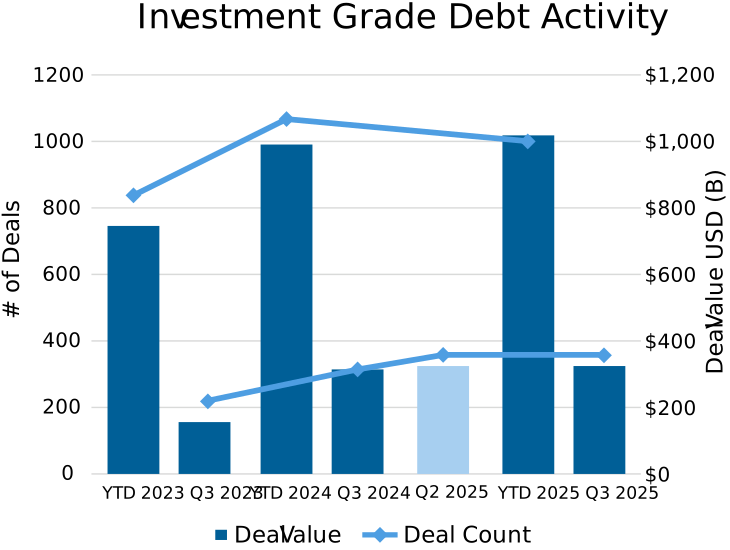
The uptick in IPOs and other equity financing did not extend to investment-grade corporate bond2 activity in Q3 2025, which was much more consistent with previous periods. Q3 2025 held moderately steady with Q3 2024 (+2% by value and 9% by volume) and with Q2 2025 (+2% by value and flat by volume). As compared to YTD 2024, YTD 2025 declined just 8% by number of issuances and was also steady by value (+2%). The consistent activity in investment-grade corporate bond issuance indicates continued strong demand for high-quality debt.
High-Yield Debt
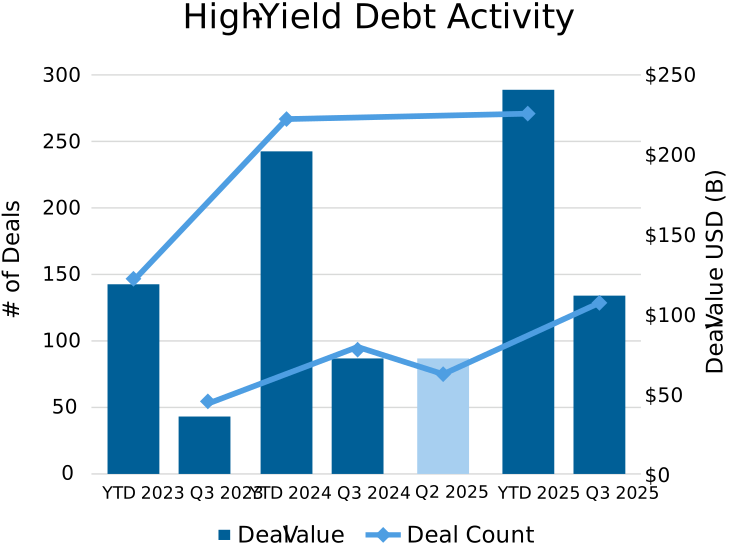
Despite investment-grade bonds’ mild incline in activity, high-yield debt offerings in Q3 2025 skyrocketed to $109 billion with 127 transactions, the highest levels in four years. Q3 2025 was up from Q2 2025 by 49% and 74% and from Q3 2024 by 51% and 31% by deal value and deal volume, respectively. Q1 and Q2 2025’s relatively moderate showings tempered YTD 2025 numbers, with totals up only 19% by deal value and steady by deal volume (with a difference of only one transaction) from YTD 2024.
- Means January 1 through September 30.
- Excludes short-term debt, convertibles, asset-backed securities, and mortgage-backed securities.
Authors












Stay Up To Date with Ropes & Gray
Ropes & Gray attorneys provide timely analysis on legal developments, court decisions and changes in legislation and regulations.
Stay in the loop with all things Ropes & Gray, and find out more about our people, culture, initiatives and everything that’s happening.
We regularly notify our clients and contacts of significant legal developments, news, webinars and teleconferences that affect their industries.