
In This Edition
- SEC Cuts Minimum Tender Offer Period in Half for Equity Securities
- SEC Policy Change on No-Action Process for Shareholder Proposals Challenged in Court
- In New Guidance, SEC Staff Grants Transition Relief to ATM Issuers Transitioning to Baby Shelfs
- SEC and CFTC Issue Landmark Joint Guidance on Classification of Crypto Assets Under Federal Securities Laws
- SEC Staff Issues New Guidance on Resale Registrations on Form S-4, Going Private Transactions and Tender Offers
- SEC Staff Updates Guidance on Rule 701 Offering Exemption, Ineligible Issuer Status, and Smaller Reporting Company Status
- SEC Grants Section 16(a) Exemption for Directors and Officers of Certain Foreign Private Issuers
- Iran Conflict: SEC Staff Grants No-Action Relief for Section 16(a) Reports of Insiders of FPIs
- New Nasdaq Rule Appears Intended to Bring SPACs Back to the Nasdaq Capital Market
- SEC Approves 23-Hour Trading Day for Equity Securities and ETPs on Nasdaq
- SEC Approves Nasdaq’s Pilot Program for Trading of Tokenized Securities
- Nasdaq Seeks Discretionary Authority to Delist Securities Following SEC Trading Suspensions
- NYSE Follows Suit: SEC Signs Off on its Tokenization Pilot Program
- NYSE Reproposes Expanding the Circumstances for the Listing of Rights
- SEC Approves Changes to NYSE American’s Initial Listing Standards
SEC Developments
SEC Cuts Minimum Tender Offer Period in Half for Equity Securities
On April 16, 2026, the Division of Corporation Finance (the “Division”) of the Securities and Exchange Commission (the “SEC”) issued an exemptive order that significantly reduces the time certain tender offers for equity securities must remain open. Effective immediately, qualifying tender offers may now remain open for as few as 10 business days—down from the standard 20-business-day minimum otherwise required under Rules 13e-4(f)(1)(i) and 14e-1(a) under the Securities Exchange Act of 1934 (the “Exchange Act”). The Division cited the need to address market inefficiencies, reflect technological advancements, and reduce unnecessary exposure to market fluctuations as the drivers behind this relief.
The exemptive order covers two categories of tender offers, both subject to a carefully structured set of conditions: (1) offers for equity securities of reporting companies and (2) offers for equity securities of nonreporting companies.
Relief for Tender Offers Involving Reporting Companies
The relief for tender offers for equity securities of reporting companies covers third-party tender offers and issuer self-tenders, respectively, under Regulation 14D and Rule 13e-4 under the Exchange Act.
Third-Party Offers under Regulation 14D
For third-party tender offers, the shortened 10-business-day period is available only when (i) the offer is made pursuant to the terms of a negotiated merger agreement or similar business combination agreement between the target company and the offeror, and (ii) the offer is made for all outstanding securities of the subject class. In addition, the target company must file and disseminate a Schedule 14D-9 no later than 5:30 p.m. Eastern time on the first business day following the commencement of the tender offer.
Issuer Self-Tenders under Rule 13e-4
For issuer self-tenders under Rule 13e-4, the abbreviated period is available when the offer is made for less than all outstanding securities of the subject class.
Conditions Applicable to All Reporting Tender Company Offers
Regardless of whether the tender offer is a third-party tender offer or an issuer self-tender, all of the following conditions must be satisfied:
- Cash-only consideration. The consideration offered must consist solely of cash at a fixed price.
- No going-private transactions. The offer must not be subject to Exchange Act Rule 13e-3 (i.e., it cannot be a going-private transaction).
- No cross-border exemptions. The offer must not be made in reliance on the cross-border exemptions under Exchange Act Rule 14d-1(d) or Exchange Act Rule 13e-4(i).
- No competing offers at launch. At the time the offer is publicly announced, the subject securities must not already be the subject of another pending or previously announced tender offer by a different offeror.
- Extension required if a competing offer emerges. If a competing tender offer is publicly announced after commencement, the initial offeror must extend its offer so that it remains open for at least 20 business days from the date it originally commenced.
- Press release with hyperlink at launch. The offer must be announced via a widely disseminated press release or wire service by 10:00 a.m. Eastern time on the commencement date, including basic terms (identity of offeror, class of securities, consideration, and expiration date) and an active hyperlink to a website where holders can access the tender offer materials.
- Early notice of price or percentage changes. Any increase or decrease in the percentage of securities sought (beyond a 2% de minimis threshold) or any change in the consideration offered must be publicly announced no later than 9:00 a.m. Eastern time on the fifth business day before expiration.
- Notice of other material changes. Any other material change in the terms of the offer must be publicly announced no later than 9:00 a.m. Eastern time on the second business day before expiration.
Relief for Tender Offers Involving Nonreporting Companies
The Division also granted relief for tender offers conducted by issuers that are not SEC reporting companies and tender offers conducted by wholly owned subsidiaries of such issuers for the issuer’s own securities.
As with reporting company tender offers, the consideration must consist solely of cash at a fixed price, and the same advance-notice requirements apply for changes to consideration or the percentage of securities sought (no later than 9:00 a.m. Eastern time on the fifth business day before expiration) and for other material changes (no later than 9:00 a.m. Eastern time on the second business day before expiration). Notably, unlike reporting company offers, this category does not require a widely disseminated press release at launch, reflecting the more limited public market for nonreporting company securities.
Important Reminders for Offerors
The exemptive order does not relax any other obligations under the federal securities laws. Offerors must remain mindful that all anti-fraud and anti-manipulation provisions continue to apply, including Sections 10(b) and 14(e) of the Exchange Act and the rules promulgated thereunder. The Division expressly noted that responsibility for compliance with all applicable federal securities laws rests with the offeror.
SEC Policy Change on No-Action Process for Shareholder Proposals Challenged in Court
Two shareholder groups, Interfaith Center on Corporate Responsibility (ICCR) and As You Sow, have sued the SEC, challenging the recent change in the SEC staff process for company no-action requests seeking to exclude shareholder proposals from proxy materials. Under the new policy, which was announced by the SEC Division of Corporation Finance in November 2025, the SEC will not substantively review or respond to such no-action requests for the 2026 proxy season unless the request is based on the shareholder proposal not being a proper subject for shareholder action under state corporate law. The SEC staff will, however, provide a non-substantive “no objection” response to a company that represents to the staff that it has a reasonable basis to exclude a shareholder proposal based on the provisions of Exchange Act Rule 14a-8 (the SEC’s shareholder proposal rule), prior published guidance, and/or judicial decisions. We discuss the policy change in detail here.
In the suit, which was filed in March, ICCR and As You Sow contend that the new policy (the “no-objection policy”) is contrary to Rule 14a-8, is arbitrary and capricious, and was adopted without notice-and-comment rulemaking and SEC approval, and, therefore, violates the Administrative Procedure Act of 1946. In support of these claims, they argue that:
- The no-objection policy is inconsistent with the burden of persuasion established by Rule 14a-8(g), which provides that the burden is on the company to demonstrate that it is entitled to exclude a proposal, except as otherwise noted.
- The no-objection policy improperly abdicates the SEC’s role in evaluating the evidence submitted by the company and the proponent in the Rule 14a-8 process.
- By making a company’s unqualified representation dispositive, the no-objection policy contravenes a proponent’s right to submit evidence and argument regarding whether a company has a legitimate basis to exclude a proposal, and to have that submission considered by the staff.
- The SEC failed to articulate a rational justification for adopting the no-objection policy as the reasons offered by the SEC for the policy change do not withstand scrutiny.
- The no-objection policy effectively amends Rule 14a-8, and such an amendment can only be made through notice-and-comment rulemaking and SEC approval.
The SEC is yet to file an answer to the complaint.
In New Guidance, SEC Staff Grants Transition Relief to ATM Issuers Transitioning to Baby Shelfs
THE BOTTOM LINE
- ATM issuers transitioning to baby shelf registration statements (i.e., limited-capacity shelf registration statements) will be allowed to continue to offer and sell the full amount of the securities covered by an ATM prospectus supplement they filed while they were qualified to offer an unlimited amount of securities, even if that amount of securities would exceed their cap under baby shelf rules.
THE DETAILS
On March 19, 2026, staff of the SEC Division of Corporation Finance issued new guidance (now known as Corporation Finance Interpretations (CFI)) granting transition relief to issuers of at-the-market offerings (ATMs) that will be transitioning to limited-capacity Form S-3 (shelf) registration statements under General Instruction I.B.6. of Form S-3 (commonly referred to as “baby shelfs”) due to their failure to meet General Instruction I.B.1.’s $75 million public float requirement at any time during the 60-day period prior to the next filing of their Annual Report on Form 10-K. Although the new guidance was given in the context of a Form S-3, the guidance should apply equally to issuers using Form F-3 registration statements as the same requirements apply to Form F-3s.
For primary offerings of straight common equity and common equity ATMs for cash, Form S-3 (and Form F-3) issuers may only rely on General Instruction I.B.1, which imposes a $75 million public float requirement and allows eligible issuers to offer an unlimited number of those securities, or General Instruction I.B.6, which is available to certain issuers that don’t meet the public float requirement but caps the aggregate market value of offerings sold in reliance on the instruction during a 12-month period to one-third of an issuer’s public float.
The new CFI, which is reproduced below, will provide such ATM issuers with greater offering capacity by allowing them to continue to offer and sell the full amount of the securities covered by the ATM prospectus supplement they filed while they met the $75 million public float requirement, even if that amount of securities would exceed General Instruction I.B.6’s offering limit. Before the new CFI, the existing ATM program of an issuer that no longer met the $75 million public float requirement at the time of filing its Annual Report on Form 10-K (or Form 20-F, as applicable) would be immediately subject to the offering limit and the issuer would need to file a new ATM prospectus supplement.
In addition to this new flexibility, such ATM issuers will be able to continue to take advantage of the relief provided in Form S-3 that terminates—with respect to new sales—the applicability of the baby shelf offering limit if the issuer meets the public float requirement at any time after the filing of its Form 10-K.
Question 116.26
Question: A company entered into a sales agreement with a named selling agent for an at-the-market offering of an amount of securities that the company reasonably expected to offer and sell. The company had an effective Form S-3 registration statement, was eligible to offer and sell securities in reliance on General Instruction I.B.1, and filed a prospectus supplement for the offering. At the time of its next Section 10(a)(3) update, the company does not meet the $75 million public float requirement of Instruction I.B.1 but remains eligible to use Form S-3 in reliance on General Instruction I.B.6 (the “baby shelf”). Will the staff object if the company continues to offer and sell the full amount of securities covered by the prospectus supplement even if that amount would exceed the offering limits of General Instruction I.B.6?
Answer: Under these circumstances, the staff will not object if the company continues offering and selling the full amount of securities covered by the prospectus supplement that was filed prior to the Section 10(a)(3) update.
SEC and CFTC Issue Landmark Joint Guidance on Classification of Crypto Assets Under Federal Securities Laws
THE BOTTOM LINE
- The guidance clarifies that while “tokenized” securities are securities under the federal securities laws, digital commodities, digital collectibles, digital tools, and stablecoins are not as their value depends on something other than the “essential managerial efforts” of others.
- The guidance also clarifies that while non-security crypto assets may be sold subject to investment contracts, which are securities, they do not necessarily remain so subject in perpetuity, as such a crypto asset would separate from an investment contract when purchasers can no longer reasonably expect the issuer’s representations or promises to engage in essential managerial efforts to remain connected to the asset.
THE DETAILS
On March 17, 2026, the SEC and the Commodity Futures Trading Commission (CFTC) jointly released interpretive guidance (the “Release”) clarifying when transactions in crypto assets are subject to regulation under federal securities laws. The Release classifies crypto assets into five categories based on their characteristics, uses, and functions, discusses when transactions in crypto assets that are not themselves securities might still involve an “investment contract” that subjects the transaction to regulation under the federal securities laws, and goes on to evaluate the treatment of mining and staking, wrapping and airdrops under the federal securities law.
The Release identifies four categories of crypto assets that are not securities: digital commodities, digital collectibles, digital tools and stablecoins, stating that digital commodities, digital collectibles and digital tools do “not have intrinsic economic properties or rights, such as generating a passive yield or conveying rights to future income, profits, or assets of a business enterprise or other entity, promisor, or obligor.” With respect to stablecoins, pending effectiveness of the GENIUS Act, the SEC adopts the guidance previously published by its staff, which similarly only covered stablecoins that do not “pay or guarantee to pay interest or otherwise convey any rights to payments or assets except upon redemption for USD on a one-for-one basis.” In each case, the SEC’s analysis is also premised in large part on the assertion that the value of the asset depends on something other than the “essential managerial efforts” of others.
On the other hand, the Release identifies digital securities, commonly known as “tokenized” securities, as securities.
Notably, while the Release clarified that a non-security crypto asset may be sold subject to an investment contract, which is a security, when the issuer promises to undertake essential managerial efforts from which a purchaser would reasonably expect to profit, it emphasizes that non-security crypto assets do not necessarily remain subject to investment contracts in perpetuity. According to the Release, a crypto asset separates from an investment contract when purchasers can no longer reasonably expect the issuer’s representations or promises to engage in essential managerial efforts to remain connected to the asset. The Release further notes that this separation may occur through either: (i) fulfillment of the issuer’s representations or promises regarding essential managerial efforts; or (ii) the issuer’s failure to perform, including abandonment of development. When, or if, these events have occurred will be a facts and circumstances determination and may depend on whether certain statements (e.g., posts on X, Discord or Telegram) are “public.” Issuers remain potentially liable under securities laws for failures to register offerings or for material misstatements that occurred while the crypto asset was subject to an investment contract, even after separation occurs.
We discuss the Release’s classification of crypto assets, other topics addressed by the Release, as well as key takeaways for market participants in detail here.
SEC Staff Issues New Guidance on Resale Registrations on Form S-4, Going Private Transactions and Tender Offers
On February 11, the staff of the SEC Division of Corporation Finance issued new guidance covering resale registrations on Form S-4, going private transactions, and tender offers. Below is a summary of the staff’s guidance.
Registration of Certain Securities for Resale on Form S-4
- Revised Section 225.03 confirms that, in a business combination registered on Form S-4, the registrant may register for resale on the Form S-4 securities that were previously offered and sold to officers, directors, or affiliates of the target company in transactions exempt from registration under the Securities Act of 1933, as amended (the “Securities Act”) in connection with the same business combination. Exemplifying this in relation to its earlier January 23, 2026 guidance, the revised guidance indicates that those securities would be regarded as having been offered and sold in connection with the same business combination if they were offered and sold pursuant to such exempt transactions in connection with written consents or lock-up agreements (i.e., agreements to vote in support of the business combination) for the same business combination executed by those officers, directors, or affiliates. In its January 23 guidance, the staff had clarified that they would not object to an S-4 registration statement preceded by such written consents or lock-up agreements (including agreements to tender) if the securities registered on the Form S-4 will be offered and sold only to those who did not execute such consents or agreements and those who executed such consents or agreements will be offered and sold securities only in a Securities Act exempt offering.
- The revised guidance is a reversal of the staff’s prior guidance which did not permit shares that had been privately placed to officers and directors of the target company to be registered for resale on the Form S-4 on the basis that they were not issued in connection with the business combination. The revised guidance, therefore, provides a target company’s officers, directors, and affiliates the timing flexibility of having those securities registered for resale on Form S-4, rather than waiting for them to be registered and declared effective on a Form S-1 or, if available, a Form S-3.
- In relation to this new flexibility, the revised guidance provides that, after completion of the business combination, the registrant may maintain an updated resale prospectus via a post-effective amendment on another form for which it is eligible. That is, the resale prospectus may be updated through a post-effective amendment on Form S-1 or, if available, on Form S-3.
Going Private Transactions
Background. Rule 13e-3 under the Exchange Act, which governs going private transactions conducted by an issuer or an affiliate of the issuer, imposes certain filing and disclosure requirements (including the filing of a Schedule 13E-3 with the SEC) on such transactions, while exempting certain transactions from those requirements.
Rule 13e-3(g)(2), which provides for one such exemption, exempts a transaction in which securityholders are offered or receive only an equity security that meets specific criteria. To qualify for the Rule 13e-3(g)(2) exemption, the offered or received security must have substantially the same rights as the equity security that is the subject of the transaction and must either be registered under Section 12 of the Exchange Act or the issuer must be required to file reports pursuant to Section 15(d) of the Exchange Act. In addition, if the subject security was listed on a national securities exchange (or authorized to be quoted in an inter-dealer quotation system), the offered or received security must also be so listed or quoted.
- In new Question 112.03, the staff addresses timing around the “listed/quoted” condition in Rule 13e-3(g)(2), indicating that the exception will still be available even if the equity consideration is not listed (or authorized for quotation) at the time the Rule 13e-3 transaction is publicly announced, so long as the Section 12 registration and approval for exchange listing (or quotation authorization) are express conditions to closing of the transaction, those conditions are disclosed, and all other requirements of the exception are satisfied.
- Question 212.01 has been revised to underscore the express closing condition point in the context of an issuer offer to exchange non-interesting convertible debentures for listed interest-bearing convertible debentures where the listing of the new debentures depends on the extent of holder participation. The prior version of Question 212.01 had noted that the Rule 13e-3(g)(2) exemption would be unavailable because the new debentures may not be listed and do not have substantially the same rights as the outstanding debentures. In revised Question 212.01, the staff clarifies that the exemption disqualification due to listing hinges on the absence of listing as an express closing condition stating that such disqualification is because “the new debentures may not be accepted for listing . . . and the listing of the new debentures . . . is not an express condition to the closing. . . .”
- New Question 112.04 clarifies that Rule 13e-3 would generally not apply to tender offers where there is an express non-waivable condition that the issuer (or its affiliate) would not purchase an amount of the subject equity securities that is reasonably likely to cause the issuer to cease being a reporting company.
Tender Offers
- New Question 101.22 clarifies that a 100%-owned subsidiary of an issuer is the only issuer affiliate that qualifies for the issuer tender offer exemption from Regulation 14D. Consequently, a parent company’s tender offer for equity securities of its 60%-owned affiliate is subject to Section 14(d) of the Exchange Act, and Regulation 14D, which regulate third-party tender offers, and is not subject to Exchange Act Rule 13e-4, which regulates issuer tender offers.
- New Question 163.02 addresses “mini-tender offers,” which are third-party tender offers that are structured to result in ownership of not more than 5% of an issuer’s securities and are only subject to the requirements of Section 14(e) of the Exchange Act and Regulation 14E. While Regulation 14E requires an issuer to state its position on a third-party tender offer within 10 business days of the offer’s commencement, the regulation does not, however, require the third-party bidder to send its offer document to the issuer or file the document on the SEC’s EDGAR, resulting in a situation where the issuer may be unaware of the mini-tender offer until after the 10-business-day period.
- The new guidance clarifies that the staff will not object to issuer’s failure to comply with the 10-business-day requirement due to the issuer’s unawareness of the tender offer so long as the issuer provides security holders the required statement of its position as soon as possible after it becomes aware of the tender offer.
SEC Staff updates Guidance on Rule 701 Offering Exemption, Ineligible Issuer Status, and Smaller Reporting Company Status
On March 6, 2026, the staff of the SEC’s Division of Corporation Finance issued new and revised guidance primarily addressing (i) exemptions for offers and sales of securities pursuant to certain compensatory benefit plans under Rule 701 under the Securities Act, (ii) the impact of foreign court convictions on ineligible issuer status under Securities Act Rule 405, and (iii) the connection between smaller reporting company (SRC) status and the SRC status checkboxes on Securities Act registration forms and reporting forms under the Exchange Act.
Securities Act Rule 701 – Compensation Benefit Plan Exemption
Securities Act Rule 701 provides an exemption from the registration requirements of the Securities Act that allows private (nonreporting) companies to issue equity and equity awards under written compensatory benefit plans or compensation agreements. The exemption is subject to limits on the amount of securities that can be sold in any 12-month period and a requirement (under Rule 701(e)) that an issuer whose sales exceed $10 million in any consecutive 12-month period must deliver enhanced disclosure (including risk factors and financial statements) to investors a reasonable period before the sale.
The new and revised Rule 701 guidance largely focus on how to apply the $10 million threshold that triggers Rule 701(e) disclosure, how option repricings should be counted, and how Rule 701 operates in the context of multiyear grants, post-Exchange Act deregistration exercises, and mergers and acquisitions (M&A).
Revised Question 271.10 (Repricing of Options)
The staff clarified that when an issuer reprices an option downward within 12 months of the original grant, the issuer may treat the repricing as effectively replacing the original grant for purposes of calculating whether the issuer has crossed the Rule 701 limit as to aggregate sales price or amount of securities sold during a 12-month period; the repriced options must be treated as a new sale and counted in the 12-month period that includes the repricing date.
Revised Question 271.12 (Rule 701(e) Disclosure; Consequences of Noncompliance)
The staff reinforced that an issuer should provide the Rule 701(e) disclosure to all participants in the Rule 701 offering during any 12-month period it expects sales/grants would exceed the $10 million threshold, not only those who participate after the threshold is crossed. The staff also reiterated that failure to provide the disclosure to all participants can result in the issuer losing the exemption for the entire offering once sales exceed the threshold.
This guidance underscores the importance of forward-looking forecasting (not just backward-looking measurement) when deciding when to begin delivering the Rule 701(e) disclosures.
Revised Question 271.14 (Foreign Issuers and the 180-Day Financial Statement Requirement)
The staff clarified that foreign issuers relying on Rule 701 and exceeding the $10 million threshold must comply with the requirement to deliver financial statements dated within 180 days and cannot alternatively deliver financial statements on the semi-annual cadence applicable to foreign issuers that are Exchange Act reporting companies. The staff noted this effectively requires financial statements to be available on at least a quarterly basis in most cases.
Revised Question 271.16 (Post-Deregistration Exercises; Clean Slate for Future Grants)
For companies whose Exchange Act reporting obligations have been suspended or terminated and who have outstanding employee options with underlying shares previously registered under a Form S-8 registration statement (and later deregistered), the staff confirmed that Rule 701 can be available for option exercises after deregistration. The staff also clarified two key points:
- If the aggregate exercise price of the outstanding options exceeds $10 million, the issuer must deliver the Rule 701(e) disclosure a reasonable period before exercise to rely on Rule 701 for the sale of the underlying shares on exercise; and
- For future grants after deregistration, the issuer begins with a clean slate for Rule 701 calculations—shares underlying previously outstanding options are not included in measuring compliance with Rule 701(d) and (e) for new grants after Exchange Act reporting is suspended/terminated.
Companies suspending or terminating Exchange Act reporting should treat Rule 701 readiness as part of the broader post-reporting life cycle, especially where equity compensation remains an important retention tool.
Revised Question 271.23 (M&A: Counting a Target’s Rule 701 Sales for Rule 701(e) Threshold)
In the merger context, the staff clarified that for purposes of determining whether the acquirer has crossed the Rule 701(e) disclosure threshold in a consecutive 12-month period, the acquirer must include securities sold by the target company in that same period.
Revised Question 271.24 (RSUs: When Disclosure Must Be Delivered)
For RSUs that settle upon satisfaction of service/performance conditions (with no additional consideration paid at settlement), the staff confirmed that—if the issuer crosses the Rule 701(e) $10 million threshold—the Rule 701(e) disclosure must be provided a reasonable time before the RSU grant date, as the “sale” date for an RSU for Rule 701 reliance purposes is the grant date (not the later settlement date).
New Questions 271.26 and 271.27 (Multiperiod Grants; Scope of “Offering” Affected by a Disclosure Failure)
The new guidance addresses a fact pattern with option grants over three consecutive 12-month periods, where only one rolling 12-month period exceeds the $10 million disclosure threshold trigger. The staff’s key clarifications are:
- The disclosure obligation turns on the value of options granted (based on exercise price) during the relevant 12-month period (and other Rule 701 sales in that period), rather than on vesting or exercise amounts exceeding $10 million;
- For the options, the required disclosure must be delivered a reasonable period before the exercise date; and
- If only one 12-month period exceeds the threshold, then the Rule 701(e) disclosure obligation—and the consequences of a failure to deliver it (i.e., loss of the Rule 701 exemption)—are confined to that period’s offering and would not taint grants from other 12-month periods.
Rule 405 — “Ineligible Issuer” Status
Revised Question 203.03 (Foreign Court Convictions and “Ineligible Issuer” Status)
The staff revised its position to provide that a conviction by a foreign court relating to conduct described in Exchange Act Section 15(b)(4)(B)(i)–(iv) does not trigger “ineligible issuer” status under Securities Act Rule 405. The staff noted that this approach is consistent with how it treats similar disqualification provisions in Regulation A and Regulation D. The staff’s prior position was that such foreign convictions would trigger “ineligible issuer” status.
Ineligible issuer status can affect the availability of certain communications and offering-related flexibilities. For example, to qualify as a well-known seasoned issuer—which allows use of an automatic shelf registration statement—an issuer must not be an ineligible issuer. Also, rules that permit certain free writing prospectuses and other post-filing communications are generally available only if the issuer is not an ineligible issuer.
Regulation S-K
New Question 102.06 (SRC Checkbox)
The staff clarified that a registrant’s failure to check the smaller reporting company (SRC) status box on a Securities Act registration or Exchange Act reporting form does not itself cause the registrant to lose SRC status or the ability to use SRC accommodations, assuming the registrant otherwise qualifies as an SRC.
SEC Grants Section 16(a) Exemption for Directors and Officers of Certain Foreign Private Issuers
THE BOTTOM LINE
- Directors and officers of foreign private issuers (FPIs) in Canada, Chile, the European Economic Area, the Republic of Korea, Switzerland, and the United Kingdom, who are subject to certain qualifying regulations, will be exempt from the reporting requirements of Section 16(a) of the Exchange Act, so long as they report relevant transactions under the applicable qualifying regulation and make an English version of the report available to the general public within two business days of public posting.
THE DETAILS
On March 5, 2026, the SEC issued an order exempting directors and officers of certain foreign private issuers (FPIs) in Canada, Chile, the European Economic Area, the Republic of Korea, Switzerland, and the United Kingdom from the reporting requirements of Section 16(a) the Exchange Act that were imposed by the Holding Foreign Insiders Accountable Act (the “HFIA Act”), which was adopted late last year and is discussed in our prior post. The order was issued pursuant to the exemptive authority granted to the SEC under the HFIA Act.
Scope and Conditions of the Exemption
The exemption is available to directors and officers of any FPI that is (i) incorporated or organized in a “qualifying jurisdiction” and (ii) subject to a “qualifying regulation.” A director or officer will qualify for the exemption if the FPI is incorporated or organized in one qualifying jurisdiction but is subject to a qualifying regulation of a different jurisdiction.
The qualifying jurisdictions are Canada, Chile, the European Economic Area, the Republic of Korea, Switzerland, and the United Kingdom.
The qualifying regulations are Canada’s National Instrument 55-104 – Insider Reporting Requirements and Exemptions, Articles 12, 17, and 20 of Chile’s Securities Market Law and General Rule No. 269, Article 19 of the European Union Market Abuse Regulation, Article 173 of the Republic of Korea’s Financial Investment Services and Capital Markets Act and Article 200 of the Enforcement Decree of the Financial Investment Services and Capital Markets Act, Article 56 of the SIX Swiss Exchange Listing Rules, and Article 19 of the UK Market Abuse Regulation. The SEC determined that each of these regulations covers substantially similar persons, securities, and transactions as Section 16(a) and requires timely public disclosure of changes in beneficial ownership.
Reliance on the exemption is subject to two conditions. First, any director or officer seeking to rely on the exemption must report their transactions in the issuer’s securities as required under the applicable qualifying regulation. Second, any report filed pursuant to a qualifying regulation must be made available in English to the general public within two business days of its public posting. If an English version cannot be filed through the regulator’s or listing venue’s online database, the report may be made publicly available on the company’s website.
The SEC noted in the order that it may exercise its right to reassess and modify the order if future changes to qualifying regulations or other material changes in the jurisdiction of incorporation result in such regulations no longer being substantially similar to Section 16(a) requirements, while also noting that it may extend exemptive relief to directors and officers of FPIs incorporated or organized in other jurisdictions in separate future orders if those jurisdictions are determined to have substantially similar requirements.
Iran Conflict: SEC Staff Grants No-Action Relief for Section 16(a) Reports of Insiders of FPIs
The staff has granted temporary no-action relief for filing Section 16(a) reports to directors and officers of foreign private issuers (FPIs) organized and headquartered in Israel or any other foreign jurisdiction in the geographic region directly affected by the ongoing Iran conflict so long as they can represent that their ability to comply with the March 18 filing deadline has been materially affected by the direct effects of the conflict. As initially granted, the no-action relief required that the relevant reports be filed by April 20, 2026. The SEC staff, however, issued a subsequent letter on April 17 extending that deadline to May 29, 2026. The relief was issued in response to an initial request and a subsequent request submitted on behalf of Tower Semiconductor Ltd., an Israeli FPI, that argued that wartime disruptions materially affected the ability of its directors and officers to comply with the generally applicable March 18, 2026 deadline.
Nasdaq Developments
New Nasdaq Rule Appears Intended to Bring SPACs Back to the Nasdaq Capital Market
On April 22, 2026, the SEC approved amendments to Nasdaq rules that increase the initial listing requirements for special purpose acquisition companies (SPACs). In proposing the amendments, Nasdaq noted that its proposal is driven by the recent trend of SPACs seeking to list on the Nasdaq Global Market (instead of the Nasdaq Capital Market as they historically did), due partly to SEC accounting guidance regarding the treatment of warrants issued by SPACs that has caused SPACs to adopt different accounting practices, resulting in insufficient equity to qualify for initial listing on the Nasdaq Capital Market under existing standards. Under the Nasdaq Global Market listing standards, a SPAC may list under the exchange’s general listing standards or an alternative standard specific to SPACs (the “alternative SPAC listing standards”).
For the Nasdaq Global Market, the amendments increase the minimum market value of listed securities required for a SPAC to list (under the “market value standard” of the exchange’s general listing standards) from $75 million to $100 million—the same threshold already applicable under the alternative SPAC listing standards. This threshold is also consistent with the approach taken by the New York Stock Exchange (NYSE), though, unlike companies listing under the alternative SPAC listing standards or the NYSE requirements (which both permit 300 shareholders), SPACs listing under the Nasdaq Global Market’s general listing standards would continue to be required to have 400 shareholders.
For the Nasdaq Capital Market, the amendments exclude SPACs from the exchange’s pre-existing “market value of listed securities standard,” which includes an equity component, and instead adopt a special “market value of listed securities standard” for SPACs. The special standard applicable to SPACs requires: (i) a market value of listed securities of at least $75 million; (ii) a market value of unrestricted publicly held shares of at least $20 million; and (iii) at least four registered and active market makers—requirements that are the same as the preexisting requirements for SPACs under Nasdaq Global Market’s general listing standards and consistent with NYSE American’s requirements. The amendments also require that SPACs listing on the Nasdaq Capital Market have a minimum of 400 public shareholders, compared to the 300 shareholders required of other companies.
The amendments will not become operative until May 22, 2026. SPACs that list before then will continue to qualify based on the preexisting rules.
SEC Approves 23-Hour Trading Day for Equity Securities and ETPs on Nasdaq
On April 10, 2026, the SEC approved a Nasdaq rule proposal to permit trading of equity securities (other than options) and exchange-traded products on the exchange on a near-continuous basis: 23 hours per day, five days per week. The rule is designed to accommodate rising investor demand for overnight trading—particularly among international investors located in jurisdictions (such as Asia) whose business hours do not align with traditional U.S. market hours—and to better position Nasdaq to compete with certain alternative trading systems already offering overnight trading. Under the new rule, Nasdaq would implement a new “Night Session” (9:00 p.m. to 4:00 a.m. ET) that would operate alongside a consolidated “Day Session” (4:00 a.m. to 8:00 p.m. ET) (comprising Nasdaq’s existing Pre-Market, Regular Market, and Post-Market trading periods). The exchange would pause trading for one hour each weekday between 8:00 p.m. and 9:00 p.m. ET to conduct maintenance, process corporate actions, and allow market participants to clear trades. The SEC approved similar proposals for extended trading by 24X and NYSE Arca in November 2024 and February 2025, respectively.
The new rule establishes a framework for the night session that mirrors the limited functionality offered during existing extended-hours trading, including a reduced selection of order types and attributes. Nasdaq member firms will be required to provide customers with enhanced risk disclosures addressing six additional potential risks associated with night session trading, including risks related to limited regulatory protections, limited trading alternatives, continuous trading, and the potential closure of financial market infrastructure companies during overnight hours.
The new trading hours will take effect after Nasdaq has implemented certain technical operational processes.
SEC Approves Nasdaq’s Pilot Program for Trading of Tokenized Securities
On March 18, 2026, the SEC approved a Nasdaq rule proposal that would allow trading of tokenized versions of certain equities and exchange-traded products on Nasdaq during a three-year tokenization pilot program to be operated by The Depository Trust Company (DTC) pursuant to the terms of a December 11, 2025 SEC No-action letter. Consistent with the DTC pilot program, only securities in the Russell 1000 Index and exchange-traded funds that track major indices, such as the S&P 500 index and Nasdaq-100 index, will be eligible for trading in tokenized form under the Nasdaq rule.
The approved rule would allow tokenized instruments to trade—in the same order book and according to the same execution priority rules—alongside traditional shares fungible with them and having the same CUSIP, trading symbol, and shareholder rights. Tokenized securities will not be treated as equivalent to their traditional counterparts if they do not have the same CUSIP and trading symbol or share the same shareholder rights. According to Nasdaq, the proposal would keep trading in tokenized securities, which are increasingly in demand, squarely inside the regulated U.S. equity market.
Operationally, the new rule relies on post-trade processing through DTC to effect clearing and settlement of transactions designated for tokenized settlement. Members of the exchange could specify tokenized settlement on an order-by-order basis, and, upon execution, that instruction would be communicated for post-trade processing. Notably, tokenized transactions would continue to settle on a T+1 basis, and fee schedules, order types, routing strategies, and risk controls would remain unchanged.
Nasdaq noted in its proposal that it would provide its members with at least 30-calendar-days notice before trading of eligible securities in tokenized form kicks off on the exchange.
Nasdaq Seeks Discretionary Authority to Delist Securities Following SEC Trading Suspensions
THE BOTTOM LINE
- Building on its recently approved rule giving it the discretion to deny initial listings based on manipulation risk, which we discussed here, Nasdaq has proposed a rule that would give it discretionary authority to delist a security whose trading activity is indicative of potential manipulation where the SEC has suspended trading in the security.
- The proposal provides that, in exercising this discretion, Nasdaq may consider various factors, including the issuer’s location and the availability of legal remedies in that jurisdiction, liquidity and security concentration concerns, third-party social media activity influencing the price of, and demand for, the security, the issuer’s recent securities issuances, including the terms of such issuances, considerations relating to the issuer’s advisors, and going concern issues.
THE DETAILS
On February 20, 2026, Nasdaq filed a rule proposal with the SEC that would provide Nasdaq with discretionary authority to delist a security whose trading activity is indicative of potential manipulation where the SEC has suspended trading in the security and Nasdaq determines it appropriate and in the public interest to do so. The proposal follows a similar Nasdaq rule proposal approved by the SEC in December 2025, which gave Nasdaq the discretion to deny the initial listing of a security on account of qualitative indicators—unrelated to misconduct by the issuer or regulatory misconduct by related individuals—that suggest that the security could be particularly susceptible to manipulative or unusual trading. Similar to the approved proposal, this proposal responds to Nasdaq’s observation of problematic or unusual trading in certain listed companies, apparently driven by recommendations made to investors by unknown persons via social media to purchase, hold, or sell securities. Because Nasdaq does not currently have discretionary authority to delist securities based on third-party misconduct—Nasdaq only has the discretion to delist in certain circumstances involving issuer misconduct or associations with individuals who have a history of regulatory misconduct—Nasdaq’s proposal is intended to address this gap.
The proposal provides that, in exercising the proposed discretionary authority, Nasdaq may consider a variety of factors like those in its analogous, recently approved rule relating to initial listings. These factors include: where the issuer or persons exercising substantial influence over it are located, including the availability of legal remedies to U.S. shareholders in that jurisdiction, potential enforcement challenges facing regulators in that jurisdiction (including due to laws such as blocking statutes and data privacy laws), the ability to conduct comprehensive due diligence in that jurisdiction, and the transparency of regulators in that jurisdiction; whether the public float, share distribution, and trading patterns in the security raise concerns about liquidity or concentration; third-party social media activity influencing the price of, and demand for, the security; the issuer’s recent securities issuances and their terms; whether the issuer’s advisors have regulatory histories or were involved in prior transactions that became subject to concerning or volatile trading; whether the issuer’s management and board have experience with U.S. public company requirements; whether there are FINRA, SEC or other regulatory referrals related to the company or its advisors, or the trading of the issuer’s securities; whether the issuer has, or has recently had, a going concern audit opinion (and, if so, the issuer’s plan to continue as a going concern), and whether there are other factors that raise concerns about the integrity of the issuer’s leadership, significant shareholders or advisors.
Notably, Nasdaq may use this authority even where the problematic or unusual trading appears to be driven by third parties with no known connection to the issuer, and even where Nasdaq cannot determine whether the issuer or any individual associated with the issuer was involved.
The SEC is expected to act on the proposal by June 4, 2026.
NYSE Developments
NYSE Follows Suit: SEC Signs Off on its Tokenization Pilot Program
A month after the SEC’s March 2026 approval of Nasdaq’s pilot program for the trading of securities in tokenized form, which we discuss above, the SEC approved the NYSE’s tokenization pilot program. The NYSE’s pilot program, which mirrors Nasdaq’s, will operate during DTC’s three-year tokenization pilot and, consistent with the DTC pilot, will only cover trading of these securities in tokenized form: securities in the Russell 1000 Index and exchange-traded funds that track major indices, such as the S&P 500 index and Nasdaq-100 index.
The NYSE indicated in its proposal that it would give its members at least 30-calendar-days notice before trading of eligible securities in tokenized form begins.
NYSE Reproposes Expanding the Circumstances for the Listing of Rights
On February 4, 2026, the NYSE reproposed a rule change that would allow the listing of rights exercisable for securities that are not already listed on the exchange and will not be concurrently listed with those rights. The NYSE had initially proposed the change in April 2024, but later withdrew the proposal in December 2024. As proposed, the rule would expand the circumstances for the listing of rights to cover rights (“prospective listing rights”) whose underlying security will be listed on the exchange only when the rights are exercised and whose exercise will be pursuant to an effective Securities Act registration statement in place by the time the rights are listed. The proposed rule change is intended to give issuers more flexibility in raising capital through rights offerings, as they would not be limited to offering rights to existing shareholders only. The registration statement requirement is intended to protect investors by ensuring they have access to current information about the issuer on a continuing basis for purposes of trading in the rights.
In reproposing the rule change, the NYSE made several enhancements to its proposal. As initially proposed, prospective listing rights had to satisfy only two initial listing requirements: at least 1,000,000 rights issued and at least 400 public holders of round lots. The new proposal significantly expands the initial listing requirements by adding additional quantitative requirements and other requirements. In addition to meeting the requirements in the initial proposal, to qualify for initial listing prospective listing rights must have an opening trading price of at least $1.00 per right and at least $1 million in public market value.
The new proposal also incorporates several important investor protection mechanisms as additional initial listing requirements. It requires that:
- funds paid upon exercise of prospective listing rights must be held in a trust account controlled by an independent custodian until consummation of the transaction for which the rights are being exercised;
- the terms of the rights must provide for the prompt return of trust funds to holders if the transaction agreement is terminated or is not consummated within one year of the initial listing; and
- the terms of the rights must provide that the rights will terminate if the relevant transaction is not consummated within one year of the commencement of trading.
The new proposal also clarifies that listing rights may be issued with or without the payment of consideration by recipients of the rights.
With respect to delisting, the NYSE will initiate suspension and delisting procedures if (i) the underlying security will not be listed on the exchange, (ii) the market value of the publicly held prospective listing rights falls below $4,000,000 or the trading price per right falls below $0.10, or (iii) the prospective listing rights are still outstanding at the time the underlying securities are listed and they fail to meet the initial listing requirements applicable to non-prospective listing rights.
The SEC is expected to act on the new proposal by May 18, 2026.
SEC Approves Changes to NYSE American’s Initial Listing Standards
On March 27, 2026, the SEC approved changes to NYSE American’s initial listing standards. Under the approved rules, all market value of publicly held shares requirements for initial listing would be recalculated based on unrestricted publicly held shares only, meaning that securities subject to resale restrictions would no longer be counted toward a company’s liquidity calculations. Relatedly, the change requires companies listing in connection with an initial public offering or other underwritten public offering to have a market value of unrestricted publicly held shares of at least $15 million, satisfied solely from offering proceeds. These changes, which are similar to Nasdaq’s rules, are intended to address concerns that securities with a substantial number of restricted shares may satisfy the exchange’s current initial listing liquidity requirements while having relatively few freely tradable shares, resulting in illiquid listings.
In addition, the new rule increases the minimum stock price required for initial listing from $2 or $3 per share (depending on the listing standard) to a uniform $4 per share, consistent with the initial listing requirements of the NYSE and Nasdaq Capital Market, and increases the minimum stockholders’ equity requirement for the exchange’s initial listing standard 2 from $4 million to $5million, consistent with Nasdaq Capital Market’s requirements.
For companies that are already publicly traded on the over-the-counter market or are transferring from another national securities exchange and seeking to list under the exchange’s Initial Listing Standards 3 or 4, the new rule would require them to meet the applicable total market capitalization and $4 minimum stock price requirements for 90 consecutive trading days prior to applying for listing.
Other Developments
The Current State of Shareholder Proposal Exclusion Litigation
Since the SEC policy change on the no-action process for shareholder proposals was announced in November 2025, six suits have been filed challenging the decisions of companies to exclude shareholder proposals from their proxy statements. The suits are a direct result of the SEC’s new policy that it will not substantively review or respond to company no-action requests seeking to exclude 2026 proxy season shareholder proposals from proxy materials under Exchange Act Rule 14a-8, the SEC’s shareholder proposal rule, unless the request is based on the shareholder proposal not being a proper subject for shareholder action under state corporate law.
Except for one suit in which the company sought to exclude the shareholder proposal on procedural grounds, the companies sued in the suits based their decisions to exclude the proposals on Rule 14a-8’s ordinary business exclusion ground (i.e., on the ground that the proposals do not “deal with a matter relating to the company’s ordinary business operations”).
While three of the suits have been resolved by settlement (two by the companies agreeing to include the proposals in their proxy statement), the other three remain pending. The pending cases have had mixed results, with preliminary injunction requests to restrain the exclusion of the proposals granted in one and declined in two of the cases, but with the defendant companies’ motions to dismiss dismissed in all three cases. While the court that granted the preliminary injunction request concluded that the plaintiff was likely to succeed in its claim, the courts that denied the request reached the opposite conclusion.
In all, the suits illustrate the real risk of litigation resulting from the SEC’s modified no-action process, with mixed results from the pending cases highlighting the fact-intensive nature of the ordinary business exclusion analysis. Companies should seriously consider whether they have a reasonable basis to exclude a proposal bearing litigation risk in mind.
Delaware Supreme Court Upholds Constitutionality of Amended Safe Harbor Provisions for Controlling Stockholder and Conflicted Transactions
THE BOTTOM LINE
- The Delaware Supreme Court affirmed the constitutionality of 2025 amendments to the Delaware General Corporation Law (DGCL) regarding safe harbor provisions for controlling stockholder transactions and conflicted transactions involving directors or officers, holding that (i) the amendments did not divest the Court of Chancery of its jurisdiction over breach of fiduciary duty claims, but only subject such claims to a new review framework, and (ii) the General Assembly exercised its legislative authority in conformity with the dictates of due process.
THE DETAILS
On February 27, 2026, in Rutledge v. Clearway Energy Group LLC, et al., the Delaware Supreme Court affirmed the constitutionality of 2025 amendments to the DGCL (particularly, DGCL Section 144), which we discuss here, regarding safe harbor provisions for controlling stockholder transactions and conflicted transactions involving directors or officers. Among other things, the amendments, which were effected by Senate Bill 21 (SB 21) effective March 25, 2025, eliminated the Chancery Court’s ability to award either “equitable relief” or “damages” where the safe harbor provisions were satisfied and apply retroactively to transactions occurring before the enactment of SB 21, except transactions that are the subject of any court proceedings completed or pending on or before February 17, 2025, the date SB 21 was introduced in the Delaware Senate.
The Delaware Chancery Court had certified two constitutional questions to the Delaware Supreme Court in June 2025: (i) whether the provision eliminating the Chancery Court’s ability to award “equitable relief” or “damages” where the safe harbor provisions are satisfied violates the Delaware constitution by purporting to divest the Chancery Court of its equitable jurisdiction; and (ii) whether the retroactive application of SB 21 violates the Delaware constitution by purporting to eliminate causes of action that had already accrued or vested.
Upholding the constitutionality of the amendments, the Supreme Court answered both questions in the negative. On the first question, the Supreme Court, noting that the plaintiff’s claim remains within the Court of Chancery’s jurisdiction, held that the amendments to Section 144 did not divest the Court of Chancery of its jurisdiction over breach of fiduciary duty claims, but only subject such claims to a new review framework. On the second question, the Supreme Court upheld the constitutionality of the retroactive application of the Section 144 amendment on two grounds. First, the Supreme Court held that the retroactive application did not impermissibly deprive the plaintiff of a vested property right in his claim. Second, the Supreme Court held that, even if it did, the retroactive application would still be constitutional as the Delaware General Assembly exercised its legislative authority in conformity with the dictates of due process.
In the underlying case, the plaintiff sued both the majority stockholder and the chief executive officer of Clearway for breaches of fiduciary duty and sought a declaration that SB 21 is unconstitutional (on its face or as applied to the action). According to the plaintiff’s complaint, although the purchase was approved by a committee of directors deemed independent by Clearway’s board, the purchase was not approved by a majority of Clearway’s disinterested stockholders, an omission that would have called into question the fairness of the purchase under Delaware case law predating SB 21. SB 21 had, however, changed the law (retroactively, in the plaintiff’s case) by providing that controlling stockholder transactions that are not going-private transactions (such as the purchase) would be protected if they are either approved by such a board committee or by a majority of votes cast by disinterested stockholders.
FINRA Proposes Amendments to its Corporate Financing and Private Placement Rules
In January 2026, the Financial Industry Regulatory Authority, Inc. (FINRA) filed with the SEC proposed amendments to FINRA Rules 5110, governing underwriting arrangements in connection with the public offering of securities, and 5123, which requires underwriters to file offering documents and related communications for private filings with FINRA.
We discuss FINRA’s proposed amendments below.
Proposed Amendments to Rule 5110
The proposed amendments to Rule 5110 would:
- simplify the valuation of securities that trade on a U.S. registered national securities exchange (or a designated offshore securities market) and constitute underwriting compensation by basing their value on their closing market price on the date acquired.
- Under current rules, a security that is deemed underwriting compensation may only be valued at its market price if a “bona fide public market” exists for the security. Whether a bona fide public market exists has sometimes been difficult to determine as it depends on certain thresholds of “average daily trading volume” and “public float,” terms defined under the SEC’s Regulation M.
- exclude the securities acquired in the following transactions from being deemed underwriting compensation when certain conditions are satisfied—on the basis that such acquisitions are in connection with bona fide financing that would benefit the issuer and investors:
- securities acquired in connection with the investment of cash to capitalize a direct participation program or a real estate investment trust (seed capital investments); and
- securities acquired by a lender affiliated with a participating underwriter through a debt-for-equity exchange that is sold by its affiliated underwriter (debt-for-equity exchanges).
- treat non-convertible/exchangeable preferred securities the same way non-convertible/exchangeable debt securities are treated under the rule. For example, this would allow such preferred securities acquired at a fair price in a transaction related to a public offering to be treated as underwriting compensation with no compensation value as such debt securities similarly acquired are currently treated. That change would also result in the lock-up restriction that applies to securities deemed underwriting compensation being inapplicable to non-convertible/exchangeable preferred securities.
- clarify that, like termination fees, “tail fees” in engagement letters that meet specific requirements that protect the issuer will not be deemed to be prohibited unreasonable terms or arrangements.
Proposed Amendments to Rule 5123
Rule 5123 mandates the filing of offering documents and retail communications used in private placements with FINRA and exempts certain private placements from the filing requirement, including private placements of securities to “institutional” accredited investors under Securities Act Rule 501(a)(1), (2), (3) or (7). FINRA proposes to conform this institutional accredited investor exemption to the current list of institutional accredited investors under Securities Act Rule 501 by adding these two additional categories of institutional accredited investors introduced by the SEC’s August 2020 amendments to Rule 501(a)’s definition of accredited investors: (i) entities owning investments in excess of $5 million and (ii) “family offices” with assets under management in excess of $5 million and that meet certain other conditions.
On April 23, 2026, the SEC instituted proceedings to determine whether to approve or disapprove the proposed amendments.
U.S. Equity & Debt Markets Activity – Q1 2026
(data sourced from Dealogic)
Traditional IPOs
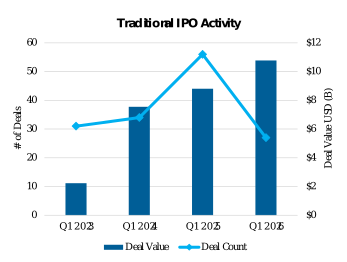
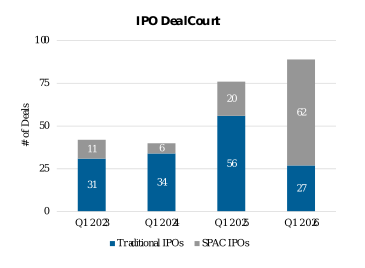
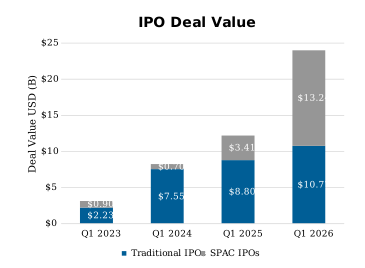
Traditional initial public offering (“IPO”) activity in Q1 2026 recorded the third-highest quarterly raise since 2021 with $10.8 billion priced. Although the proceeds from Q1 2026 IPOs were down from the highs of Q3 2025 and Q4 2025 by 35% and 20% respectively, they were up 22% from Q1 2025, continuing the consistent rise in first quarter proceeds since 2022. Despite this growth, deal volume was halved (down 52%) as compared to Q1 2025. With 27 IPOs in Q1 2026, the mixed results for deal value and volume in the quarter signals that IPOs are getting larger and more selective with an average of approximately $400 million raised per IPO.
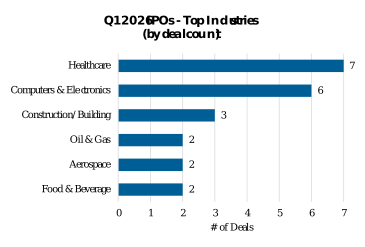
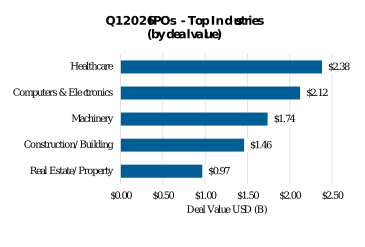
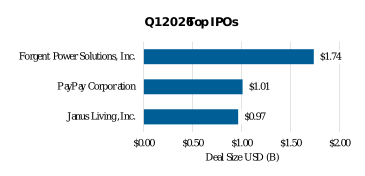
The healthcare and technology industries continued to top the charts in Q1 2026, continuing 2025’s trend. Healthcare IPOs raised $2.38 billion across seven IPOs, while technology IPOs raised $2.12 billion across six IPOs. Despite ranking the industry with the largest value and volume, the healthcare industry did not have an IPO in the top five; the second-highest IPO of the quarter bolstered the technology industry, making up nearly half of the aggregate value. The construction and machinery industries also made strong showings, with the construction industry ranking third by deal count and fourth by deal value and the machinery industry producing the largest IPO of the quarter, with the $1.74 billion raise of Forgent Power Solutions, a manufacturer of electrical distribution equipment.
SPAC IPOs
IPOs by special purpose acquisition companies (“SPACs”) in Q1 2026 strengthened the recent resurgence that started last year. $13.2 billion was raised across 62 SPAC IPOs, the highest quarter volume and value since 2021, with thirteen of the SPAC IPOs raising about $300 million or higher. Deal value and volume of SPAC IPOs have consistently increased since Q3 2025. Proceeds raised in Q1 2026 nearly quadrupled, and volume more than tripled, that of Q1 2025. Compared to Q4 2025, Q1 2026 was up 44% by value and 41% by volume.
Follow-Ons
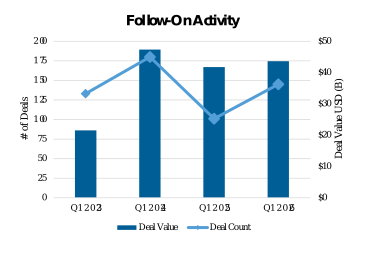
Follow-on activity increased in Q1 2026 compared to Q1 2025, up 44% by deal volume and 5% by deal value, with $43.6 billion raised across 145 offerings. Deal value was also up compared to last quarter (Q4 2025) by 25%, but deal count was down slightly (-9%). Overall, follow-on activity continues to hold strong, up 3% by volume and 17% by value from the average per quarter over the last three years.
Convertible Bonds
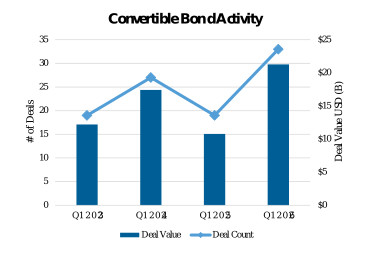
In Q1 2026, convertible bond offerings cooled slightly from the record levels of the last three quarters of 2025. Although Q1 2026 offerings were down by 35% and 13% by value and volume, respectively compared to Q4 2025, they were nearly double the value (+97%) and 1.75 times the volume (+74%) of Q1 2025. Q1 2026 was also the best first quarter since 2021 by both value and volume with $21.3 billion raised across 33 offerings, signaling that 2026 may well be a banner year for the convertible bond market.
Investment-Grade Debt
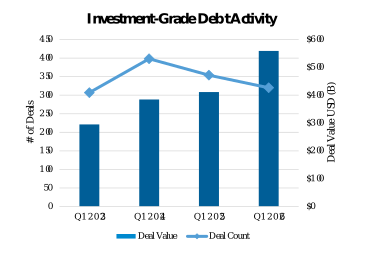
Investment-grade corporate bond offerings1 in Q1 2026 yielded the largest issuance in a quarter since Q2 2020, with nearly $560 billion in issuance, up 36% from last year (Q1 2025) and 72% from last quarter (Q4 2025). Volume was less impressive, down 10% from Q1 2025 to 320 issuances, continuing a trend of declining first-quarter volumes since Q1 2024. Volume was up, however, from Q4 2025 by 23% and above the average of 304 issuances per quarter over the last three years. Overall, the continued growth in investment-grade corporate bond issuance indicates continued strong demand for high-quality debt.
High-Yield Debt
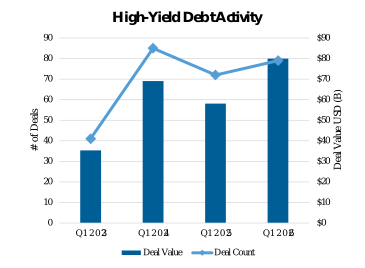
High-yield debt offerings increased in Q1 2026 compared to last year (Q1 2025), up 38% by value and 10% by volume, and were similarly up from last quarter (Q4 2025) by 38% by value and 36% by volume. With $80 billion of high-yield debt issued, Q1 2026 ranks second in deal value since Q3 2021 (behind Q3 2025 with $113 billion issued). Volume also held strong in Q1 2026 with 79 issuances, above the average of 73 per quarter over the last three years.
- Excludes short-term debt, convertibles, asset-backed securities, and mortgage-backed securities.
Contacts














Stay Up To Date with Ropes & Gray
Ropes & Gray attorneys provide timely analysis on legal developments, court decisions and changes in legislation and regulations.
Stay in the loop with all things Ropes & Gray, and find out more about our people, culture, initiatives and everything that’s happening.
We regularly notify our clients and contacts of significant legal developments, news, webinars and teleconferences that affect their industries.