
In This Edition
- SEC Staff Expands No-Action Relief for Retail Voting Programs
- SEC Proposes to Rescind Rule Requiring Companies to Include Shareholder Proposals in Their Proxy Statements
- SEC Proposes Updates to Proxy Solicitation Mechanics and Requirements
- SEC Takes Initial Step to Expand Accredited Investor Pathways for Individuals
- New SEC Guidance Expected to Prompt a Further Re-Evaluation of Investor Engagement with Issuers and External Organizations – Broader Than Just ESG
- SEC Staff Issues New Guidance on Shareholder Engagement and Schedule 13G Eligibility
- SEC Staff Discontinues No-Action Relief for Shareholder Proposals Indefinitely
- Nasdaq Proposes Broader Corporate Action Halts for 23/5 Trading
- Nasdaq Proposes $4 Minimum Initial Listing Price for Nasdaq Capital Market
- New $5 Million MVLS Continued Listing Requirement for Nasdaq Companies Stayed Pending SEC Review
- NYSE Proposes to Extend Transition Period for Listed Company Internal Audit Function to Five Years
- SEC Approves NYSE’s New Minimum Trading Price Standard: Immediate Delisting for Sub-$0.25 Stocks
U.S. Equity & Debt Markets Activity – Q3 2026
Covering developments as of October 7, 2026
SEC Developments
SEC Staff Expands No-Action Relief for Retail Voting Programs
THE BOTTOM LINE
- Broader reliance. Any issuer operating an issuer voluntary retail shareholder voting program (an “IVRVP”) in the same manner described in Tesla’s no-action request letter may rely on the Staff’s position, without obtaining its own no-action letter.
- A more complete roadmap. The relief gives issuers a more complete roadmap than the no-action relief the staff granted to Exxon Mobil Corporation in September 2025 for its retail voting program, covering seven federal proxy rules, including the provisions cited in post-Exxon challenges.
- More design flexibility. The framework contemplates centralized “Hubs,” householding and persistent account-level elections, and potentially offering the program to only some retail shareholders.
- Limits remain. The relief rests on the specific representations in Tesla’s letter and does not address compliance with other proxy rules or with state law. Issuers considering an IVRVP should confirm state law authority and closely track the framework’s features.
THE DETAILS
Overview
On September 29, 2026, the staff of the Division of Corporation Finance (the “Staff”) of the U.S. Securities and Exchange Commission (SEC) granted no-action relief to Tesla, Inc. (“Tesla”) for its proposed framework for issuer voluntary retail shareholder voting programs (each, an “IVRVP”) by public companies. Under an IVRVP, a participating retail shareholder may give a standing instruction to have its shares voted at each shareholder meeting in line with the recommendations of the issuer’s board of directors (a “standing instruction”).
The Staff stated that it will not recommend enforcement action in respect of Rules 14a-3(a), 14a-4(d)(2), 14a-4(d)(3), 14a-4(f), 14a-6(o), 14a-10, or 14a-12(a) under the Securities Exchange Act of 1934 (the “Exchange Act”) if Tesla implements the IVRVP as described in its no-action request letter. Significantly, the Staff added that its position applies to any issuer operating an IVRVP in the same manner described in Tesla’s letter.
The Tesla relief builds on, and is meaningfully broader than, the no-action relief the Staff granted to Exxon Mobil Corporation (“Exxon”) on September 15, 2025, for its retail voting program (the “Exxon RVP”). That no-action relief addressed only Rules 14a-4(d)(2) and 14a-4(d)(3), which generally prohibit a proxy from conferring authority to vote at more than one meeting. Tesla’s relief covers those two rules and also Rules 14a-3(a), 14a-4(f), 14a-6(o), 14a-10, and 14a-12(a). The framework proposed by Tesla also widens the program features available to issuers, including centralized “Hubs” for managing standing instructions, a “householding” opt-in across all of a shareholder’s accounts, and a persistent, account-specific opt-in.
The broader request appears designed, at least in part, to respond to rule-based objections raised after the Exxon letter. Following the Exxon relief, two shareholder advocacy organizations asked the Staff to reconsider and rescind that relief, arguing, among other things, that the standing proxy contravened Rule 14a-4(f) in addition to Rules 14a-4(d)(2) and (d)(3). Separately, two shareholder suits were filed, collectively alleging, among other things, that Exxon’s program invitation was an unlawful solicitation in violation of Rules 14a-3 through 14a-6, 14a-9 through 14a-12, and 14a-19. While Tesla’s no-action request letter did not seek relief for Rules 14a-3, 14a-4(a), (b), and (d)(1), 14a-5, 14a-6 (other than 14a-6(o)), 14a-9, 14a-11, and 14a-19, it, nonetheless, addressed Rules 14a-3, 14a-4(a), (b), and (d)(1), 14a-5, and 14a-6 (other than 14a-6(o)), stating its understanding that the Staff does not object to its views that those rules are inapplicable.
The discussion below summarizes the features the Tesla framework shares with the Exxon RVP, how it differs, the arguments Tesla advanced in support of relief, and the provisions for which Tesla did not seek relief.
Features in Common with the Exxon RVP
The core design of an IVRVP under the Tesla framework tracks the Exxon RVP. The key shared features relevant to issuers considering a retail shareholder voting program are as follows.
No fee: The program is available at no fee to participating retail shareholders, and opting out and overriding are likewise free.
Opt-in via standing voting instruction: Participation is voluntary. Retail shareholders must affirmatively opt in to the program by providing a standing instruction to vote their shares, on an ongoing basis, in accordance with the voting recommendations of the company’s board. Participants may choose to have the standing instruction apply to (1) all matters (“unqualified standing instructions”) or (2) all matters except contested director elections or any acquisition, merger, or divestiture transaction that requires shareholder approval under applicable state law or stock exchange rules (together with contested director elections, “special matters”) (“qualified standing instructions”).
Ability to opt out: Participants may opt out of the program and cancel their standing instruction at any time at no cost. Cancellation will, however, only apply to meetings for which the company has not yet filed a definitive proxy statement (i.e., future meetings).
Ability to override vote: Even though participants may only opt out of the program in relation to future meetings, they may at any time (and at no cost) override their standing instruction for any particular proposal or proposals by casting their vote using the proxy materials, identical to any other shareholder voting at that meeting.
Continuous receipt of proxy materials: Even after opting in to the program, participants will continue to receive all the company’s proxy materials for each meeting.
Annual reminders: Participants will receive at least annual reminders, during a period when the company is not soliciting votes, of their enrollment status, the standing instruction they selected, and their ability to opt out with respect to future meetings and to override their standing instruction.
Disclosure: The company will fully disclose the program and its features on its website and in its proxy statements, including the ability to override and opt out.
Filed program communications: Materials describing the program (and any material changes to them) (“program communications”) will be filed with the SEC under cover of Schedule 14A pursuant to Rule 14a-12.
Common communication channels: The company will communicate directly with registered owners, while banks, brokers, and plan administrators will communicate with beneficial owners via their shareholder communication service providers.
Voting Mechanics: The actual voting of shares under a standing instruction, and related administrative actions, will be facilitated by a vote processing agent. Votes are submitted after the company files its definitive proxy statement with the SEC and before that proxy statement is distributed to shareholders, and those votes are cast unless overridden by the shareholder. Information in the vote processing agent’s system relating to objecting beneficial owners stays within that system and will never be disclosed to the issuer as part of the program.
State law authorization: Each company represented that the granting of a standing instruction is permitted under the law of its state of incorporation—Texas for Tesla (supported by a legal opinion) and New Jersey for Exxon. Referring to Section 212(b) of the Delaware General Corporation Law, the Exxon letter also notes that Delaware law permits standing instructions.
Meetings only: The programs cover voting at duly called annual or special meetings, not corporate actions taken by shareholder written consent.
How an IVRVP Differs from the Exxon RVP
Special Matter Reminders
Under the Exxon RVP, additional reminders similar to the annual reminders on enrollment status are required to be provided, ahead of meetings involving special matters, to participants that provided unqualified standing instructions. Under an IVRVP, those additional reminders will be provided to all participants prior to such meetings.
Additional Options Available to Issuers
The Tesla framework permits, but does not require, several features that were not part of the Exxon RVP. Tesla submitted that none of its analysis would differ if these options were offered.
Retail Shareholder Eligibility: While the Exxon RVP is available to all retail shareholders, except investment advisers exercising voting authority with respect to client securities, a company will have the option to make its IVRVP available to all retail shareholders or only to some retail shareholders. Unlike the Exxon no-action relief response letter, the Tesla response letter does not recite an exclusion for registered investment advisers exercising voting authority over client securities, although it states that it expresses no views on compliance with the Investment Advisers Act of 1940 or the Investment Company Act of 1940.
Hubs: Providers of shareholder communication services may host centralized management hubs for standing instructions (“Hubs”). A Hub may offer beneficial owners the opportunity to opt in to a specific issuer’s qualifying IVRVP, or to all qualifying IVRVPs established by issuers whose shares are in their accounts. Through a Hub, retail investors will be able to access each participating issuer’s filed program communications, and each issuer must still file its program communications under Rule 14a-12(b) notwithstanding its participation in a Hub.
Enrollment opportunities: Once a Hub is established and program communications are filed, retail investors may be offered the chance to participate when or shortly after they first become shareholders, or at any later time while the IVRVP is maintained.
Householding/all-accounts option: An issuer may allow a retail shareholder to give a standing instruction covering all of the issuer’s shares held in all accounts under the shareholder’s name from time to time, permitting a unified voting strategy across accounts.
Persistent particular-account elections: An issuer may allow a standing instruction to apply to a particular account from time to time, so that a shareholder who temporarily exits its position and later reacquires the issuer’s securities need not opt in again. Shareholders who select the persistent-account option will receive a notification, after reacquiring the issuer’s securities but before votes are cast for the next applicable meeting, that their votes will be submitted under their pre-existing standing instruction.
The Case for No-Action Relief
Tesla put forward the following arguments in making its case for relief. In general, it emphasized that participants retain the protections of the federal proxy rules for every meeting, with the overriding theme being that overrides and cancellation preserve each participant shareholder’s voting choice for each meeting.
Rules 14a-3(a), 14a-6(o), and 14a-12(a): Rule 14a-3(a) generally prohibits a solicitation before a proxy statement is furnished, while Rule 14a-12(a) permits a solicitation before a proxy statement is furnished if specified conditions are met, and Rule 14a-12(b) requires soliciting material to be filed no later than the date it is first used. Tesla argued that an IVRVP affords protections “generally consistent with” those the SEC contemplated in adopting Rule 14a-12. Program communications will be filed under cover of Schedule 14A pursuant to Rule 14a-12(b) no later than first use; will tell shareholders where to find more information about the IVRVP (including the issuer’s role) via linked website disclosure; will carry a prominent legend directing shareholders to read the proxy statement when available; and will not obtain votes on specific proposals. A definitive proxy statement will also continue to be provided before or with the proxy card for each vote. Tesla submitted that, taken together, these safeguards strike the balance the SEC sought in Rule 14a-12 and achieve the intent of Rule 14a-6(o), which requires that solicitations before providing a proxy statement must be made in accordance with Rule 14a-12.
Rule 14a-4(f): Rule 14a-4(f) prohibits delivering “a form of proxy, consent or authorization” unless the holder has concurrently or previously received a definitive proxy statement. Tesla argued that this phrase should be read consistently with “form of proxy” in Rules 14a-4(a) and (b). Under that reading, Tesla opined that a standing instruction is not covered because it does not address specific matters; it only sets a default voting position for future meetings, which can be overridden for any meeting or matter and canceled at any time at no cost. In any event, Tesla noted, program communications will be filed under Rule 14a-12(b), and, before each meeting, compliant proxy cards will be delivered with or after a definitive proxy statement and will allow shareholders to override their standing instructions. As a result, standing instructions do not raise the concerns that Rule 14a-4(f) was designed to address.
Rules 14a-4(d)(2), 14a-4(d)(3), and 14a-10: Citing SEC releases, Tesla noted that Rule 14a-4(d)(2) was intended “to prevent the premature solicitation of proxies at a time when material information has not yet become available,” and that Rule 14a-4(d)(3) codified related interpretations. Tesla argued that participants are protected by receipt of proxy materials for each meeting; the ability to override by voting on each item on a compliant proxy card; at least annual reminders; free cancellation for future meetings; and filed, legended program communications. Because standing instructions do not “lock in” the proxy or the vote, Tesla argued, they provide the protections these rules were designed to provide and do not constitute an undated or postdated proxy under Rule 14a-10(a) or a proxy deemed dated after signing under Rule 14a-10(b). Exxon had made a related argument for Rules 14a-4(d)(2) and (d)(3), reasoning that a participant’s choice to leave its instruction in place is “a reaffirmation or renewal” of the instruction.
Provisions for Which No-Action Relief Was Not Sought
Tesla identified several rules for which it did not seek relief, stating its understanding that the Staff does not object to its views. The Staff’s no-action letter does not separately address these views and expressly declines to express views on compliance with other provisions of the federal proxy rules. Tesla expressed the following views on those rules:
- Rule 14a-3(b). Because Rule 14a-3(b) applies only when a proxy statement is furnished under Rule 14a-3(a), Tesla viewed it as inapplicable to standing instructions and program communications.
- Rules 14a-4(a) and (b). These rules prescribe the content of a “form of proxy.” Tesla’s position is that standing instructions are not “forms of proxy” because they do not address specific matters to be acted upon but rather set default positions that can be overridden or canceled. Tesla further noted that meeting-specific proxy cards complying with these rules will be delivered with or after the definitive proxy statement before each meeting.
- Rules 14a-4(d)(1). A standing instruction should not be considered a proxy conferring authority “to vote for the election of any person to any office for which a bona fide nominee is not named in the proxy statement.”
- Rules 14a-4(d)(4). A standing instruction should not be considered a proxy conferring authority “to consent to or authorize any action other than the action proposed to be taken in the proxy statement.”
- Rule 14a-5 and Rule 14a-6 (other than Rule 14a-6(o)). Neither standing instructions nor program communications are proxy statements; program communications will instead be filed under Rule 14a-12(b) with appropriate legends.
SEC Proposes to Rescind Rule Requiring Companies to Include Shareholder Proposals in Their Proxy Statements
THE BOTTOM LINE
- The SEC has proposed rescinding Exchange Act Rule 14a-8, the SEC’s shareholder proposal rule. Rule 14a-8 governs when companies must include shareholder proposals in proxy materials. The predecessor to Rule 14a-8 was adopted by the SEC in 1942.
- If adopted, the recission would substantially change the landscape for shareholder engagement and activism. The proposal follows recent changes in the SEC staff’s approach to engaging in disputes regarding whether companies are permitted to exclude shareholder proposals.
- The SEC’s primary argument is that the rule exceeds its statutory authority under Section 14(a) of the Exchange Act by improperly intruding into matters of state law.
- The SEC also cites policy reasons for rescission: the rule’s original justifications are less compelling today, the rule has had unintended consequences, and retaining any version of it is unwarranted.
- Relatedly, the SEC has also proposed amending Exchange Act Rule 14a-4(c)(2) to expand the circumstances when companies may exercise discretionary voting authority on proposals submitted outside the Rule 14a-8 process, while allowing shareholders to opt out.
THE DETAILS
Overview
On September 16, 2026, the SEC issued a rule proposal proposing to rescind Exchange Act Rule 14a-8, the SEC’s shareholder proposal rule that governs when a company must include a shareholder proposal in its shareholder meeting proxy statement and proxy form, arguing primarily that the rule exceeds the SEC’s statutory authority under Section 14(a) of the Exchange Act “by improperly intruding into State law without express authorization from Congress,” while also advancing policy reasons for the proposed rescission of the rule. The predecessor to Exchange Act Rule 14a-8 was adopted by the SEC in 1942.
The proposal comes just a little over a month after the SEC’s Division of Corporation Finance (the “Division”) announced that it will entirely discontinue its practice of responding to no-action requests by companies seeking to exclude shareholder proposals from their proxy statements and 10 months after the Division suspended substantive responses to most of such no-action requests. The proposal also comes after several speeches by SEC Chair Atkins challenging Exchange Act Rule 14a-8 (“Rule 14a-8”), notably his July 9, 2026 remarks at a conference by the Society for Corporate Governance, where, referring to Rule 14a-8, he stressed that he maintained his “conviction that the [SEC]’s authority to prescribe rules ‘in the public interest’ is not plenary” emphasizing that “[g]overnment agencies may not add to their powers by adverse possession; longevity is not a substitute for legal authority.”
In connection with, but also independent of, the Rule 14a-8 rescission proposal, the SEC, in the same proposing release (the “Proposing Release”) is also proposing to amend Exchange Act Rule 14a-4(c)(2) to expand the circumstances under which a company may exercise discretionary voting authority on shareholder proposals omitted from the company’s proxy materials, while also providing shareholders with avenues to prevent the company from exercising such authority with respect to their individual shares.
The public comment period for the proposals will last until November 20, 2026.
The SEC’s Case for Rescission – Rule 14a-8 Exceeds SEC Authority
Section 14(a) of the Exchange Act makes it unlawful “to solicit any proxy or consent or authorization in respect of any security” “in contravention of such rules and regulations as the [SEC] may prescribe as necessary or appropriate in the public interest or for the protection of investors.” The SEC’s position is that Section 14(a) only gives the SEC the authority to regulate “proxy solicitation . . . which encompasses the manner in which that solicitation is made (e.g., the timing and form of proxy) and the information that the soliciting party must disclose in the request,” but not the authority to regulate the scope of the voting rights shareholders may have under state law, such as the right to propose a matter for a shareholder vote. According to the SEC, through several amendments over time, the SEC has increasingly assumed responsibility for defining and interpreting standards that implicate core state law concepts of governance, with the result that Rule 14a-8, including its eligibility and procedural requirements, “has come to operate not as a procedural mechanism to facilitate shareholders’ rights under State law through the proxy process, but as a substantive Federal overlay that improperly intrudes into matters of State law by dictating that companies include (or allowing them to exclude) certain shareholder proposals in the companies’ proxy materials.” Further noting that “by establishing standards not found in State law for whether a shareholder proposal must be included in a company’s proxy materials, the [SEC] effectively dictates the scope of shareholder voting rights.” The SEC’s position is that Section 14(a) does not authorize such an intrusion.
The SEC’s Case for Rescission – Policy Reasons for Rescission
In further support of rescinding Rule 14a-8, the SEC advanced three policy reasons for rescinding the rule. The SEC believes that:
- many of the justifications that were originally provided to support adoption of the rule either have not been substantiated in practice or are less compelling today—the SEC notes in the Proposing Release that “the rule was adopted with the understanding that (i) the cost to companies to include shareholder proposals in their proxy materials was “small”; (ii) many proposals were either already supported by management or received meaningful shareholder support; (iii) the overall volume of proposals was low; and (iv) the rights of shareholders to present certain matters for a vote to their fellow shareholders under State law was reasonably clear”;
- the rule has had, and will continue to have, certain unintended consequences—the SEC hinges this on three grounds: (i) the rule influences interactions between companies and shareholders in ways that are inconsistent with the rule’s original purpose; (ii) the rule forces the SEC to make judgments about the application of state law that are best left to state legislatures, courts, and, if permitted by applicable state law, companies; and (iii) the rule has inhibited the development of state law and private ordering. In his separate statement, Commissioner Uyeda expanded on these considerations, stating that “Rule 14a-8 has been co-opted to advance the agendas of various political interests—acting without any fiduciary duty to a corporation or its shareholders—at the expense of the millions of investors that directly and indirectly own public companies. These political interests use Rule 14a-8 as leverage in order to achieve objectives that often are not materially relevant to a public company”; and
- retaining any version of the rule is unwarranted and unlikely to avoid these unintended consequences.
Proposed Amendments to Rule 14a-4(c)(2)
The SEC is proposing to amend Exchange Act Rule 14a-4(c)(2) (“Rule 14a-4(c)(2)”) to allow companies to exercise discretionary voting authority with respect to timely received shareholder proposals for annual meetings that are submitted outside the Rule 14a-8 process even where the shareholder proponent delivers its own proxy materials to holders of the requisite percentage of the company’s shares necessary to carry out the proposal, provided that the shareholder giving the company proxy has not opted out of granting that discretionary voting authority. To exercise such discretionary voting authority, the proposal would require companies to (i) include in the proxy statement a brief description of the proposal and how the company intends to exercise its voting discretion on it, and (ii) include in the proxy form, a cross-reference to that description and a box shareholders can use to opt out from the company’s exercise of that discretion on their behalf. The SEC notes in the Proposing Release that, while the proposed amendments are intended to align with the proposed rescission of Rule 14a-8 as companies may receive shareholder proposals more frequently outside of Rule 14a-8, there are independent justifications for the proposed amendments even if Rule 14a-8 were to be retained. According to the SEC, the proposed amendments are intended to provide companies with greater flexibility to seek and obtain discretionary authority regarding such shareholder proposals while providing shareholders with the option to prevent the company from exercising such authority with respect to their individual shares.
Under current Rule 14a-4(c)(2), a company is not allowed to exercise discretionary voting authority with respect to a timely received shareholder proposal for an annual meeting that is submitted outside the Rule 14a-8 process if the proponent solicits the requisite percentage of the company’s shareholders required to carry the proposal and satisfies certain other conditions, including providing the company with a timely written statement of the proponent’s intention to make such a solicitation through a proxy statement. In such situations, the company’s only option would be to include the shareholder proposal in its proxy card to enable it to obtain direct (as opposed to discretionary) voting authority from shareholders, a practice among companies that has become increasingly more common since the adoption of the universal proxy rules, according to the SEC. Retaining Rule 14a-4(c)(2) in its current form, the SEC says, would effectively allow proponents to have their proposals included on a company’s proxy card at the company’s expense, even if Rule 14a-8 is rescinded, and would be counter to the SEC’s goal of leaving decisions about including shareholder proposals in company proxy materials to the states and companies.
Practical Implications for Proposed Rescission of Rule 14a-8—If Adopted, as Proposed
No Federal Obligation to Include Shareholder Proposals in Proxy Materials. Whether a shareholder proposal must be included in a company’s proxy materials would be determined solely by state law and, where state law permits, by the company’s own charter and bylaw provisions.
A Regulatory Vacuum and Prolonged Transition Period. As state law is often silent or ambiguous about what matters may be presented for a shareholder vote, companies would need to make decisions about whether to include or exclude shareholder proposals without clear and settled legal requirements, and this transition period could extend for several years and may be associated with elevated litigation costs as disputes over whether particular proposals are “proper subjects” for shareholder action under state law increase.
SEC Proposes Updates to Proxy Solicitation Mechanics and Requirements
On September 16, 2026, the SEC proposed amendments to its proxy solicitation rules that are intended to reduce costs and eliminate requirements that the SEC believes are outdated and unnecessary.
The SEC issued this proposal on the same date as a separate proposal to rescind Exchange Act Rule 14a-8, which governs the shareholder proposal process, and which proposal we discuss above.
THE BOTTOM LINE
- The proposal would amend the timing rules for broker searches, shortening the required period from at least 20 business days before the record date to at least five business days before the record date.
- The proposal would eliminate requirements to:
- deliver a proxy statement at least 20 business days prior to the meeting if information is incorporated by reference;
- deliver an annual report even if the registrant’s most recent Annual Report on Form 10-K has already been filed with the SEC (currently often satisfied through use of a “wrapped” Form 10-K or a “glossy” annual report); and
- file notices of exempt solicitation.
THE DETAILS
Changes to the Broker Search Rules
Exchange Act Rule 14a-13 currently requires registrants to inquire of brokers, dealers, banks, and other nominees regarding the beneficial owners of securities held in street name so that proxy materials may be forwarded to those owners. Currently, the inquiry must be made at least 20 business days prior to the record date for an annual meeting and, if practicable, at least 20 business days prior to the record date for a special meeting. If it is not practicable to conduct the broker search 20 business days before the record date of a special meeting, the current rule requires that it be conducted “as many days before the record date of such meeting as is practicable.”
The proposal would require that the broker search be conducted at least five business days prior to a record date, rather than 20 business days. Registrants would retain the ability to use a shorter period for special meetings if the five-business day period is not practicable.
The proposed amendment is directionally consistent with an interpretive position taken earlier in 2026 by the SEC’s Division of Corporation Finance. In CFI 133.02 regarding the Proxy Rules and Schedules 14A/14C, dated January 23, 2026, and available here, the staff stated that it would not object if a registrant conducts its broker search fewer than 20 business days before the record date, provided that the registrant reasonably believes proxy materials will be disseminated to beneficial owners on a timely basis and otherwise complies with Rule 14a-13. Unlike the proposal, however, the staff interpretation does not specify a particular minimum number of business days.
Elimination of the Delivery Deadline When Documents Are Incorporated by Reference
Note D.3 to Schedule 14A currently requires that, when specified information is incorporated by reference into a proxy statement, the proxy statement must be sent to security holders at least 20 business days prior to the date of the meeting or the date on which the relevant action may be taken. Parallel timing requirements exist in Forms S-4 and F-4 for registered business combination transactions. The proposal would delete Note D.3 and the corresponding Form S-4 and Form F-4 provisions.
The SEC noted that the 20-business day advance delivery requirement was adopted at a time when investors needed additional lead time to obtain incorporated documents, but that the widespread availability of filings through EDGAR, the SEC’s electronic filing system, has made this requirement unnecessary.
Elimination of the Separate Annual Report Requirement
Under current Exchange Act Rule 14a-3(b), a registrant soliciting proxies for a meeting at which directors are to be elected must generally cause an annual report to security holders to accompany or precede the proxy statement. The proposal would eliminate both the delivery requirement and the obligation to prepare a separate annual report to security holders if the registrant’s most recent Annual Report on Form 10-K has been filed with the SEC (registrants that have not filed a Form 10-K for the relevant period would still be required to produce an annual report along with their proxy). As a result, registrants would no longer need to produce a “wrapped” Form 10-K or “glossy” annual report that includes the few disclosure items not required in Form 10-K itself. Registrants that prefer to distribute a separate annual report would retain the option to do so and must file the annual report on EDGAR in that case.
Relatedly, the proposal would eliminate the stock performance graph required by Item 201(e) of Regulation S-K for registrants other than investment companies and business development companies (one of the few items often included in a “wrapped” Form 10-K that is not required to be included in the Form 10-K itself).
Elimination of the Notice of Exempt Solicitation Requirement
Exchange Act Rule 14a-6(g) currently requires any person who beneficially owns more than $5 million of the class of securities that is the subject of a solicitation and engages in certain written solicitations exempt under Exchange Act Rule 14a-2(b)(1) to furnish a Notice of Exempt Solicitation to the SEC. The proposal would rescind Rule 14a-6(g), eliminating the requirement to furnish the notice. The proposal would also eliminate the ability to voluntarily furnish notices of exempt solicitation, which certain market participants have used as a means of publicizing their views on matters subject to a shareholder vote. This aspect of the proposal is consistent with a staff interpretive position set forth in CFI 126.06 regarding the Proxy Rules and Schedules 14A/14C, dated January 23, 2026, and available here, in which the staff stated that it would object to the filing of voluntary notices of exempt solicitation.
SEC Takes Initial Step to Expand Accredited Investor Pathways for Individuals
THE BOTTOM LINE
- The SEC is seeking public comment on the following six new ways it is considering for individuals to qualify as “accredited investors” based on professional credentials or a proposed examination, rather than net worth or income:
- a license as a U.S. Certified Public Accountant (CPA);
- a charter as a Chartered Financial Analyst (CFA);
- certification as a Certified Financial Planner (CFP);
- the FINRA Investment Banking Representative License (Series 79);
- the FINRA Research Analyst License (Series 86 and 87); and
- passing a new accredited investor exam to be developed by FINRA.
THE DETAILS
Overview
On September 30, 2026, the SEC issued notices seeking public comment on six new ways it is considering for individuals to qualify as “accredited investors” based on professional credentials or a proposed examination, rather than net worth or income. The notices were issued under Rule 501(a)(10) under the Securities Act of 1933 (the “Securities Act”), which was adopted by the SEC in 2020 and allows the SEC to designate professional certifications, designations, or credentials that qualify a natural person holding them in good standing as an accredited investor, after notice and an opportunity for public comment. The public comment period will last until December 4, 2026.
The accredited investor definition is the “cornerstone” of Regulation D, which lets companies raise capital in private offerings without registering them under the Securities Act. For individuals, the definition has long rested mainly on financial thresholds, notwithstanding the adoption of Rule 501(a)(10). In general, an individual qualifies with net worth over $1 million (excluding the primary residence) or annual income over $200,000 ($300,000 jointly with a spouse or spousal equivalent) in each of the two most recent years, with a reasonable expectation of the same in the current year.
At the time of Rule 501(a)(10)’s adoption, the SEC designated three examinations administered by the Financial Industry Regulatory Authority (FINRA)—FINRA Series 7 (General Securities Representative Qualification Examination), Series 82 (Private Securities Offerings Representative Qualification Examination), and Series 65 (Uniform Investment Adviser Law Examination)—as qualifying credentials for accredited investor status for individuals.
If adopted by the SEC, the designations, which are aimed at expanding the access of individual investors to private securities offerings (especially offerings by private companies), would be the first expansion of the credential-based pathway since the SEC’s initial 2020 designations.
The Proposed Designations
The notices cover the following pathways, each of which would need to be held in good standing:
- a license as a U.S. Certified Public Accountant (CPA);
- a charter as a Chartered Financial Analyst (CFA);
- certification as a Certified Financial Planner (CFP);
- the FINRA Investment Banking Representative License (Series 79) and the FINRA Research Analyst License (Series 86 and 87), which are addressed in a single notice, but would each independently qualify a holder; and
- passing a new accredited investor exam to be developed by FINRA.
Each notice defines “good standing” by reference to the credentialing body’s own standards. In every case, a credential holder would qualify only for their own account and could not rely on that status to buy securities on behalf of another person.
The FINRA Accredited Investor Exam
The proposed exam is the most novel part of the package. It would be open to anyone age 18 or older. Any investor could opt in to accredited investor status by passing it. Candidates would not need to be associated with a FINRA member firm, and passing the exam would not qualify anyone for FINRA registration. The exam is still being developed, however. The notice’s description reflects what FINRA staff currently anticipate and could change. Based on the notice:
- Format: The exam would be modeled largely on FINRA’s Securities Industry Essentials (SIE) exam, with about 75 multiple-choice questions to be completed in about two hours.
- Cost: The fee is expected to be similar to the SIE fee, which is currently $100.
- Topics: Planned topics include definitions and structures of securities, investment risks, disclosure and regulatory requirements, financial statements, conflicts of interest, and corporate governance. Investment risks would carry the heaviest weighting, at 20% to 28% of exam items. The exam would specifically cover exempt offering structures, such as Regulation D, Regulation A, Regulation Crowdfunding, and SAFEs, as well as liquidity, dilution, and leverage risks.
- Administration and verification: FINRA would create and administer the exam, with delivery by a third-party vendor. FINRA would also develop a process for issuers and others to independently verify whether a person has passed, the date of passage, and when the 10-year validity period ends.
- Duration: Passing the exam would confer status for 10 years. After that, an individual would need to pass it again or qualify under another prong of the definition.
The SEC is specifically requesting comment on the exam itself, including its content, format, administration, result verification, fees, and validity period, and will share those comments with FINRA.
New SEC Guidance Expected to Prompt a Further Re-Evaluation of Investor Engagement with Issuers and External Organizations – Broader Than Just ESG
Introduction
On October 7, 2026, the SEC issued a report of investigation (the “Report”) addressing when engagement with multistakeholder initiatives may cause investors to be treated as a “group” under Section 13(d) of the Exchange Act or lose eligibility to report their beneficial ownership on the shorter-form Schedule 13G, rather than the longer and more detailed Schedule 13D, and rely on an exemption from Section 16 of the Exchange Act. It is the first such report issued by the SEC in nearly eight years. Although the SEC decided not to bring an enforcement action (in light of the lack of evidence supporting such an action), it indicated that it “has serious concerns about the conduct of CA100 members and other participants” described in the Report.
This is the latest in a series of recent SEC actions reshaping engagement between issuers and shareholders, including, but not limited to, in connection with ESG-related matters. Those developments include, among others, the staff’s guidance on shareholder engagement published in February 2025 and the SEC’s recent proposal to rescind the rule requiring companies to include shareholder proposals in their proxy materials, which we discuss above.
The Report’s novel (and untested) reading of the applicable rules governing beneficial ownership leaves potential implications for investors to bear in mind going forward.
Key Takeaways
- Many institutional investors are likely to re-evaluate engagement with some ESG-focused and other multistakeholder initiatives. The Report focuses on Climate Action 100+ (CA100) and Ceres, but extends to “any initiative, enterprise, association, foundation, society, agency, syndicate, or similar group of persons that combine for the purpose or effect of changing or influencing control at a specific issuer.” Importantly, the SEC clarifies in a footnote that the organizations covered by the Report do not include “groups that do not pressure, negotiate, or otherwise introduce recommendations or proposals that have the purpose or effect of changing or influencing control at specific issuers, including trade associations and public advocacy groups.”
Issuer-specific engagement is a touchstone of the guidance. Organizations that publish broad principles without identifying or targeting particular companies should pose less risk than those seeking change at identified companies.
The Report focuses on climate-related issues, but its principles would apply equally to efforts addressing other topics at a specific issuer.
Some investors may be prompted by the SEC’s interpretation to adjust their engagement with specific external organizations and their related messaging, as well as enhance their internal recordkeeping, to mitigate enforcement risk. It also is likely that some investor-focused organizations will proactively reframe their messaging, policies, and practices to align with the Report.
The SEC provides a new interpretation of “ordinary course of business.” Many institutional investors file a Schedule 13G as qualified institutional investors (QIIs) and rely on a parallel exemption from Section 16 of the Exchange Act. In order to file a Schedule 13G as a QII and rely on that exemption from Section 16, the relevant securities must be acquired and held “in the ordinary course of the person’s business and not with the purpose nor with the effect of changing or influencing the control of the issuer, nor in connection with or as a participant in any transaction having such purpose or effect.” As the Report notes, the SEC has never defined, and has issued only limited guidance addressing, the phrase “ordinary course of business,” generally leaving the determination to the QII’s own judgment and the surrounding facts. The Report includes new views on that requirement, stating that:
Index funds typically have mandates limited to tracking the financial performance of a designated benchmark. A manager of an index fund that directs the acquisition, disposition, and voting of securities held by the fund should therefore carefully evaluate whether joining a coordinated effort or initiative unrelated to the fund’s benchmark performance, including through participation in an intermediary-driven organization such as CA100, aligns with Rule 13d-1(b)’s “ordinary course” requirement.
Although directed at index funds and external organizations, this interpretation may raise concerns that any fund engaging on topics not specifically identified in its mandate could be viewed as acting outside its ordinary course and lose eligibility to file as a QII and exemption from Section 16. Institutional investors should consider how the rationale for engagement with issuers is expressed and documented.
Engagement through an external organization can raise control-intent concerns. The Report discusses when, in the SEC’s view, engagement with external organizations may call into question whether an investor is acting with the purpose or effect of changing or influencing control of an issuer. It is clear that engagement with efforts to change the composition of a board of directors at any issuer presents substantially heightened risk that an investor will become ineligible to use Schedule 13G. However, the Report is clear that efforts on other topics may also be seen to impact eligibility to file on Schedule 13G, stating that:
Even in the absence of a board refresh initiative, a QII’s eligibility to report on Schedule 13G may be called into question when the investor joins an organization—such as CA100—that engages on specific issuers and targets specific management or policy outcomes. Membership in such an organization, coupled with commitments to the organization’s objectives and actions undertaken in support of them, can demonstrate that the securities are being held with a purpose or effect of changing or influencing control.
Group formation and Schedule 13G eligibility are separate questions: an investor can lose Schedule 13G eligibility even if no group forms. Conversely, an independently determined vote for an activist’s nominees, without more, does not itself cause loss of Schedule 13G eligibility.
While broadly consistent with the February 2025 staff guidance, the Report extends that guidance by making clear that engagement through external organizations—not just direct engagement with an issuer—may be considered evidence of an intent to influence management.
The Report reiterates that disclaimers alone are insufficient if actual conduct suggests coordination or control intent.
- A group can be established through circumstantial evidence. The Report emphasizes the SEC’s position that the existence of a group “is a factual question that can be demonstrated through circumstantial evidence.” It further states that “[c]ertain CA100 members voting in alignment following CA100 ‘flagging’ a vote and working to influence its members’ votes may constitute circumstantial evidence of an ‘agreement, arrangement, understanding, or concerted action’” and that “[s]uch coordination may occur through organized engagement efforts, evaluative frameworks that the members have agreed upon, and harmonization of its members’ voting decisions on specific matters presented at an issuer’s shareholder meetings.”
The Report reiterates guidance that “parallel actions that arise from independent decision-making” and simply having aligned interests do not, without more, result in the creation of a group. It will continue to be important for investors to establish a record that decisions were made and any actions taken independently rather than as part of a coordinated effort.
Investors that beneficially own 5% or less of a class of Exchange Act registered voting equity securities of an issuer would nonetheless have reporting obligations under Section 13(d) or Section 13(g) of the Exchange Act if they are deemed to be part of a “group” that in the aggregate beneficially owns more than 5%. Investors can also become subject to Section 16 if they are part of a group that in the aggregate beneficially owns more than 10%. As a result, the Report is likely to prompt even many smaller investors to re-evaluate their policies around engagement with external organizations.
- Membership dues and contributions may trigger proxy disclosure obligations. The Report also discusses contributions to external organizations, specifically addressing membership dues paid to Ceres. The Report notes that “it appears Ceres’ use of those funds was not restricted” and goes on to assert that if contributions “were channeled through CA100 or Ceres and used to support” a proxy solicitation, contributing investors may have become participants whose identities must be disclosed to remain in compliance with Section 14(a) of the Exchange Act.
The Report does not expressly address whether an investor intended, or even knew about, the ultimate use of its contribution to support a proxy solicitation, or whether such funds were in fact used for solicitation. It is possible those factors would be relevant. However, absent further guidance, some investors may consider restricting how membership dues and contributions may be used, or obtaining further clarity from the external organization.
Next Steps
The Report makes clear that the SEC views joining an organization, together with related commitments or conduct, as providing potential circumstantial evidence of “group” formation, or of control intent or acting outside the ordinary course of business that results in a loss of Schedule 13G eligibility and the related exemption from Section 16 of the Exchange Act. The Report is therefore likely to prompt many institutional investors to further re-evaluate policies and practices for engagement with external organizations, including public statements and commitments (especially with respect to specific issuers), and the use of their dues and contributions. At a more fundamental level, some institutional investors may reconsider their participation in some external organizations.
The Report is likely to draw harsh criticism from some constituencies as inconsistent with the applicable securities laws and perhaps the First Amendment, and there may be some investors that seek to goad the SEC into enforcement to be able to mount a challenge to the position taken by the SEC in the Report. Other institutional investors may try to manage just below the radar screen for the next two years, waiting things out until there is clarity on the policies of the next administration.
In the meantime, institutional investors should review all of their organizational commitments – not just those mentioned in the Report or that are ESG-focused – and make sure they understand how those organizations’ activities and the investors’ related practices fit within the framework of the Report. Investors also should consider how to position and document their engagements to demonstrate independent decision-making rather than coordinated efforts, that any engagements are consistent with the mandates of their funds and taken in the “ordinary course” of their activities, and that there is an absence of efforts aimed at influencing control.
SEC Staff Issues New Guidance on Shareholder Engagement and Schedule 13G Eligibility
On September 2, 2026, staff of the SEC Division of Corporation Finance issued new guidance in the form of three new Corporation Finance Interpretations (CFIs) to clarify the effect of certain shareholder engagement scenarios on investors’ eligibility to report their beneficial ownership of an issuer’s securities on short-form Schedule 13G as passive or institutional investors rather than on long-form Schedule 13D. The new guidance expands on the staff’s February 2025 guidance, which we discussed here. In the February 2025 guidance, the staff outlined circumstances where Schedule 13G may be unavailable to an investor due to engagement that transcends the discussion of a topic to exerting pressure on management to implement specific measures or changes to a policy.
In the new CFIs, the staff clarified that:
- in general, a shareholder’s participation in a discussion (i) initiated by the issuer itself or (ii) in response to an issuer’s request to understand why the shareholder voted in a certain manner at a past shareholder meeting would not, by itself, make the shareholder ineligible to use Schedule 13G as such a discussion is less likely to be viewed as an attempt by the shareholder to “influence” control of the issuer;
- a shareholder’s discussion with a person engaged in a proxy solicitation about the shareholder’s views on a particular topic and how those views could inform its voting decisions would not, by itself, disqualify the shareholder from using Schedule 13G; and
- a shareholder would not lose Schedule 13G eligibility solely because it engages with an issuer to better understand the issuer’s disclosures or other public communications.
SEC Staff Discontinues No-Action Relief for Shareholder Proposals Indefinitely
On August 14, 2026, the SEC Division of Corporation Finance (the “Division”) announced that it will no longer respond to any no-action requests by companies seeking to exclude shareholder proposals from their proxy materials under Exchange Act Rule 14a-8, the SEC’s shareholder proposal rule, including requests—under Rule 14a-8(i)(1)—that a shareholder proposal is not a proper subject for shareholder action under state corporate law.
The announcement, which the Division indicated would operate indefinitely, follows the Division’s November 2025 statement that it would not substantively review or respond to any such no-action requests, other than those grounded on Rule 14a-8(i)(1), during the 2025-2026 proxy season (October 1, 2025 – September 30, 2026), as we discussed here. In its November 2025 statement, the Division had also stated that it would provide a non-substantive “no-objection” response on no-action requests not based on Rule 14a-8(i)(1) if a requesting company includes in its request a representation that it has a reasonable basis to exclude the proposal based on the provisions of Rule 14a-8, prior published guidance, and/or judicial decisions. The Division made clear in its August 14 announcement that it would also no longer issue those non-substantive “no-objection” responses.
According to the Division, its decision to indefinitely discontinue responding to all shareholder proposal no-action requests stems from its need to “focus Division resources on the review of Securities Act and Exchange Act filings” and is in light of “the extensive body of guidance from the [SEC] and the staff available to both companies and proponents on Rule 14a-8.”
Notwithstanding the Division’s latest stance, companies intending to exclude shareholder proposals from their proxy materials must, however, still notify the SEC and proponents no later than 80 calendar days before filing a definitive proxy statement, as required by Rule 14a-8(j).
As we discuss elsewhere in this newsletter, following the Division’s action, on September 16, 2026, the SEC issued a rule proposal proposing to rescind Rule 14a-8.
Nasdaq Developments
Nasdaq Proposes Broader Corporate Action Halts for 23/5 Trading
In preparation for its plan to operate on a 23 hours a day, five days a week trading schedule (“23/5 trading”), Nasdaq has proposed amending its rules to extend its existing mandatory regulatory halt framework for reverse stock splits to additional corporate actions affecting securities for which it is the primary listing market. Under 23/5 trading, Nasdaq’s nontrading window will shrink to a one-hour pause from 8:00 p.m. to 9:00 p.m. ET, primarily intended for maintenance, eliminating the substantial overnight window (from 8:00 p.m. – 4:00 a.m. ET) now available for corporate action processing.
Under Nasdaq’s proposal, halts for covered corporate actions would commence during the one-hour nontrading pause on the day immediately preceding the action’s market effective date, with trading resuming at 8:00 a.m. ET on the market effective date. The 8:00 a.m. reopening time would also apply to reverse splits, moving their current 9:00 a.m. reopening one hour earlier and providing additional time for price discovery and liquidity formation before the 9:30 a.m. Nasdaq Opening Cross. According to Nasdaq, the mandatory halt would preserve time for coordinated systems, order, quote, and reference-data updates, reducing the risk that trading on incomplete or inconsistent information could cause price dislocations, investor confusion, erroneous executions and operational problems in a nearly continuous trading environment.
The expanded framework would cover trading-symbol and CUSIP changes; qualifying dividends; forward and reverse stock splits, including similar adjustments; de-SPAC transactions; spin-offs; security-type changes; and mergers and mandatory exchanges. Dividends would qualify when Nasdaq determines their aggregate value per share equals at least 25% of the affected security’s official closing price on the date immediately preceding the ex-dividend date. A residual provision would cover other corporate actions or issuer-related events Nasdaq determines warrant a halt to maintain fair and orderly markets, protect investors or otherwise serve the public interest.
The changes will become operative when 23/5 trading commences; other primary listing exchanges plan substantially identical rules to support consistent treatment across the market.
Nasdaq Proposes $4 Minimum Initial Listing Price for Nasdaq Capital Market
On September 30, 2026, Nasdaq proposed amending its listing rules to require all companies seeking to list on the Nasdaq Capital Market to have a minimum $4 stock price at initial listing. The proposal would repeal its current alternative price requirement that permits certain companies to list on the Nasdaq Capital Market at $3 or $2 per share if they satisfy specified listing standards and additional net tangible asset or revenue tests designed to qualify them for an exclusion from the “penny stock” definition.
Nasdaq originally adopted the alternative price requirement to compete with NYSE American, which was then the only other exchange permitting listings below $4 and has since removed that ability. According to Nasdaq, a $4.00 floor would align Nasdaq Capital Market’s initial listing standards with the initial listing standards of other national securities exchanges. Nasdaq intends for the change to become operative on October 30, 2026.
New $5 Million MVLS Continued Listing Requirement for Nasdaq Companies Stayed Pending SEC Review
On July 22, 2026, the SEC’s Division of Trading and Markets (the “Division”), acting under delegated authority, approved Nasdaq’s proposal to require companies listed on the Nasdaq Global Select Market, Nasdaq Global Market, and Nasdaq Capital Market to maintain a market value of listed securities (MVLS) of at least $5 million. Under the new continued listing standard, a company that fails to maintain at least $5 million in MVLS for 30 consecutive business days will be immediately subject to suspension and delisting and will not receive the ordinary cure or compliance period available for many other continued listing deficiencies. In addition, although the affected company may still seek review of the delisting determination by Nasdaq’s Hearings Panel, the hearing request will not halt suspension from Nasdaq trading, and the Hearings Panel’s authority will be limited to reversing an erroneous delisting determination or granting up to 180 days for the company to demonstrate compliance with all initial listing requirements, which are higher than Nasdaq’s continued listing requirements.
Nasdaq stated that the rule is intended to address companies whose very low market values may signal sustained financial or operational distress. According to Nasdaq, such companies are unlikely to regain compliance and are more susceptible to manipulation and harder to keep in a fair and orderly market.
Following the July 22 approval, two petitions were filed asking the SEC to review the Division’s approval of the Nasdaq proposal, and, on September 11, 2026, the SEC agreed to review the approval while noting that the approval remains suspended pending further order of the SEC.
NYSE Developments
NYSE Proposes to Extend Transition Period for Listed Company Internal Audit Function to Five Years
The New York Stock Exchange (NYSE) has proposed amendments to Sections 303A.00 and 303A.07 of the NYSE Listed Company Manual that would extend the transition period for a newly listed company to establish an internal audit function from one year after listing to five years. The internal audit function is intended to provide management and the audit committee with ongoing assessments of a company’s risk management processes and internal control systems, and it may be outsourced to a third-party service provider other than the company’s independent auditor. Unlike Nasdaq-listed companies, NYSE-listed companies are required to maintain an internal audit function. Under NYSE rules, companies listing in connection with an initial public offering or a carve-out or spin-off transaction are afforded a one-year transition period to come into compliance.
The proposal responds to concerns about the difficulty newly public companies experience in building capable internal audit functions within the first year after listing while they are also addressing competing business and regulatory demands. NYSE states that additional time should allow issuers to design a more effective function as they upgrade accounting systems, strengthen internal controls, hire additional personnel, and enable newly seated directors and audit committee members to assess the company’s operations.
In support of the extended transition period, NYSE points to other governance and regulatory requirements that it believes will continue to support risk oversight, including the requirement that listed companies maintain an audit committee composed of at least three independent directors, audit committee charter obligations relating to the independent auditor’s quality-control reporting, management’s internal control assessment obligations under Section 404(a) of the Sarbanes-Oxley Act (“Sarbanes-Oxley”), auditor attestation obligations under Section 404(b) of Sarbanes-Oxley, and CEO/CFO certifications under Sections 302 and 906 of Sarbanes-Oxley.
The SEC is expected to act on the proposal by November 16, 2026.
SEC Approves NYSE’s New Minimum Trading Price Standard: Immediate Delisting for Sub-$0.25 Stocks
On August 14, 2026, the SEC approved a rule proposal from the NYSE to add a new “Minimum Trading Price” standard under which a listed security that closes below $0.25 per share on any trading day will be subject to immediate trading suspension and delisting proceedings. The exchange proposed the change in response to concerns that very low-priced securities are more susceptible to manipulation, more likely to experience trading volatility, and generally unlikely to recover to a meaningful degree once they fall below the new threshold.
The new $0.25 standard differs from the exchange’s existing $1.00 average closing price standard, which is based on a 30-trading day measuring period and generally allows a company to regain compliance within six months. A company that fails the new Minimum Trading Price standard will not be entitled to the cure or compliance plan procedures otherwise available under NYSE rules, though issuers will retain the right to appeal an NYSE delisting decision. The amendment also codifies the exchange’s existing discretionary authority to suspend trading in, or delist, a security whose price has experienced a precipitous decline to an abnormally low level, even where that security has not fallen below $0.25. The rule will become effective on July 1, 2027, giving affected listed companies time to consider measures such as reverse stock splits before the standard applies.
Other Developments
SEC Approves Amendments to FINRA’s Corporate Financing and Private Placement Rules
On July 24, 2026, the SEC approved the proposal by Financial Industry Regulatory Authority, Inc. (FINRA) to amend FINRA Rule 5110, governing underwriting arrangements in connection with the public offering of securities, and FINRA Rule 5123, which requires underwriters to file offering documents and related communications for private filings with FINRA.
We discuss the amendments below.
Amendments to Rule 5110
The amendments to Rule 5110:
- simplify the valuation of securities that trade on a U.S. registered national securities exchange (or a designated offshore securities market) and constitute underwriting compensation by basing their value on their closing market price on the date acquired.
- Under the prior rules, a security that is deemed underwriting compensation may only be valued at its market price if a “bona fide public market” exists for the security. Whether a bona fide public market exists has sometimes been difficult to determine as it depends on certain thresholds of “average daily trading volume” and “public float,” terms defined under the SEC’s Regulation M.
- exclude the securities acquired in the following transactions from being deemed underwriting compensation when certain conditions are satisfied—on the basis that such acquisitions are in connection with bona fide financing that would benefit the issuer and investors:
- securities acquired in connection with the investment of cash to capitalize a direct participation program or a real estate investment trust (seed capital investments); and
- securities acquired by a lender affiliated with a participating underwriter through a debt-for-equity exchange that is sold by its affiliated underwriter (debt-for-equity exchanges).
- treat non-convertible/exchangeable preferred securities the same way non-convertible/exchangeable debt securities are treated under the rule. For example, this would allow such preferred securities acquired at a fair price in a transaction related to a public offering to be treated as underwriting compensation with no compensation value as such debt securities similarly acquired are treated. The change also means that the lock-up restriction that applies to securities deemed underwriting compensation does not apply to non-convertible/exchangeable preferred securities.
- clarify that, like termination fees, “tail fees” in engagement letters that meet specific requirements that protect the issuer will not be deemed to be prohibited unreasonable terms or arrangements.
Amendments to Rule 5123
Rule 5123 mandates the filing of offering documents and retail communications used in private placements with FINRA and exempts certain private placements from the filing requirement, including private placements of securities to “institutional” accredited investors under Securities Act Rule 501(a)(1), (2), (3) or (7). The amendments to Rule 5123 conform this institutional accredited investor exemption to the current list of institutional accredited investors under Securities Act Rule 501 by adding these two additional categories of institutional accredited investors introduced by the SEC’s August 2020 amendments to Rule 501(a)’s definition of accredited investors: (i) entities owning investments in excess of $5 million and (ii) “family offices” with assets under management in excess of $5 million and that meet certain other conditions.
U.S. Equity & Debt Markets Activity – Q3 2026
(data sourced from Dealogic)
Traditional IPOs
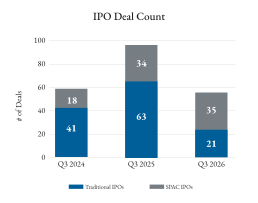
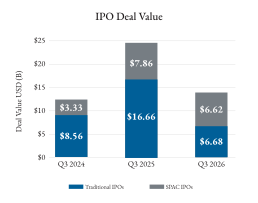
In Q3 2026, traditional IPO activity fell significantly as compared to Q3 2025, down 67% by deal count—with only 21 deals, the lowest Q3 deal count since 2021— and down 60% by value. Despite the weak third quarter, traditional IPOs in YTD1 2026 raised $139.42 billion in proceeds—largely due to Space X’s $86.3 billion IPO in Q2 2026—across 95 offering, up 316% by value but down 43% by volume from the comparable 2025 period.
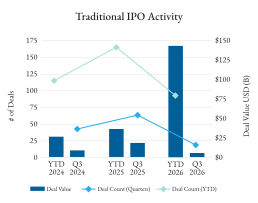
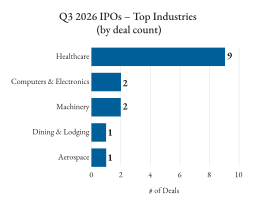
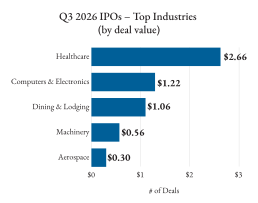
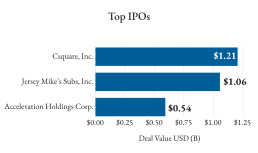
Healthcare led the traditional IPO market in Q3 2026 with nine offerings raising $2.66 billion, representing 43% of the quarter’s deal count and 40% of its deal value. Computers/electronics was next by value, at $1.22 billion from two offerings. Jersey Mike’s Subs pulled the dining/lodging industry onto the charts with its IPO, the second-biggest IPO of the quarter at $1.06 billion, lunging the dining/lodging industry to third place by deal value with that single IPO.
SPAC IPOs
SPAC IPOs accounted for 35 offerings and $6.62 billion in Q3 2026. Compared with Q3 2025, deal count was relatively steady (35 vs. 34 in Q3 2025) while value declined 16%. Despite the relatively steady performance of SPAC IPOs in Q3 2026, they featured prominently in general IPO activity during the quarter, accounting for 63% of IPOs and roughly half of IPO deal value. In YTD 2026, there were 153 SPAC IPOs with an aggregate of $30.06 billion in proceeds, up 53% in deal count and 42% in proceeds as compared to YTD 2025.
Follow-Ons
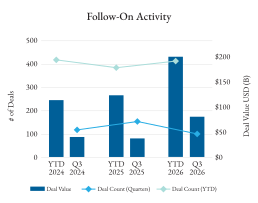
In Q3 2026, follow-on offerings raised $82.50 billion—the highest quarterly raise since Q1 2021—across 99 transactions. Although deal value more than doubled from Q3 2025 (+114%), deal count fell by 35% as compared to Q3 2025. In YTD 2026, 411 follow-ons raised $198.61 billion, up 7% by count and 59% by value year over year. Although Q3 2026 had the highest quarterly raise since Q1 2021, it ranked poorly from a deal count perspective, ranking third from the bottom in quarterly transactions during the same period.
Convertible Bonds
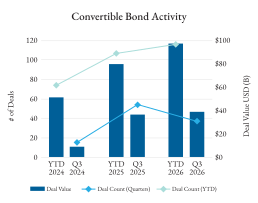
Convertible bond issuance reached $39.59 billion across 36 offerings in Q3 2026. As compared to Q3 2025, deal value increased by 10%, even as deal count declined by 31%. With fewer but bigger deals, average Q3 deal value rose to approximately $1.10 billion from $692 million a year earlier. With $99.67 billion raised across 117 offerings in YTD 2026, convertible bond activity was up 22% by value and 9% by count year over year.
Investment-Grade Debt
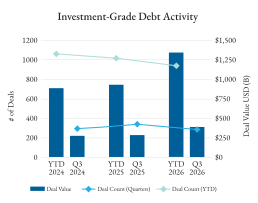
Investment-grade debt issuance2 continues to hold strong, totaling $432.49 billion across 281 transactions in Q3 2026. Compared with Q3 2025, proceeds increased by 36% while deal count fell by 18%. In YTD 2026, proceeds reached $1,494.90 billion, up 44% year over year, on 943 transactions, down 7% year over year. YTD 2026 proceeds have already exceeded full-year 2025 proceeds by approximately $135 billion, or 10%.
High-Yield Debt
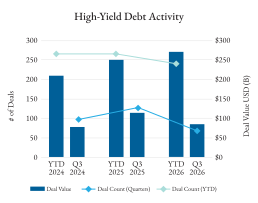
There was a significant decline in high-yield debt activity in Q3 2026, with proceeds of $84.02 billion across 68 transactions representing a 25% decline in deal value and a 47% decline in deal count from Q3 2025. In YTD 2026, proceeds totaled $262.24 billion across 246 transactions, up 8% by value but down 10% by volume from YTD 2026. Overall, however, 2026 had the best first nine months since 2021 from a deal value standpoint.
- Means January 1 through September 30.
- Excludes short-term debt, convertibles, asset-backed securities, and mortgage-backed securities.
Contacts














Stay Up To Date with Ropes & Gray
Ropes & Gray attorneys provide timely analysis on legal developments, court decisions and changes in legislation and regulations.
Stay in the loop with all things Ropes & Gray, and find out more about our people, culture, initiatives and everything that’s happening.
We regularly notify our clients and contacts of significant legal developments, news, webinars and teleconferences that affect their industries.