
In This Edition
- SEC Proposes Sweeping Reforms to Registered Offering Process: Expanding Access to the Public Capital Markets for a Broader Range of Issuers
- SEC Proposes Major Overhaul of Public Company Reporting Framework
- SEC Proposes Optional Semiannual Reporting for Public Companies
- In New Exemptive Order, SEC Expands Availability of Five-Business-Day Tender and Exchange Offers for Non-Convertible Debt Securities
- SEC Issues Spring 2026 Regulatory Flexibility Agenda
- SEC Proposes to Rescind its Climate Disclosure Rules
SEC Developments
SEC Proposes Sweeping Reforms to Registered Offering Process: Expanding Access to the Public Capital Markets for a Broader Range of Issuers
THE BOTTOM LINE
Summary of the Key Elements of the Proposal
The SEC proposal would substantially expand access to registered offerings by opening Form S-3 shelf registration to significantly more issuers, replacing the domestic well-known seasoned issuer (WKSI) framework with new Eligible Listed Issuer (ELI) and Seasoned Eligible Listed Issuer (SELI) categories, and extending many enhanced registration and communication benefits beyond current WKSIs.
Under the proposal:
- Any current and timely Exchange Act reporting issuer that is not a newly defined “BSP issuer” (mainly blank check companies, most shell companies, and penny stock issuers) generally could use Form S-3 for primary or secondary offerings without satisfying the current one-year seasoning, $75 million public float or other transaction requirements; ATM offerings would, however, be limited to securities listed on a national securities exchange or traded on an SEC-designated market.
- Domestic WKSIs would be replaced by ELIs and SELIs, with most enhanced registration and communication benefits extended to all ELIs and automatic shelf registration reserved for SELIs; the SEC estimates that approximately 74% of Exchange Act reporting issuers would qualify as SELIs, compared with approximately 36% that currently qualify as WKSIs.
- Form S-1 would be modernized by eliminating the annual report prerequisite for backward incorporation by reference and extending forward incorporation by reference to all eligible Form S-1 issuers, which the SEC estimates could increase the number of issuers eligible to forward incorporate on Form S-1 by up to 106%.
- State “blue sky” registration and qualification requirements would be preempted for all registered offerings by defining purchasers in registered offerings as “qualified purchasers,” while preserving state anti-fraud enforcement and notice-filing authority.
- Business development companies (BDCs) and registered closed-end funds would receive expanded access to short-form N-2, automatic shelf registration for SELIs, and other offering-process benefits, and registered non-variable annuity issuers would be permitted to use broad-based advertising under Rule 482, subject to specified conditions.
- The proposal also includes targeted modernizing amendments, including automatic operation of delaying amendments, limited changes to financial statement age rules, and conforming and technical updates.
Key Takeaways and Implications for Issuers and Market Participants
The proposed registered offering reform, if adopted, would have broad and significant implications:
- Dramatically Expanded Access to Shelf Registration. Smaller and newer issuers would gain access to Form S-3 and shelf registration, enabling faster, more flexible, and lower-cost capital-raising in the public markets and reducing their reliance on more expensive exempt offerings or dilutive instruments such as convertibles.
- Access to Enhanced Registration and Communication Benefits for Exchange-Listed Issuers. Exchange-listed issuers of all sizes would gain access to the enhanced registration and communication benefits currently available only to WKSIs, significantly expanding their offering-process flexibility. Under the proposal, approximately 74% of all Exchange Act reporting issuers would qualify as SELIs — as compared to the current 36% that qualify as WKSIs — allowing the vast majority of listed companies to file automatically effective shelf registration statements.
- Simplified Form S-1 Practice. Extending forward incorporation by reference to all Form S-1 issuers will simplify ongoing offering programs for a wide range of companies that currently bear the burden of post-effective amendments and prospectus supplement updates.
- BDCs and Closed-End Funds. BDCs and closed-end funds would enjoy expanded access to shelf offerings, automatic shelf registration (for SELIs), and the other enhanced registration and communication benefits, making it easier to respond to market opportunities in a timely and flexible manner.
- Insurance Companies. Insurance companies issuing registered non-variable annuities would be able to engage in broad-based advertising — including television commercials — without being required to deliver a prospectus, subject to specified disclosure conditions.
- Major Implications for Unlisted Issuers. Non-traded REITs, non-traded BDCs, and other issuers of unlisted securities would benefit from the complete preemption of state blue sky registration and qualification requirements, reducing transactional costs, eliminating the need for multistate blue sky counsel in connection with offers and sales of unlisted securities, and potentially speeding up the registered offering process.
- Important Investor Protection Carve-outs Remain. Notably, the proposal does not extend its benefits to blank check companies, shell companies, penny stock issuers, or issuers with recent securities law violations, reflecting the SEC’s effort to balance expanded access with targeted investor protection safeguards.
THE DETAILS
Overview
The Securities and Exchange Commission (SEC) has proposed a sweeping package of rule and form amendments under the Securities Act of 1933 (the “Securities Act”) that, if adopted, would represent the most significant overhaul of the registered offering framework in nearly two decades. The proposal is aimed squarely at facilitating capital formation in the public securities markets by expanding issuer eligibility for key registration forms and offering tools, modernizing the rules governing how issuers communicate with investors, and eliminating duplicative regulatory burdens that currently drive issuers toward private markets.
The proposed amendments span seven broad categories: (1) expanded Form S-3 eligibility; (2) a new tiered framework replacing the WKSI designation for domestic issuers; (3) modernized Form S-1 incorporation by reference; (4) preemption of state “blue sky” registration requirements for all registered offerings; (5) expanded registration and communication benefits for business development companies and registered closed-end funds; (6) new advertising rules for registered non-variable annuities; and (7) a series of other modernizing amendments.
Comments on the proposal are due by July 27, 2026.
Expanded Eligibility for Form S-3: Opening Shelf Registration to Significantly More Issuers
Form S-3 is a short-form registration statement that eligible issuers can use to register offerings under the Securities Act. Its value to issuers is substantial: it permits forward incorporation by reference from filings under the Securities Exchange Act of 1934 (the “Exchange Act”) such as Form 10-Ks, 10-Qs, and certain 8-Ks, thereby eliminating duplicative disclosure; allows shelf registration (enabling an issuer to register securities in advance and “take them off the shelf” as market conditions warrant); and facilitates at-the-market (ATM) offerings, which allow issuers to sell securities at prevailing market prices over time. Issuers that cannot use Form S-3 must instead register offerings on Form S-1, which is subject to SEC staff review and does not permit shelf or delayed primary offerings.
Proposed Amendments to Form S-3
The proposed amendments would make the following key changes to Form S-3’s eligibility requirements:
- Elimination of the One-Year Seasoning Requirement. The proposal would eliminate the requirement that an issuer must have been subject to Exchange Act reporting requirements for at least 12 calendar months prior to filing a Form S-3 registration statement. Instead, issuers would simply need to be current and timely in their Exchange Act reporting during the preceding 12 calendar months (or for such shorter period that they were required to report).
- Elimination of the $75 Million Public Float Requirement and All Other Transaction Requirements. The proposal would eliminate the current requirement that an issuer have a public float of at least $75 million to conduct unlimited primary offerings on Form S-3, as well as all other transaction requirements in Form S-3 (e.g., the one-third of public float limitation on primary offerings by certain smaller issuers that are sometimes referred to as the “baby shelf” rules). Any issuer meeting the proposed registrant requirements would be eligible to use Form S-3 for any primary or secondary offering, regardless of its public float.
- New Additions to Eligibility Requirements. The proposal would add a new prohibition barring “BSP issuers” — a newly defined term encompassing blank check companies, shell companies (other than business combination related shell companies), and penny stock issuers — from using Form S-3. Importantly, the proposal provides that an issuer would not be considered a shell company solely because during the past three years it or a predecessor was a special purpose acquisition company (SPAC), allowing post-de-SPAC entities to use Form S-3 if they are not shell companies at the time of filing. Additionally, issuers that have committed certain criminal violations or are subject to SEC enforcement actions would also be ineligible to use Form S-3.
- ATM Offerings Limited to Listed or Designated Trading Markets. To balance the expanded access to ATM offerings with investor protection concerns, the proposal would limit ATM offerings to securities listed on a national securities exchange or traded on a market designated by the SEC based on specified criteria.
New Framework to Replace the WKSI System: Eligible Listed Issuers (ELIs) and Seasoned Eligible Listed Issuers (SELIs)
Since 2005, a category of issuers known as “well-known seasoned issuers” (WKSIs) has enjoyed what the SEC calls “enhanced registration and communication benefits” — a suite of offering-process flexibilities, including the ability to file automatic shelf registration statements (effective immediately upon filing), to pay registration fees on a “pay-as-you-go” basis at the time of each offering, to engage in pre-filing and post-filing communications with flexibility not available to other issuers, and to add securities or classes to an effective registration statement by post-effective amendment.
To qualify as a WKSI, a domestic issuer currently must, among other things, have either a public float of at least $700 million or have issued at least $1 billion in non-convertible securities in primary registered offerings over the prior three years. These thresholds have not been revisited since the WKSI framework was adopted more than 20 years ago. According to the SEC proposal, as of 2024, only approximately 36% of Exchange Act reporting issuers qualified as WKSIs.
The Proposed New Framework: ELIs and SELIs
The SEC proposes to eliminate the WKSI designation for domestic issuers and replace it with two new categories of issuers:
- An “Eligible Listed Issuer” (ELI) would be an issuer that (i) meets the proposed Form S-3 registrant requirements (i.e., is current and timely in Exchange Act reporting and is not a BSP issuer) and (ii) has at least one class of common equity securities listed on a national securities exchange.
- A “Seasoned Eligible Listed Issuer” (SELI) would be an ELI that has additionally been subject to Exchange Act reporting requirements for at least 12 calendar months.
Under the proposal, approximately 74% of Exchange Act reporting issuers would qualify as SELIs, representing a dramatic increase from the current 36% that qualify as WKSIs. This represents an increase of over 200% in the number of issuers eligible for all the “enhanced registration and communication benefits.”
A table summarizing the key benefits and who would receive them under the proposed framework, as compared to current rules, is available here.
The WKSI definition would be retained only for foreign private issuers (FPIs), which would continue to qualify under the existing criteria.
Modernization of Form S-1: Expanded Incorporation by Reference
Form S-1 is the default registration statement available to any domestic issuer not eligible for another form. Currently, Form S-1 permits issuers to “backward incorporate” — i.e., incorporate previously filed Exchange Act reports into the registration statement by reference — but only if the issuer has filed a Form 10-K for its most recently completed fiscal year. Form S-1 currently permits “forward incorporation” — automatic updating of the registration statement via future Exchange Act filings — only for smaller reporting companies (SRCs).
The proposed amendments to Form S-1 would make two important changes:
- Elimination of the Annual Report Requirement for Backward Incorporation. The proposal would eliminate the requirement that an issuer must have filed a Form 10-K for its most recently completed fiscal year in order to use incorporation by reference on Form S-1. This would benefit, for example, issuers in their first year as Exchange Act reporting companies who have not yet filed an annual report, allowing them to incorporate by reference their initial Securities Act or Exchange Act filing that contains “Form 10 information.”
- Extension of Forward Incorporation by Reference to All Eligible Issuers. The proposal would amend Form S-1 to permit any issuer that meets the eligibility requirements for backward incorporation to also forward incorporate — not just SRCs. The SEC notes that the current limitation to SRCs is “anomalous” and creates unnecessary compliance costs for larger issuers by requiring them to file post-effective amendments and prospectus supplement updates instead.
The SEC estimates that these changes could result in an increase of up to 106% in the number of issuers eligible to forward incorporate on Form S-1.
Federal Preemption of State “Blue Sky” Registration and Qualification Requirements for All Registered Offerings
In what may be one of the most far-reaching proposals in the release, the SEC proposes to preempt state securities law registration and qualification requirements for all registered offerings under the Securities Act.
Section 18(b) of the Securities Act provides that certain “covered securities” are exempt from state securities law registration and qualification requirements. Currently, registered offerings of exchange-listed securities are covered securities and therefore exempt from state “blue sky” requirements. However, registered offerings of unlisted securities — including those by non-traded BDCs, non-traded REITs, and other issuers whose securities are not listed on a national securities exchange — are not currently covered securities, requiring issuers to comply with registration and qualification requirements in each state where they offer and sell securities.
Section 18(b)(3) of the Securities Act authorizes the SEC to define “qualified purchasers,” with the effect that securities sold to such purchasers become covered securities exempt from state requirements.
The Proposed Amendment
The SEC proposes to add a definition of “qualified purchaser” to Securities Act Rule 146, providing that any person to whom securities are offered or sold pursuant to a registered offering is a “qualified purchaser” within the meaning of Section 18(b)(3). This definition would render such securities “covered securities,” fully preempting state registration and qualification requirements for all registered offerings, regardless of whether the securities are exchange-listed.
The SEC notes that the robust investor protections available in registered offerings — including registration statement disclosure requirements, Section 11 and Section 12(a)(2) liability for material misstatements and omissions, potential SEC staff review of registration statements, and ongoing Exchange Act reporting obligations — adequately protect investors and address any concerns about eliminating state oversight for these offerings. States would retain authority to investigate and bring enforcement actions for fraud and to require notice filings for fee purposes.
Expanded Benefits for Business Development Companies and Registered Closed-End Funds
The proposal would extend the expanded eligibility framework described above to BDCs and registered closed-end investment companies (registered CEFs) (collectively, “Affected Funds”) that register securities on Form N-2. Specifically, the SEC proposes to:
- Extend availability of the short-form registration statement on Form N-2 (“Short-Form N-2”) (which functions like Form S-3 for operating companies) to all Affected Funds that qualify as ELIs or SELIs under the proposed amendments, eliminating the current $75 million public float requirement for Form N-2 eligibility.
- Extend automatic shelf registration to SELI-qualifying Affected Funds (currently limited to WKSIs) and extend the other enhanced registration and communication benefits to ELI-qualifying Affected Funds.
- Amend Securities Act Rule 139b (the research report exemption for covered investment funds) to remove the minimum public float requirement, making the safe harbor available to all covered investment funds, including unlisted Affected Funds.
Unlisted Affected Funds — including interval funds and certain non-traded BDCs — would not be able to use Short-Form N-2. Instead, these funds would continue to rely on the existing Rule 486 registration and offering framework, which already provides many similar efficiencies (including automatically effective post-effective amendments). We discuss the proposal’s potential impact on Affected Funds in more detail here.
Broad-Based Advertising for Registered Non-Variable Annuities
The SEC proposes to amend Securities Act Rule 482 to permit insurance companies to engage in broad-based advertising for registered non-variable annuities — a category that includes Registered Index-Linked Annuities (RILAs) and registered market value adjustment annuities — in a manner consistent with the existing framework for variable annuities.
In 2024, the SEC required insurance companies to register offerings of non-variable annuities on Form N-4, the same form used to register variable annuities. However, at that time, the SEC declined to extend Rule 482 (which permits registered investment companies to advertise without satisfying prospectus delivery requirements) to registered non-variable annuities, leaving them to rely instead on the free writing prospectus provisions of Securities Act Rule 433 — but only if the issuer was eligible to file on Form S-3. This created an inconsistency: variable annuities and registered non-variable annuities use the same form and provide investors with similar information, yet they were subject to different advertising frameworks based on whether the insurance company happened to file Exchange Act reports.
Proposed Amendments
The proposed amendments would:
- Amend Rule 482 to apply to registered non-variable annuity advertisements, permitting broad-based advertising (including television commercials, print advertisements, and similar media) without satisfying prospectus delivery requirements or Form S-3 eligibility.
- For RILA advertisements specifically, prohibit the inclusion of performance data of the RILA itself, given that the complex features of RILAs (including variable upside and downside rates that change frequently) make past performance potentially misleading. Historical index performance may nonetheless be included, but only in the manner prescribed by the RILA prospectus disclosure requirements and accompanied by a mandatory legend.
- Require any advertisement that includes fee or expense figures (or states that there are no fees or expenses) to include specified disclosures, including the maximum amount of any sales load, the potential for contract adjustments, and — for RILAs specifically — a statement alerting investors that the insurance company limits their upside in exchange for downside protection.
- Require registered non-variable annuity advertisements to be filed with either the SEC or FINRA, consistent with variable annuity advertising practice.
Other Modernizing Amendments
Beyond the major proposals described above, the SEC also proposes a number of other, more targeted amendments:
- Delaying Amendments (Securities Act Rule 473). Under current practice, issuers include a “delaying amendment” legend on the face of a registration statement—pursuant to Securities Act Rule 473—to prevent it from going effective automatically on the 20th day after filing in accordance with the provisions of Section 8(a) of the Securities Act. Under the proposal, the delaying mechanism would operate automatically—without requiring the inclusion of a specific legend; issuers will be able to stop or prevent the default delaying mechanism by including on the registration statement’s facing page a legend stating that the registration statement will become effective on the 20th day after filing in accordance with the provisions of Section 8(a) of the Securities Act.
- Age of Financial Statements (Regulation S-X). The SEC proposes to eliminate income-related conditions in Rules 3-01(c) and 8-08(b) of Regulation S-X that currently extend the time period during which financial statements may be used in Securities Act registration statements for SRCs under certain circumstances. The SEC believes these conditions are no longer necessary given the SEC’s existing disclosure requirements.
- Conforming and Technical Amendments. The release also includes a broad array of conforming and technical amendments to update cross-references, remove obsolete provisions (such as the Form S-2 and F-2 references, which were rescinded in 2005), correct typographical errors, and simplify various rules and forms.
SEC Proposes Major Overhaul of Public Company Reporting Framework
THE BOTTOM LINE
Summary of the Key Elements of the Proposal
- The proposal would streamline existing filer statuses under the Exchange Act into two principal categories: large accelerated filers and non-accelerated filers, eliminating the accelerated filer and smaller reporting company categories.
- The proposal would raise the threshold for large accelerated filer status from $700 million to $2 billion in public float.
- The proposal would define a non-accelerated filer as any issuer that is not a large accelerated filer. As a practical result, non-accelerated filer status would become the default status for most public companies.
- The proposal would give newly public companies a minimum five-year on-ramp before they could become large accelerated filers by requiring a registrant to have been subject to Exchange Act reporting requirements for at least the preceding 60 consecutive calendar months before large accelerated filer status can apply. This would effectively extend the policy rationale of the “emerging growth company” on-ramp to all new registrants, regardless of whether they qualify as emerging growth companies.
- The proposal would also make filer status more stable by requiring a registrant’s public float to be at or above, or below, the $2 billion threshold for two consecutive years before it transitions into or out of large accelerated filer status. Public float would be calculated using the average closing price, or bid-ask average if no closing price is available, over the last 10 trading days of the second fiscal quarter, multiplied by the shares held by non-affiliates as of the last day of that quarter.
- The proposal would extend to non-accelerated filers many scaled disclosure accommodations now associated with smaller reporting companies and emerging growth companies. These accommodations would include, among others, scaled business disclosure, two years of Management’s Discussion and Analysis (MD&A) disclosure instead of three, scaled executive compensation disclosure, two years of audited financial statements for many issuers, and no required auditor attestation report on internal control over financial reporting.
- The proposal would create a new subcategory of small non-accelerated filers, consisting of non-accelerated filers with total assets of $35 million or less as of the end of each of their two most recent second fiscal quarters. Small non-accelerated filers would be required to file their Form 10-Ks 120 days after their fiscal year-end and to file their Form 10-Qs 50 days after their fiscal quarter-end, compared with 90 days and 45 days, respectively, for other non-accelerated filers.
- The proposal would exclude foreign private issuers (FPIs) that elect to comply with the rules and use the forms designated for FPIs, and asset-backed issuers, from the new LAF and NAF filer status definitions.
Practical Implications for Public Companies
The proposed framework would have significant practical consequences across the spectrum of public companies.
For companies currently classified as AFs or smaller LAFs: A substantial number of these companies—those with public floats between $700 million and $2 billion or that have been reporting for less than five years—would transition from LAF or AF status to NAF status under the proposed rules. These companies would gain the ability to provide scaled disclosure, eliminate the ICFR auditor attestation, and benefit from the other NAF accommodations described above.
For companies currently classified as NAFs, SRCs, or EGCs: These companies would continue to benefit from their existing accommodations, now consolidated and formalized under a single NAF status. Most notably, non-EGC NAFs that currently must conduct say-on-pay votes and provide more extensive executive compensation disclosure would gain the benefit of the EGC-level accommodations in those areas.
For newly public companies: The mandatory 60-month seasoning period would mean that every company completing an IPO would benefit from NAF status — and all of the accommodations described above — for at least five years after going public, regardless of its public float. This is intended to create a meaningful on-ramp that reduces the initial compliance burden of being a public company and may encourage more private companies to access the public markets.
For the very smallest public companies (SNFs): The extended Form 10-K and Form 10-Q deadlines could be especially meaningful in reducing filing pressure and managing external auditor and counsel workloads. If the proposal is adopted, these companies should, nevertheless, consider whether filing earlier than the extended deadline may be advantageous in light of investor expectations, market practice, and comparability with other reporting companies.
For foreign private issuers: The proposal is more limited because foreign private issuers using foreign private issuer forms generally would not be able to rely on the new non-accelerated filer accommodations. Foreign private issuers should continue monitoring the SEC’s broader foreign private issuer review, because the SEC expressly cites that ongoing review as a reason for limiting this proposal’s effect on foreign private issuers.
THE DETAILS
Overview
On May 19, 2026, the SEC proposed significant amendments to its public company reporting framework that would fundamentally restructure the way public companies are categorized and the disclosure obligations they must satisfy. The proposed rules would consolidate the current multi-tiered filer status system into two principal categories: large accelerated filers (LAFs) and non-accelerated filers (NAFs), eliminating the accelerated filer and smaller reporting company (SRC) categories, while extending a robust set of existing disclosure accommodations to all NAFs. The proposal would also create a new sub-category for the very smallest NAFs.
The proposed amendments represent the most comprehensive simplification of the SEC’s filer status framework in over two decades and, if adopted, would significantly reduce compliance costs and reporting burdens for the large majority of public companies while preserving full disclosure requirements for the largest issuers.
A chart that highlights some of the differences between the current filer categories and the proposed filer categories is available here.
Comments on the proposal are due by July 20, 2026.
Current Filer Status Framework
The current framework establishes three broad filer tiers based primarily on a company’s public float (the aggregate market value of equity held by non-affiliates):
- Large Accelerated Filers (LAFs) are registrants with a public float of $700 million or more, at least 12 months of Exchange Act reporting history, at least one filed annual report, and no eligibility for smaller reporting company status under the applicable revenue test. They face the most accelerated filing deadlines — 60 days for Form 10-K and 40 days for Form 10-Q — and must comply with the most comprehensive disclosure requirements, including the requirement to obtain an auditor attestation on internal control over financial reporting (ICFR) under Section 404(b) of the Sarbanes-Oxley Act.
- Accelerated Filers (AFs) are registrants with a public float of $75 million to less than $700 million, subject to less accelerated filing deadlines (75 days for Form 10-K and 40 days for Form 10-Q) and the same comprehensive disclosure requirements as LAFs, including the ICFR auditor attestation.
- Non-Accelerated Filers (NAFs) are registrants with a public float of less than $75 million (or, under certain conditions, less than $700 million with revenues under $100 million), subject to non-accelerated filing deadlines (90 days for Form 10-K and 45 days for Form 10-Q), and exempt from the ICFR auditor attestation requirement.
In addition to these three categories, the smaller reporting company (SRC) status — applicable to registrants with less than $250 million in public float or, in some circumstances, with less than $100 million in annual revenues — provides scaled disclosure accommodations on top of a registrant’s underlying filer status. The emerging growth company (EGC) status is a statutory category available to companies for up to five years after their initial public equity offering, so long as certain revenue and debt thresholds are not exceeded, and provides an overlapping but distinct set of accommodations.
Key Proposed Changes
A Simplified Two-Tier Filer Status System
The centerpiece of the proposal is the consolidation of the current five filer statuses into two principal categories: LAFs and NAFs. The accelerated filer (AF) and SRC categories would be eliminated as standalone statuses. The EGC status, which is created by statute, would be preserved but as discussed below, would in most cases be rendered practically unnecessary by the extension of EGC accommodations to all NAFs.
Revised Large Accelerated Filer Definition: Higher Threshold, Longer Seasoning, and Two-Year Lookback
Under the proposal, the requirements to qualify as an LAF would be meaningfully tightened in three important respects:
- Raised Public Float Threshold. The public float threshold to become an LAF would be increased from the current $700 million to $2 billion. The proposed $2 billion threshold would be a single threshold for both entering and exiting large accelerated filer status, replacing the existing separate lower exit thresholds that the SEC says have contributed to complexity. The SEC noted that registrants meeting this higher threshold would collectively represent approximately 93.5% of total market public float and have both the investor demand and the compliance resources to support the most comprehensive reporting requirements. Under this new threshold, only approximately 19.2% of current public companies would be LAFs, compared to 35.4% today.
- New Public Float Calculation Methodology. To provide a more stable measurement, the proposal would change how public float is calculated for LAF purposes. Under the current rules, public float is determined using the closing price (or average of bid/ask prices) on the last business day of the second fiscal quarter. Under the proposal, public float would instead be calculated by multiplying the number of shares held by non-affiliates as of the last day of the second fiscal quarter by the average price over the last 10 trading days of the second fiscal quarter. This change is intended to smooth out single-day price volatility that can distort filer status determinations under the current rules.
- Two-Year Lookback for Status Transitions. Rather than permitting a registrant to change filer status based on a single year’s public float, the proposal would require a registrant to exceed (or fall below) the $2 billion threshold for two consecutive fiscal years before transitioning between LAF and NAF status. This two-year lookback is designed to reduce the frequency of status changes and provide greater predictability for both registrants and investors in planning disclosure controls and procedures.
- Extended Seasoning Requirement. Currently, a registrant may qualify as an LAF after only 12 calendar months as a public company. The proposal would extend this seasoning period to 60 consecutive calendar months (five years). This means that every newly public company would benefit from a mandatory five-year on-ramp during which it would be treated as an NAF, regardless of its public float — a structure designed to reduce the immediate compliance burden on new public companies and incentivize more companies to go public.
Redefined and Expanded Non-Accelerated Filer Status
Under the proposal, every issuer that is not an LAF would be an NAF. This would include all registrants from the moment of their initial public offering or registration and for at least five years thereafter, by operation of the seasoning requirement.
Critically, all NAFs would become entitled to the full range of scaled disclosure accommodations currently available only to registrants that qualify as both SRCs and EGCs. According to the SEC, while NAFs under the proposed rules would account for approximately 81% of all public companies, they would represent only approximately 6.5% of total market public float. The NAF filing deadlines would remain at 90 days for Form 10-K and 45 days for Form 10-Q.
Expanded Accommodations for All NAFs
The following is a summary of the significant accommodations that would be available to all NAFs under the proposed rules:
- Financial Statements. NAFs would not be required to provide: risk factor disclosure in Forms 10-K and 10-Q; (consistent with the current accommodations for SRCs); a stock performance graph (with an exception for NAFs that are investment companies); supplementary financial information; quantitative and qualitative disclosures about market risk; compensation committee interlocks and insider participation disclosure; compensation committee reports; and disclosure regarding certain payments made by resource extraction issuers. Notably, if approved as proposed, NAFs who choose not to include risk factor disclosure in their periodic reports may not be able to access the capital markets quickly as more lead time will be required to draft risk factors for the registration statements for their offerings and to keep them current throughout the offering or shelf period.
- ICFR Auditor Attestation. NAFs would not be required to obtain an ICFR auditor attestation under Section 404(b) of the Sarbanes-Oxley Act. This is one of the most significant and costly compliance burdens for public companies, and, according to the SEC, the proposal would increase the number of registrants exempt from this requirement by approximately 26.7% compared to today. Management’s assessment and report on ICFR effectiveness would still be required of all NAFs.
- Executive Compensation Disclosure. NAFs would be entitled to provide significantly scaled executive compensation disclosure, including disclosure for only three (instead of five) named executive officers; only two years (instead of three years) of summary compensation table information; and exemptions from the requirement to provide a Compensation Discussion and Analysis, pay ratio disclosure, pay versus performance disclosure, and several executive compensation tables (including grants of plan-based awards, pension benefits, option exercises and stock vested, and nonqualified deferred compensation tables).
- Shareholder Advisory Votes. NAFs would be entirely exempt from the requirement to conduct say-on-pay votes (the advisory vote on executive compensation), say-on-pay frequency votes, and golden parachute compensation advisory votes in connection with mergers and acquisitions. Currently, only EGCs are exempt from these requirements.
- Other Disclosure Accommodations. NAFs would not be required to provide: risk factor disclosure in Forms 10-K and 10-Q (consistent with the current accommodations for SRCs); a stock performance graph (with an exception for NAFs that are investment companies); supplementary financial information; quantitative and qualitative disclosures about market risk; compensation committee interlocks and insider participation disclosure; compensation committee reports; and disclosure regarding certain payments made by resource extraction issuers. Notably, if approved as proposed, NAFs who choose not to include risk factor disclosure in their periodic reports may not be able to access the capital markets quickly as more lead time will be required to draft risk factors for the registration statements for their offerings and to keep them current throughout the offering or shelf period.
- Deferred Adoption of New Accounting Standards. For the first five years after their initial registration with the SEC, NAFs would be permitted to elect to defer compliance with new or revised financial accounting standards until the date that a non-issuer (i.e., a private company) is required to comply with such standards. This accommodation is currently available only to EGCs, and the proposal would extend it as a time-limited on-ramp benefit to all newly public companies. Consistent with the current EGC framework, the election would be irrevocable: NAFs electing not to use the accommodation may not revisit the election in future filings.
- Material Unresolved Staff Comments. As a new obligation, NAFs would be required to disclose in their Form 10-K or Form 20-F the substance of material unresolved staff comments received from the SEC not less than 180 days before the fiscal year end — a disclosure that is currently required only of LAFs and AFs. The SEC explains that this change is important because a separate contemporaneous offering reform proposal would make Form S-3 and shelf offering eligibility available to significantly more issuers, including non-accelerated filers, and investors in those issuers should be informed of material unresolved staff comments when periodic reports may be incorporated by reference.
New Small Non-Accelerated Filer (SNF) Sub-Category
The proposal would create a new sub-category within NAF status for the very smallest registrants: small non-accelerated filers (SNFs). To qualify as an SNF, a registrant must: (1) be an NAF; and (2) report total assets of $35 million or less as of the end of each of its two most recent second fiscal quarters.
SNFs would be granted extended filing deadlines: 120 days (rather than 90 days) after fiscal year-end to file their Form 10-K, and 50 days (rather than 45 days) after fiscal quarter-end to file their Form 10-Q. These extensions are designed to address the practical reality that the smallest public companies disproportionately struggle to meet existing filing deadlines—the SEC found that approximately 39.7% of registrants at or below the $35 million total asset threshold failed to file their Form 10-K by the initial reporting deadline in 2024, compared to only 11% of larger NAFs.
The SEC estimates that setting the SNF asset threshold at $35 million would result in approximately 1,072 registrants qualifying for the SNF subcategory, representing approximately 22.2% of NAFs and 17.9% of all registrants. According to the SEC, the total asset threshold, rather than public float or revenue, was selected for consistency and reliability across registrant types and industries.
Treatment of Foreign Private Issuers and Asset-Backed Issuers
The proposal would exclude foreign private issuers (FPIs) that elect to comply with the rules and use the forms designated for FPIs, and asset-backed issuers, from the new LAF and NAF filer status definitions. FPIs filing on Form 20-F would continue to be required to obtain an ICFR auditor attestation if they had a public float of $75 million or more at the end of the most recently completed second fiscal quarter (unless they qualify as EGCs), pending the SEC’s ongoing broader review of the FPI framework. Asset-backed issuers have a separate disclosure regime under Regulation AB and would not be affected by the proposed changes.
Proposed Transition Rules
Existing registrants as of the effective date of any final rules would be required to assess large accelerated filer or non-accelerated filer status as of the end of their fiscal year before the final rules become effective. The assessment would be based on public float and, if applicable, total assets for that fiscal year and the immediately prior fiscal year.
Existing registrants would be permitted to complete the initial assessment at any time after effectiveness of the final rules, but no later than the day before the last day of the fiscal year in which the final rules become effective. If an existing registrant does not complete the initial assessment by the deadline, it would be deemed to be a large accelerated filer until the next assessment date if it was a large accelerated filer before effectiveness, and otherwise would be deemed to be a non-accelerated filer until the next assessment date.
A registrant that qualifies as a non-accelerated filer after the initial assessment could use non-accelerated filer accommodations in its next Securities Act or Exchange Act filing made after the assessment is completed. A registrant that qualifies as a small non-accelerated filer could use the extended small non-accelerated filer deadlines in its next Form 10-Q or Form 10-K filed after the initial assessment is completed.
SEC Proposes Optional Semiannual Reporting for Public Companies
THE BOTTOM LINE
- The SEC proposal would give reporting companies that currently file quarterly reports on Form 10-Q the option to file a new “Form 10-S” semiannual report in lieu of three quarterly reports on Form 10-Q.
- Under the proposal:
- The election to report semiannually would be made on an annual basis through a new checkbox on the cover page of the Form 10-K; a similar check box would be added to the cover page of Securities Act registration statements on Forms S-1, S-3, S-4, and S-11 and Exchange Act registration statements on Form 10;
- Form 10-S would require the same narrative disclosures and financial information as existing Form 10-Q but would cover a six-month period rather than a fiscal quarter, and scaled disclosure would remain available to smaller reporting companies on Form 10-S, as with Form 10-Q;
- The deadline for filing Form 10-S would be 40 days (for large accelerated filers and accelerated filers) or 45 days (for all other reporting companies) after the end of the fiscal year’s first semiannual period — the same deadlines that currently apply to Form 10-Q after a fiscal quarter end; and
- As regards interim financial statements, a registrant would no longer assess the number of days from the filing date or effective date to the date of the most recent balance sheet to determine if that balance sheet falls within 130 or 135 days (depending on filer status), as currently required. Instead, registrants would be required to include the interim financial statements as of the end of the most recently completed fiscal quarter (for quarterly filers) or semiannual period (for semiannual filers) that has been filed, or is required to be filed on or before the filing (or effective) date, in a Form 10-Q or Form 10-S — no substantive changes are being proposed to existing requirements for annual financial statements.
- The proposal does not include any general changes to the current regulatory requirements governing earnings releases (other than technical amendments to Item 2.02 of Form 8-K, regarding disclosure of earnings releases, to include references to semiannual periods) or earnings guidance practices.
THE DETAILS
Overview
On May 5, 2026, the SEC issued a proposed rule that would, for the first time in over 50 years, allow reporting companies to file interim reports on a semiannual basis rather than quarterly. Specifically, the SEC is proposing amendments to Rules 13a-13 and 15d-13 under the Exchange Act and related rules and forms to permit companies to file a new “Form 10-S” semiannual report in lieu of three quarterly reports on Form 10-Q. The proposal would also amend the financial statement requirements of Regulation S-X to facilitate semiannual reporting and to simplify the rules governing the age of financial statements in registration statements and other SEC filings. According to the SEC, the proposal is aimed at reducing regulatory burden and compliance costs, encouraging companies to go public and remain public, promoting long-term business strategies (instead of short-termism), and providing flexibility to “emerging growth companies” and “smaller reporting companies,” among other things.
The public comment period on the proposed rule ended on July 6, 2026.
We summarize the key elements of the proposal and highlight important practical considerations for public companies and their advisors below.
The Semiannual Reporting Election
- Eligible Reporting Companies. Under the proposal, all reporting companies currently required to file quarterly reports on Form 10-Q would have the option to file semiannual reports on new Form 10-S in lieu of quarterly reports. The option would be available to those reporting companies, regardless of filer status, revenues, market capitalization, or other criteria.
- Election Timing; Making the Election. The election to report semiannually or quarterly would be made on an annual basis and cannot be changed mid-fiscal year. A reporting company would indicate its election to report semiannually by checking a new semiannual reporting box on the cover page of its Form 10-K; leaving the box unchecked would indicate a choice to report quarterly. A similar check box would be added to the cover page of Securities Act registration statements on Forms S-1, S-3, S-4, and S-11 and Exchange Act registration statements on Form 10, so that private companies conducting initial public offerings could make their initial election at that time.
- Correcting an Election Error. If a company mistakenly checks or fails to check the semiannual reporting box, it may amend its Form 10-K to correct the error. Such a corrective amendment must be filed as soon as practicable after discovery of the mistake but no later than the due date for the company’s first Form 10-Q for the fiscal year in which the initial Form 10-K with the erroneous election was filed. Electing to file semiannual reports and filing such a corrective amendment would not impact the company’s timeliness for the purposes of determining eligibility to file a Form S-3 registration statement.
New Form 10-S
A company electing semiannual reporting would file one semiannual report on new Form 10-S and one annual report on Form 10-K for each fiscal year. Form 10-S would require the same narrative disclosures and financial information as existing Form 10-Q but would cover a six-month period rather than a fiscal quarter. The financial statements for the covered semiannual period would be required to be prepared in accordance with U.S. GAAP and reviewed by an auditor (though not audited). Scaled disclosure would remain available to smaller reporting companies on Form 10-S, as with Form 10-Q.
- Filing Deadlines. The deadline for filing Form 10-S would be 40 days (for large accelerated filers and accelerated filers) or 45 days (for all other reporting companies) after the end of the fiscal year’s first semiannual period — the same deadlines that currently apply to Form 10-Q after a fiscal quarter end. The second semiannual period would be subsumed in the annual report on Form 10-K.
Companies Switching Between Reporting Frequencies
A company switching from quarterly to semiannual reporting generally would not need to take extra steps to prepare the comparable prior-year financial statements for its first semiannual report, because those six-month financial statements would already have been included in the prior year’s second-quarter Form 10-Q. However, a company switching from semiannual to quarterly reporting may need to take additional steps to prepare financial statements for comparable quarterly periods in the prior year, including ensuring that an independent public accountant has reviewed those comparable quarterly periods.
Proposed Amendments to Regulation S-X
Streamlining Age of Financial Statements Requirements
The SEC is proposing amendments to Rules 3-01 and 8-08 of Regulation S-X to simplify and consolidate the age of financial statement requirements. The requirements of current Rule 3-12 of Regulation S-X, which addresses the age of financial statements at the effective date of a registration statement or mailing of a proxy statement, would be consolidated into revised Rule 3-01, and Rule 3-12 would be eliminated. Similar conforming amendments would be made to Rule 8-08 for smaller reporting companies.
Annual Financial Statements
No substantive changes are being proposed to existing requirements for annual financial statements.
New Model for Determining Age of Interim Financial Statements
Under the proposed amendments, a registrant would no longer assess the number of days from the filing date or effective date to the date of the most recent balance sheet to determine if that balance sheet falls within 130 or 135 days (depending on filer status), as currently required. Instead, registrants would be required to include the interim financial statements as of the end of the most recently completed fiscal quarter (for quarterly filers) or semiannual period (for semiannual filers) that has been filed, or is required to be filed on or before the filing (or effective) date, in a Form 10-Q or Form 10-S. A non-reporting registrant (e.g., a private company registering its initial public offering) would apply this rule as if it were required to file Form 10-Q or Form 10-S, as applicable, in line with the election it makes on its registration statement.
Other Regulation S-X Amendments
The SEC is proposing amendments to Rules 10-01 and 8-03 of Regulation S-X to clarify that “interim” for quarterly filers means a fiscal quarterly period and for semiannual filers means a fiscal semiannual period. Under these amendments, semiannual filers would provide an interim balance sheet as of the end of the first semiannual period and statements of comprehensive income and cash flows for that period and the corresponding period of the preceding fiscal year.
Proposed Amendments Regarding Transition Reports
The SEC is proposing amendments to Exchange Act Rules 13a-10 and 15d-10 to incorporate the semiannual reporting option into the SEC’s requirements for transition reports upon a change in fiscal year. The proposed amendments for semiannual filers would mirror the rules currently applicable to quarterly filers.
Earnings Releases and Guidance
The proposal does not include any general changes to the current regulatory requirements governing earnings releases (other than technical amendments to Item 2.02 of Form 8-K, regarding disclosure of earnings releases, to include references to semiannual periods) or earnings guidance practices. Federal securities laws do not impose general duties upon reporting companies to announce or publish earnings, conduct earnings calls, or issue earnings guidance. The SEC noted, however, that it is requesting comment on whether Item 2.02 Form 8-K disclosures should be treated as “filed” rather than “furnished” for semiannual filers, which would subject earnings releases by such filers to additional liability provisions such as Exchange Act Section 18.
The SEC acknowledged that quarterly earnings releases furnished under Item 2.02 of Form 8-K differ from Form 10-Q financial information because they are not required to be reviewed by an independent public accountant or to comply with the SEC’s interim financial statement requirements. The SEC expects that a company’s individual characteristics, facts, and circumstances will determine whether it continues to make quarterly earnings releases after electing to report semiannually, noting that experience in the United Kingdom was broadly illustrative: when quarterly reporting was no longer required of UK companies in 2014, fewer than 10% stopped issuing quarterly reports (as of the end of 2015).
Practical Considerations
Why Some Companies May Elect to Continue Quarterly Reporting. Companies might continue to report quarterly where they determine that quarterly frequency is best for the company and its investors, due to factors such as expectations of investors and securities analysts, disclosure practices in a particular industry, liquidity and fundraising considerations, contractual obligations, or other regulatory requirements. Some companies may also view semiannual reporting as increasing the length of time that directors or employees possess non-public information subject to closed trading windows and may prefer quarterly reporting because it provides more frequent open trading windows.
Impact on Insider Trading Policies. The SEC has requested comment on the impact of optional semiannual reporting on company insider trading policies, including trading windows. Companies may need to consider whether they would impose longer trading blackout periods at the beginning or end of a semiannual period than they would under quarterly reporting.
Impact on Securities Offerings. The SEC acknowledged that, depending on when a registration statement becomes effective, an investor in a semiannual filer may not receive interim financial statements that are as current as would be required today, noting, for example, that a registration statement filed as late as August 13 by a non-reporting registrant that elects semiannual reporting would not be required to include interim financial statements. If adopted as proposed, companies electing semiannual reporting would need to consider whether they would nonetheless include quarterly or more recent financial information in Securities Act registration statements or prospectuses based on market practices or liability concerns.
Exchange Rules and Accounting and Auditing Standards. The SEC recognized that, if the proposal is adopted, changes may be necessary or appropriate to the rules of securities exchanges or to various accounting or auditing standards. The SEC staff would be expected to coordinate with accounting and auditing standard-setters, securities exchanges, and other market participants on such changes.
Potential Impact on Auditor Reviews and Comfort Letters. Companies that elect semiannual reporting may still retain independent public accountants to perform quarterly reviews to support quarterly earnings releases or to guard against the possible need for quarterly review data should the company later switch back to quarterly reporting. The SEC has also requested comment on whether changes to PCAOB Auditing Standards governing comfort letters would be needed to permit auditors to provide negative assurance for semiannual filers conducting securities offerings.
In New Exemptive Order, SEC Expands Availability of Five-Business-Day Tender and Exchange Offers for Non-Convertible Debt Securities
THE BOTTOM LINE
Below are the exemptive order’s most important features and expansions relative to the 2015 no-action letter that established a five-business-day regime for certain debt tender and exchange offers.
- Partial offers now available. For the first time, issuers may conduct a Five-Business-Day Tender Offer for less than all the outstanding class or series of subject debt securities, a significant expansion from the prior “any and all” securities requirement.
- Broader exchange offer eligibility. The pool of investors eligible to participate in qualified exchange offers has been expanded to include institutional accredited investors, in addition to qualified institutional buyers (QIBs) and non-U.S. persons.
- No cash alternative required for non-eligible exchange offer participants. The requirement that non-eligible exchange offer participants be offered a concurrent cash alternative has been eliminated.
- Consent solicitations for simple majority amendments now permitted. The prohibition on concurrent consent solicitations has been narrowed to apply only where the proposed indenture amendment requires the consent of more than a simple majority of holders, enabling a broader range of combined tender offer/consent solicitation transactions.
- Expanded Qualified Debt Securities definition. The similarity standard for debt securities eligible as consideration for the subject debt securities (“Qualified Debt Securities”) has been relaxed from being “identical to” to being “substantially similar to,” the subject debt securities, and debt securities that are substantially similar to the issuer’s most recent issuance of debt securities that are pari passu with the subject debt securities may now qualify as Qualified Debt Securities. The weighted average life to maturity requirement for Qualified Debt Securities has also been eliminated.
- Guaranteed delivery procedure eliminated. Offers are no longer required to include a guaranteed delivery mechanism, simplifying offer mechanics.
- Senior Indebtedness financing prohibition eliminated. Offerors are no longer restricted in the sources of financing they may use to fund a Five-Business-Day Tender Offer.
- Form 8-K filing requirement eliminated. Reporting companies are no longer required to file the launch press release or consideration change announcements on Form 8-K as a condition of the relief.
- Bright-line extraordinary transaction blackout. The open-ended prohibition on offers made “in anticipation of” a change of control or extraordinary transaction has been replaced with a clear 10-business-day blackout period following public announcement or consummation of such a transaction.
- Updated benchmark rates. SOFR replaces LIBOR as an enumerated benchmark rate, reflecting current market practice.
THE DETAILS
Overview
On June 30, 2026, the SEC Division of Corporation Finance (the “Division”) issued an exemptive order (the “Exemptive Order”) permitting tender or exchange offers for non-convertible debt securities to be held open for a minimum of five business days rather than the standard 20-business-day minimum otherwise required by Rule 14e-1(a) under the Exchange Act, subject to the satisfaction of certain conditions. The Exemptive Order supersedes the Division’s January 23, 2015 no-action letter (the “2015 No-Action Letter”), which established a five-business-day regime for certain debt tender and exchange offers that satisfied specified conditions and had, itself, superseded earlier staff no-action letters dating to 1986 that provided for certain abbreviated tender offers for non-convertible debt securities. In addition to establishing a five-business-day regime, the 2015 No-Action Letter removed a prior distinction between investment grade and non-investment grade securities, and added new conditions, such as immediate widespread dissemination, a guaranteed delivery mechanism, and a Form 8-K filing requirement.
The Exemptive Order preserves much of the framework established by the 2015 No-Action Letter while introducing a series of meaningful expansions and simplifications that makes the five-business-day offer regime available for more transactions and eliminates certain unduly burdensome conditions.
Importantly, whereas the 2015 No-Action Letter represented the SEC staff’s informal position that it would not recommend enforcement action against debt tender or exchange offers meeting its conditions, the Exemptive Order constitutes a formal legal exemption from Exchange Act Rules 14e-1(a) and (b) granted by the Division for the SEC pursuant to delegated authority, providing a stronger legal basis for reliance.
A table summarizing the key differences between the Exemptive Order and the 2015 No-Action letter is available here.
Key Requirements of the Exemptive Order
To qualify as a “Five-Business-Day Tender Offer” under the Exemptive Order, a tender or exchange offer for any class or series of non-convertible debt securities must satisfy all of the following conditions.
Eligible Offerors
The offer must be made by the issuer of the subject non-convertible debt securities, a direct or indirect wholly owned subsidiary of the issuer, or a parent company that directly or indirectly owns 100% of the capital stock (other than directors’ qualifying shares) of the issuer. This eligibility requirement is unchanged from the 2015 No-Action Letter.
Subject Securities
Consistent with the requirements of the 2015 No-Action Letter, the offer may be made for any class or series of non-convertible debt securities, regardless of any particular credit rating assigned to those securities.
Eligible Consideration
The offer must be made solely for cash consideration and/or consideration consisting of Qualified Debt Securities. The Exemptive Order updates the definition of “Qualified Debt Securities” in two important respects relative to the 2015 No-Action Letter.
First, the Exemptive Order relaxes the similarity standard: Qualified Debt Securities must be substantially similar in all material respects (including as to issuer(s), guarantor(s), collateral, lien priority, covenants, and other terms) to either (i) the debt securities that are the subject of the tender offer or, notably, (ii) the most recent issuance of debt securities that are pari passu to the subject securities; the 2015 No-Action Letter required Qualified Debt Securities to be identical in all material respects to the subject securities themselves.
Second, the Exemptive Order eliminates the requirement in the 2015 No-Action Letter that Qualified Debt Securities have a weighted average life to maturity longer than the subject debt securities.
Qualified Debt Securities must in all events have all interest payable solely in cash. Consistent with the 2015 No-Action Letter, the consideration may be a fixed amount, or an amount based on a fixed spread to a benchmark (including U.S. Treasury Rates, SOFR, swap rates, or relevant foreign currency equivalents). The Exemptive Order replaces LIBOR, which appeared in the 2015 No-Action Letter, with SOFR, reflecting the market transition away from LIBOR.
With respect to pricing deadlines, the exact amount of consideration on Qualified Debt Securities must be fixed no later than the expiration time of the offer, replacing the 2015 No-Action Letter’s requirement that consideration be fixed no later than 2:00 p.m., Eastern time, on the last business day of the offer.
Partial Offers Now Permitted; Pro-Ration Required
One of the most significant expansions in the Exemptive Order is the elimination of the requirement that the offer be made for any and all of the subject debt securities. The 2015 No-Action Letter conditioned relief on the offer being for 100% of the outstanding class or series, meaning that partial offers were not permissible under the prior regime. The Exemptive Order removes this restriction. Offers for less than all of the outstanding class or series of non-convertible debt securities are now permissible, subject to the condition that, if a greater amount of securities is tendered than the offeror is bound or willing to accept, the securities accepted must be taken up on a pro rata basis among tendering holders, disregarding fractions.
Given this new flexibility, the Exemptive Order adds a new proration-related condition requiring that if an offer is oversubscribed, the offeror must use commercially reasonable efforts to announce the proration factor by press release no later than 10 a.m., Eastern time, on the next business day after expiration (or as soon thereafter as practicable).
Eligible Exchange Offer Participants
Exchange offers continue to be restricted to sophisticated investors. The 2015 No-Action Letter limited eligible participants to Qualified Institutional Buyers (as defined under Rule 144A under the Securities Act) and non-U.S. persons (within the meaning of Regulation S). The Exemptive Order modestly expands this category to also include institutions that are accredited investors within the meaning of Rule 163B(c)(2) under the Securities Act. The offer must be made in a transaction exempt from the registration requirements of the Securities Act.
Importantly, the 2015 No-Action Letter required that any holder who was not an eligible exchange offer participant be given a concurrent cash option — from either the offeror or a dealer manager — approximating the value of the Qualified Debt Securities, set at commencement of the offer. The Exemptive Order eliminates this cash alternative requirement entirely, presumably in recognition of the fact that partial offers are now permitted. The implication of this, however, is that non-eligible exchange offer participants would be forced to continue holding their debt securities if the offeror decides not to conduct a concurrent cash offer.
Consent Solicitation Restriction Narrowed
Both the Exemptive Order and the 2015 No-Action Letter restrict concurrent consent solicitations, reflecting the concern that soliciting consents to amend the governing indenture in conjunction with a short-form tender offer could put holders under undue pressure to tender. However, the Exemptive Order significantly narrows this restriction. The 2015 No-Action Letter broadly prohibited any concurrent consent solicitation to amend the indenture. The Exemptive Order, however, prohibits only consent solicitations in which the proposed amendment requires the consent of holders of more than a simple majority of the outstanding principal amount of the subject securities. Consent solicitations requiring only a simple majority or a lesser threshold are now permissible alongside a Five-Business-Day Tender Offer.
No Default or Bankruptcy
The offer may not be made if a default or event of default exists under the governing indenture or any other indenture or material credit agreement to which the issuer is a party, and may not be made when the issuer is subject to bankruptcy or insolvency proceedings, has commenced a “pre-packaged” bankruptcy consent solicitation, or if the board of directors of the issuer has authorized discussions with creditors to effect a consensual restructuring of outstanding indebtedness. These conditions are unchanged from the 2015 No-Action Letter.
Announcement and Dissemination Requirements
The offer must be announced by a press release issued through a widely disseminated news or wire service by 10 a.m., Eastern time, on the date the offer commences. The press release must disclose the basic terms of the offer (identity of the offeror, class or series of securities, type and amount of consideration, and expiration date), pro-ration procedures (if applicable), and must contain an active hyperlink to a website where security holders can access the offer materials, letter of transmittal (if any), and other related documents. In addition, the offeror must use commercially reasonable efforts to send the press release via email or other electronic communication to all investors subscribing to corporate action email lists, use other customary methods to expedite dissemination to beneficial holders, and issue a press release promptly after consummation setting forth the results of the offer. These requirements are substantively consistent with those in the 2015 No-Action Letter.
Notably, the Exemptive Order eliminates the requirement in the 2015 No-Action Letter that Exchange Act reporting companies (including voluntary filers) file the launch press release (and any press release announcing a change in consideration) as a Current Report on Form 8-K.
Notice Requirements for Changes to the Offer
The Exemptive Order modifies the notice requirements applicable to changes in offer terms. Under the 2015 No-Action Letter, any change in the consideration required the offer to remain open for at least five business days following the announcement of that change, and any other material change required the offer to remain open for at least three business days. The Exemptive Order replaces these extension requirements with advance-announcement deadlines: any increase or decrease in the percentage of securities sought (other than the acceptance of up to an additional 2% of the class, a carve-out not present in the 2015 No-Action Letter) or any change in consideration must be communicated by press release no later than 9 a.m., Eastern time, on the third business day before expiration; any other material change must be communicated no later than 9 a.m., Eastern time, on the second business day before expiration. Critically, these announcement requirements do not require an automatic extension of the offer; they simply require that material changes be publicized with sufficient lead time before the existing scheduled expiration.
Withdrawal Rights
The Exemptive Order preserves the withdrawal rights framework from the 2015 No-Action Letter. Withdrawal rights must be exercisable at least until the earlier of (i) the expiration date of the offer or (ii) in the event the offer is extended, the 10th business day after commencement. In addition, if for any reason the offer has not been consummated within 60 business days after commencement, withdrawal rights must be available at any time after the 60th business day.
Prompt Payment
The offeror may not pay consideration until promptly after expiration of the offer, consistent with Exchange Act Rule 14e-1(c) and the 2015 No-Action Letter.
Guaranteed Delivery Procedure Eliminated
The 2015 No-Action Letter expressly required that offers permit tenders through a guaranteed delivery procedure, under which holders could certify beneficial ownership prior to expiration with actual delivery of securities required by the close of business on the second business day after expiration. This requirement, which reflected concerns about custodian bank processing timelines at the time, has been eliminated in the Exemptive Order, simplifying the mechanics of Five-Business-Day Tender Offers. In a January 2026 letter to the SEC, the Credit Roundtable, an association of fixed-income investors, had suggested that the requirement could be eliminated stating that, “[m]odern tender mechanics such as [The Depository Trust Company’s Automated Tender Offer Program (“ATOP”)] are available for the overwhelming majority of corporate bonds and establish beneficial ownership and intent to tender without the need for a delayed delivery procedure.”
Senior Indebtedness Financing Prohibition Eliminated
The 2015 No-Action Letter prohibited financing a Five-Business-Day Tender Offer with the proceeds of “Senior Indebtedness”—broadly defined as new indebtedness incurred to fund the offer that was structurally or contractually senior to, or had a shorter weighted average life than, the subject debt securities. This restriction was designed to prevent the offer from being financed in a manner that would disadvantage the holders of remaining subject securities. The Exemptive Order removes this restriction entirely, giving offerors substantially greater flexibility in selecting their financing sources.
Prohibited Transactions
The Exemptive Order retains the 2015 No-Action Letter’s general prohibition on offers made in anticipation of or in response to competing tender offers for the issuer’s securities, and on offers made concurrently with a tender offer for another class of the issuer’s securities if the effect of that offer would be to add obligors, guarantors, or collateral (or increase lien priority securing such other class).
The Exemptive Order, however, replaces the 2015 No-Action Letter’s open-ended prohibition on offers made “in anticipation of or in response to, or concurrently with” a change of control or other extraordinary transaction with a bright-line 10-business-day blackout period: the offer may not be commenced within 10 business days after the first public announcement or consummation of a change of control, merger, reorganization, liquidation, or sale of all or substantially all of the issuer’s consolidated assets. Similarly, a 10-business-day blackout period applies after the first public announcement or consummation of a purchase, sale, or transfer by the issuer or any subsidiary of a material business or assets that would require pro forma financial information under Article 11 of Regulation S-X. These bright-line standards replace the inherently fact-intensive and ambiguous “in anticipation of” formulation in the 2015 No-Action Letter.
SEC Issues Spring 2026 Regulatory Flexibility Agenda
The SEC recently issued the SEC Chair’s Spring 2026 agenda of rulemaking actions, which reflects the targeted timelines for the SEC Chair’s rulemaking priorities. Most of the rulemaking actions in the agenda relating to public companies, as well as exempt offerings, are scheduled for October 2026, except for proposed rules on crypto regulation and market structure, which are slated for July 2026.
The Spring 2026 agenda updates the proposal timelines for proposed rules on crypto regulation and market structure, updating the exempt offering pathways, rationalization of disclosure practices, and shareholder proposal modernization, which featured in the SEC Chair’s Spring 2025 agenda and we discussed here. In addition to those proposed rules, the Spring 2026 agenda lists the following public company- and exempt offering-related proposed rules:
Rule 144 Safe Harbor
Agenda item: Proposed rule amendments to Rule 144 under the Securities Act, a non-exclusive safe harbor that permits the public resale of restricted or control securities if certain conditions are met, to increase instances in which the safe harbor would be available.
Foreign Private Issuer Eligibility Enhancements
Agenda item: Proposed rule amendments to enhance regulatory framework governing foreign private issuers.
Executive Compensation Disclosure Reform
Agenda item: Proposed rule amendments to Item 402 of Regulation S-K to rationalize executive compensation disclosure requirements.
Amendments to Certain Proxy Rules
Agenda item: Proposed rule amendments to modernize certain rules regarding the proxy solicitation process, including certain filing and procedural requirements relating to proxy solicitations and shareholder meetings, to reduce costs and compliance burdens.
Electronic Delivery of Information under the Federal Securities Laws
Agenda item: Proposed rule amendments to modernize the SEC’s approach on the use of electronic delivery for information required to be delivered under the federal securities laws.
Transfer Agents
Agenda item: Proposed rule amendments to modernize the SEC’s regulatory regime for transfer agents, including rules relating to crypto assets and the use of distributed ledger technology by transfer agents.
SEC Proposes to Rescind its Climate Disclosure Rules
On May 29, 2026, the SEC formally proposed the repeal of its 2024 climate disclosure rules.
The SEC’s climate disclosure rules were adopted by the then Democratic-led Commission in March 2024, in a 3-2 vote split along party lines. In the days following their adoption, challenges to the rules were brought in several federal appellate courts. The petitions were consolidated for judicial review in the Eighth Circuit (see our post here). Given the challenges to the rules, that April, the SEC voluntarily stayed the rules pending the completion of the Eighth Circuit’s review (see our post here).
Following the change in SEC leadership after the presidential inauguration, in March 2025, the now Republican-led SEC withdrew from defending the rules in court. The Eighth Circuit subsequently put the proceedings on hold while the SEC decided how it planned to address the rules. The proposal to rescind the rules had therefore been expected for some time.
A Repudiation of the Rules on Several Grounds
The rescission proposal cites several grounds for rescinding the rules, all of which reflect concerns expressed by Republican SEC commissioners and other detractors over the last several years.
As a threshold matter, the proposing release indicates that the SEC does not have the authority to issue the rules under the powers granted to it by Congress. However, the SEC indicates that, even if it does have authority to issue the rules, there are other reasons why they should be rescinded:
- The rules are unnecessary and inconsistent with a registrant-specific, materiality-based approach to disclosure that best serves the interests of registrants and investors. “The Final Rules’ sharp departure from these important tenets provides investors, at great cost, with an avalanche of information that is unlikely to be material to the decision-making of a reasonable investor.”
- They stray well beyond the policy concerns of the federal securities laws. “[T]he Final Rules require registrants to provide costly and lengthy disclosures about climate-related matters, a divisive social and political issue that is well outside the policy concerns of the Federal securities laws. In so doing, the Final Rules inappropriately intrude on corporate decision-making.”
- They impose substantial costs on public companies and their shareholders that are not justified by the informational benefits they may provide to some investors. “In imposing new disclosure obligations, the Commission should assess whether the benefits of the information required to be disclosed—considered from the perspective of the reasonable investor—justify the costs of providing the disclosure. The Final Rules fall well short of this standard.”
- The rules are at odds with the SEC’s policy objectives of facilitating capital formation and promoting public company status. “If the Final Rules were to go into effect, they would be in direct contravention of the Commission’s current policy objectives of promoting public company status and facilitating capital formation.”
We discuss the rescission proposal in greater detail here.
Stock Exchange Developments
Nasdaq Gets Discretionary Authority to Delist Securities Following SEC Trading Suspensions
THE BOTTOM LINE
- The SEC has approved a proposed Nasdaq rule granting Nasdaq discretionary authority to delist a security whose trading activity is indicative of potential manipulation where the SEC has suspended trading in the security.
- The rule provides that, in exercising this discretion, Nasdaq may consider various factors, including the issuer’s location and the availability of legal remedies in that jurisdiction, liquidity and security concentration concerns, third-party social media activity influencing the price of, and demand for, the security, the issuer’s recent securities issuances, including the terms of such issuances, considerations relating to the issuer’s advisors, and going concern issues.
THE DETAILS
On June 3, 2026, the SEC approved a Nasdaq rule proposal that provides Nasdaq with discretionary authority to delist a security whose trading activity is indicative of potential manipulation where the SEC has suspended trading in the security and Nasdaq determines it appropriate and in the public interest to do so. The approval follows the December 2025 SEC approval of a similar Nasdaq proposed rule, which we discussed here. That rule gives Nasdaq the discretion to deny the initial listing of a security on account of qualitative indicators — unrelated to misconduct by the issuer or regulatory misconduct by related individuals — that suggest that the security could be particularly susceptible to manipulative or unusual trading. Similarly, the new rule responds to Nasdaq’s observation of problematic or unusual trading in certain listed companies, apparently driven by recommendations made to investors by unknown persons via social media to purchase, hold, or sell securities.
The rule provides that, in exercising its discretionary authority, Nasdaq may consider a variety of factors like those in its analogous rule relating to initial listings. These factors include where the issuer or persons exercising substantial influence over it are located, including the availability of legal remedies to U.S. shareholders in that jurisdiction, potential enforcement challenges facing regulators in that jurisdiction (including due to laws such as blocking statutes and data privacy laws), the ability to conduct comprehensive due diligence in that jurisdiction, and the transparency of regulators in that jurisdiction; whether the public float, share distribution, and trading patterns in the security raise concerns about liquidity or concentration; third-party social media activity influencing the price of, and demand for, the security; the issuer’s recent securities issuances and their terms; whether the issuer’s advisors have regulatory histories or were involved in other transactions that became subject to concerning or volatile trading; whether the issuer’s management and board have experience with U.S. public company requirements; whether there are FINRA, SEC, or other regulatory referrals related to the company or its advisors, or the trading of the issuer’s securities; whether the issuer has, or has recently had, a going concern audit opinion (and, if so, the issuer’s plan to continue as a going concern), and whether there are other factors that raise concerns about the integrity of the issuer’s leadership, significant shareholders, or advisors.
Notably, Nasdaq may use this authority even where the problematic or unusual trading appears to be driven by third parties with no known connection to the issuer, and even where Nasdaq cannot determine whether the issuer or any individual associated with the issuer was involved.
SEC Approves NYSE Rule Proposal Expanding the Circumstances for the Listing of Rights
The SEC has approved a rule proposed by the NYSE that allows the listing of rights exercisable for securities that are not already listed on the exchange and will not be concurrently listed with those rights. The new rule expands the circumstances for the listing of rights to cover rights (“prospective listing rights”) whose underlying security will be listed on the exchange only when the rights are exercised and whose exercise will be pursuant to an effective Securities Act registration statement with disclosure on the transaction/business combination in connection with which such rights are being exercised and that is in place by the time the rights are listed. The rule is intended to give issuers more flexibility in raising capital through rights offerings, as they would not be limited to offering rights to existing shareholders only. The registration statement requirement is intended to protect investors by ensuring they have access to current information about the issuer on a continuing basis for purposes of trading in the rights.
To qualify for initial listing on the NYSE, at least 1,000,000 of the prospective listing rights must be issued, there must be at least 400 public holders of round lots, and the prospective listing rights must have an opening price of at least $1.00 per right and at least $1 million in public market value.
The rule also incorporates several important investor protection mechanisms as additional initial listing requirements. It requires that:
- funds paid upon exercise of prospective listing rights must be held in a trust account controlled by an independent custodian until consummation of the transaction for which the rights are being exercised;
- the terms of the rights must provide for the prompt return of trust funds to holders if the transaction agreement is terminated or is not consummated within one year of the initial listing; and
- the terms of the rights must provide that the rights will terminate if the relevant transaction is not consummated within one year of the commencement of trading.
The rule also clarifies that listing rights may be issued with or without the payment of consideration by recipients of the rights.
With respect to delisting, the NYSE will initiate suspension and delisting procedures if (i) the underlying security will not be listed on the exchange, (ii) the market value of the publicly held prospective listing rights falls below $4,000,000, or the trading price per right falls below $0.10, or (iii) the prospective listing rights are still outstanding at the time the underlying securities are listed and they fail to meet the initial listing requirements applicable to non-prospective listing rights.
Other Developments
California to Propose Delaying Corporate GHG Emissions Reporting by Three Months
On June 24, 2026 — with 48 days to go until the first reports are due — the California Air Resources Board (CARB) announced that it will be proposing a three-month pushback of this year’s deadline for reporting Scope 1 and 2 greenhouse gas emissions under SB 253, moving the due date from August 10 to November 10. SB 253, which is more formally known as the Climate Corporate Data Accountability Act (California Health & Safety Code Section 38532), requires annual public disclosure of Scope 1, 2, and 3 greenhouse gas emissions by U.S.-organized entities doing business in California with total annual revenues exceeding $1 billion. We shared our observations on the SB 253 reporting cycle in this post.
CARB approved the initial regulation under SB 253 and SB 261 on February 26, 2026. That mandate on SB 261, the companion climate risk reporting requirement, is on pause following an order by the Ninth Circuit Court of Appeals preliminarily enjoining the enforcement of SB 261 pending an ongoing appeal being considered by the court.
In its announcement, CARB indicated that it will be proposing limited changes to the regulation to clarify certain requirements and will make these changes available for comment as part of a forthcoming 15-day public comment period. Because this step may delay finalizing the regulatory package, CARB will be proposing a three-month deferral in the reporting deadline.
U.S. Equity & Debt Markets Activity – Q2 2026
(data sourced from Dealogic)
Traditional IPOs
The traditional IPO market experienced a historic second quarter in 2026, driven primarily by a single transformational offering—Space Exploration Technologies Corp.’s (SpaceX) $86.3 billion IPO in June. Q2 2026 saw 47 traditional IPOs raise approximately $121.8 billion in aggregate proceeds, representing a staggering 1,413% increase in value compared to Q2 2025 ($8.1 billion across 47 deals) and a 1,023% increase over Q1 2026 ($10.9 billion across 27 deals). Even when factoring out SpaceX’s historic trade, the most IPO proceeds since 2021 were raised in Q2 2026, with $35.6 billion in additional IPOs. Deal count remained largely flat compared to Q2 2025 but increased 74% when compared to Q1 2026. Looking at the first half of 2026 as a whole, 74 traditional IPOs raised approximately $132.7 billion, a 687% increase in value compared to 1H 2025 ($16.9 billion), though deal count declined 28% over the same period.
Overall, the last quarter rounded out a notable first half of 2026, and further growth is expected in the market, as more large companies plan IPO debuts in the coming months.
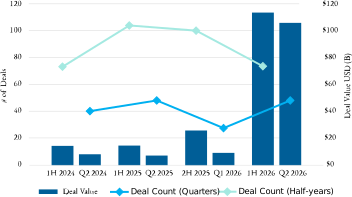
Excluding the SpaceX outlier, the remaining offerings still reflected a meaningfully active market, with Cerebras Systems Inc. ($6.4 billion) and Innio N.V. ($2.8 billion) rounding out the top three deals. On an industry basis, while healthcare IPOs topped the deal count charts with 10 IPOs, closely followed by computer and electronics IPOs (nine IPOs), aerospace dominated Q2 2026 deal value at approximately $88.6 billion (driven by SpaceX), followed by computers and electronics ($11.3 billion) and healthcare ($4.0 billion).
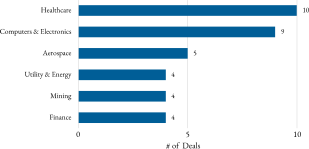
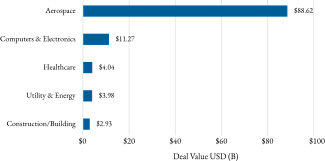
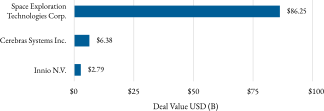
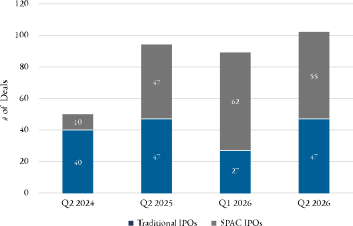
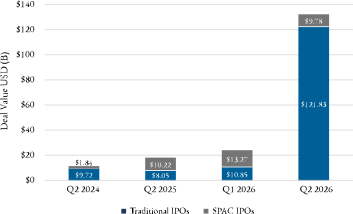
SPAC IPOs
SPAC IPO activity remained elevated in Q2 2026, with 55 offerings raising approximately $9.8 billion in aggregate proceeds. While deal value declined 26% and deal count fell 11% compared to Q1 2026 (62 deals, $13.3 billion), year-over-year trends remained positive, with deal count up 17% from Q2 2025 (47 deals), though deal value dipped 4% from Q2 2025’s $10.2 billion. For the first half of 2026, SPAC IPOs totaled 117 transactions raising approximately $23.1 billion, representing a 69% increase in value and a 75% increase in deal count compared to the first half of 2025 (67 deals, $13.6 billion). 1H 2026 SPAC IPO value also rose 35% and deal count increased 50% compared to 2H 2025 (78 deals, $17.1 billion), continuing the trend of sustained SPAC issuance that has characterized the market since mid-2025.
Follow-Ons
The follow-on market posted strong results in Q2 2026, with 166 deals raising approximately $72 billion in aggregate proceeds. On a year-over-year basis, Q2 2026 follow-on deal value increased 62% from Q2 2025 ($44.4 billion), while deal count rose 27% from 131 offerings. As compared to Q1 2026 (144 deals, $43.7 billion), there was a 65% increase in deal value and a 15% increase in deal count in Q2 2026. For the first half of 2026, follow-on activity totaled $115.7 billion across 310 deals, reflecting a 34% increase in both value and deal count compared to 1H 2025 ($86.2 billion, 232 deals). Relative to the second half of 2025 ($73.7 billion across 314 deals), 1H 2026 value increased 57% while deal count was essentially flat.
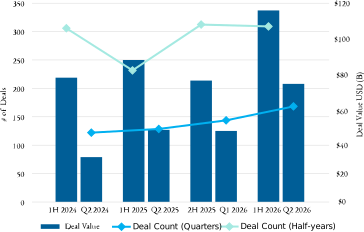
Convertible Bonds
Convertible bond issuance rebounded in Q2 2026 following a relatively quieter first quarter, with 48 offerings raising approximately $38.8 billion. This represented an 11% increase in deal value from Q2 2025 ($34.8 billion) and 82% from Q1 2026 ($21.3 billion), as well as a 33% increase in deal count compared to Q2 2025’s 36 deals and 45% from Q1 2026’s 33. For the first half of 2026, convertible issuance totaled $60.1 billion across 81 deals, a 32% increase in value and 47% increase in deal count compared to the first half of 2025 ($45.6 billion, 55 deals). However, 1H 2026 activity declined modestly from 2H 2025 ($68.9 billion, 90 deals), with value down 13% and deal count down 10%.
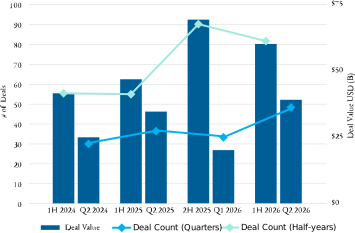
Investment-Grade Debt
Investment grade debt issuance1 remained at historically elevated levels in Q2 2026, with 326 offerings raising approximately $500.9 billion in aggregate deal value. While Q2 2026 value declined 11% from the exceptionally strong Q1 2026 ($560.6 billion, 325 deals), deal count held essentially flat. Year-over-year comparisons remained striking, with Q2 2026 deal value up 64% from Q2 2025 ($305.1 billion) while deal count increased just 2%, indicating a meaningful rise in average deal size. The first half of 2026 saw $1.06 trillion in investment grade issuance across 651 deals, a 48% increase in value over the first half of 2025 ($717.1 billion) despite a 3% decline in deal count. 1H 2026 value also surged 65% compared to 2H 2025 ($642.5 billion).
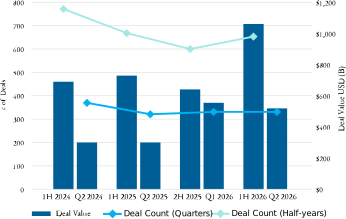
1 Excludes short-term debt, convertibles, asset-backed securities, and mortgage-backed securities.
High-Yield Debt
The high yield debt market maintained its strong momentum in Q2 2026, with 99 offerings raising approximately $94.2 billion. On a year-over-year basis, Q2 2026 deal value rose 29% from Q2 2025 ($73.2 billion) and deal count increased 36% from 73 offerings, continuing the trend of expanding high yield issuance. As compared to Q1 2026 (79 deals, $80 billion), activity increased 18% in value and 25% in deal count. For the first half of 2026, high yield issuance totaled $174.1 billion across 178 deals, representing a 33% increase in value and 24% increase in deal count compared to the first half of 2025 ($130.6 billion, 144 deals). 1H 2026 value edged up 3% from 2H 2025 ($169.2 billion) while deal count dipped 5%.
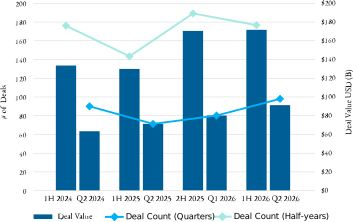
Contacts














Stay Up To Date with Ropes & Gray
Ropes & Gray attorneys provide timely analysis on legal developments, court decisions and changes in legislation and regulations.
Stay in the loop with all things Ropes & Gray, and find out more about our people, culture, initiatives and everything that’s happening.
We regularly notify our clients and contacts of significant legal developments, news, webinars and teleconferences that affect their industries.